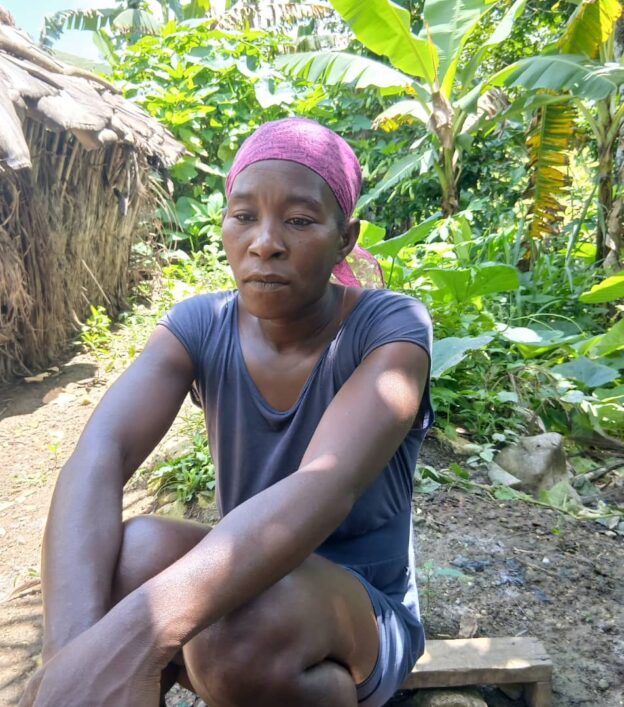
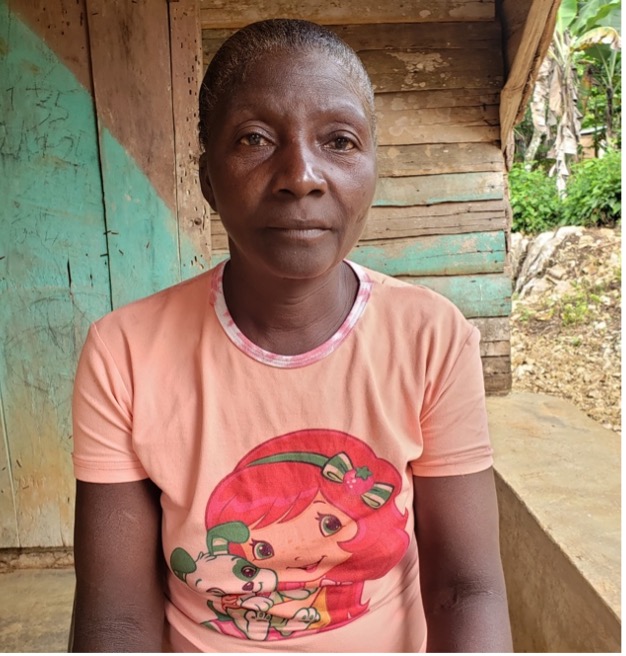
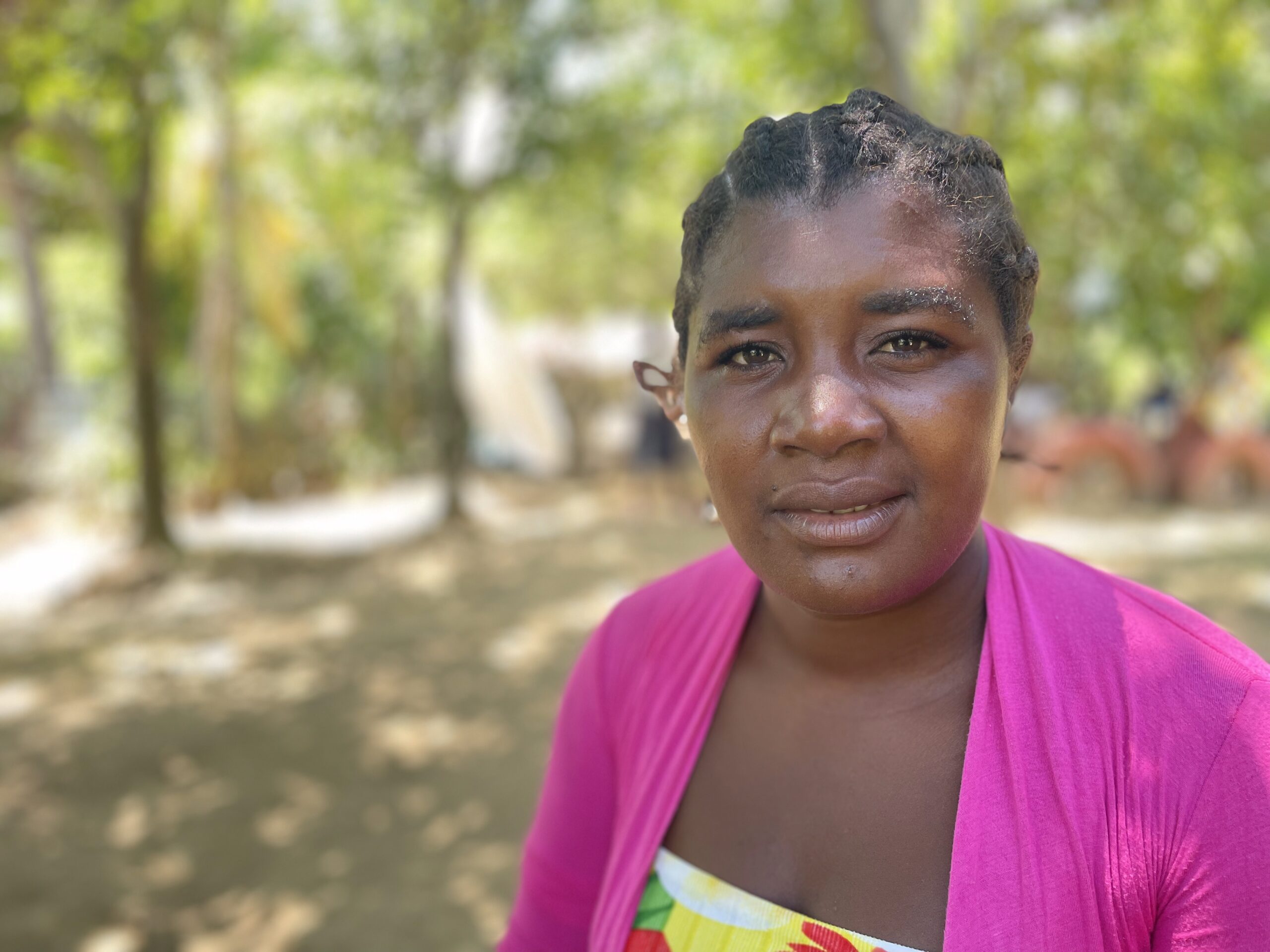
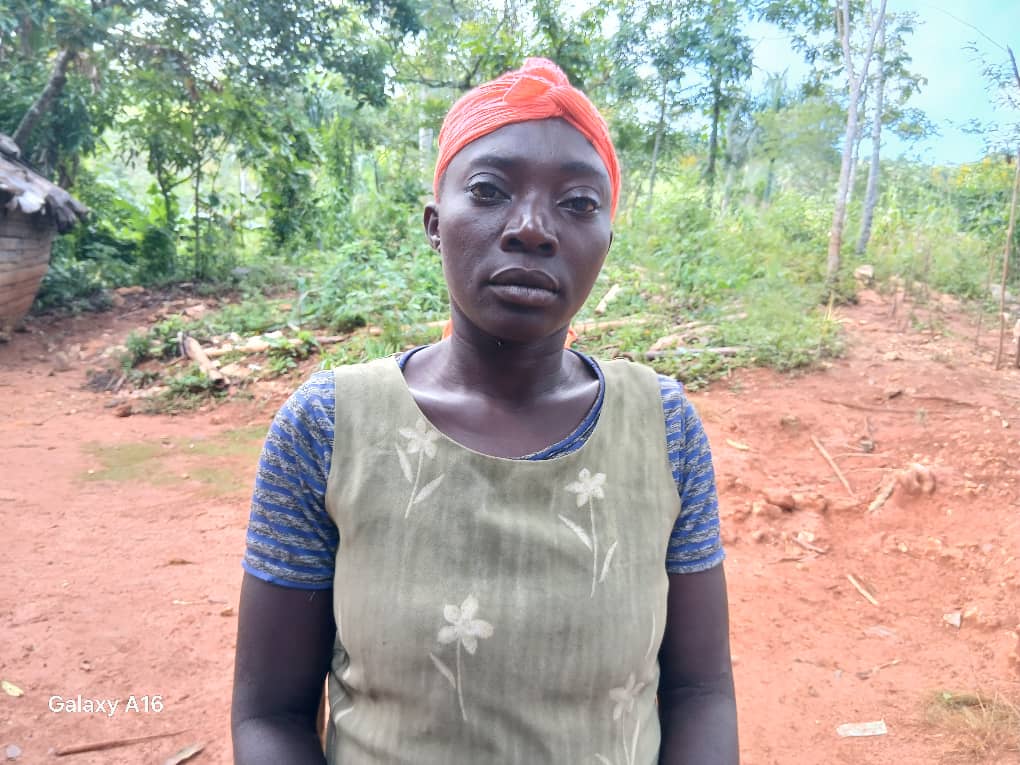
Yolette lives in Motèl, a neighborhood of Gwo Moulen. She was widowed, raising her first child, and she took up with another man, Polyte. She felt she needed help to take care of her girl. She and Polyte have since had five more children.
But as they lived together, she had to face his mistreatment of her and of her oldest daughter. At first, he would give Yolette money to buy the clothes the girl needed. But that eventually stopped, and as her girl became a young woman, she took up with a man when she was still too young, and soon she had a child of her own. When the man abandoned her and her child, Yolette was left with the burden. She struggles to provide what her grandchild needs.
She did it all with her own farming. When Polyte gave her something out of his harvest to sell at market, he insisted that she bring him all the proceeds. And that was at the heart of her problems. If she tried to argue, he would yell, he would swear, he would even hit her.
Despite it all, she managed to acquire two goats and some chickens. She bought them with the little money she could secretly save out of the food money Polyte provided. To keep him from getting mad or from taking the animals away, she lied. She told him that they did not belong to her, that she was taking care of them for someone else.
When she joined the CLM program, she began saving her weekly stipend and investing it. She bought ducks and a turkey. She received 23,000 gourds as funds for business capital, and together with her case manager, Makenson, she planned her purchases. She bought two goats and a pig, and she used the balance to invest in a business selling cooking charcoal. She used her income from the charcoal to feed her family. By this time, Polyte had stopped providing any help at all. He wouldn’t even help her look after her livestock.
One day, Yolette was sitting with Makenson, talking about her troubles with Polyte. Makenson started looking for chances to talk with him. Polyte seemed to want to avoid him, staying away from home whenever Makenson was scheduled for a visit. So, Makenson made efforts to cross paths with the man when he was out and about in the neighborhood. Their short conversations began to help. Polyte started to change.
She was scheduled to receive 20,000 gourds to repair her home, like all the CLM members in her cohort, but she and her family were living in a small house on Polyte’s family’s land, and it did not really need serious repair. So, she discussed it with Makenson, and she made another plan.
She had money in a sòl, a sort of savings club common in Haiti. Members make a fixed regular contribution and take turns receiving the whole pot. When it was her turn to receive the money, Yolette added the home repair money, and she bought a horse. Buying a pack animal really set her business in motion. With the money she earned, she soon bought another pig and another goat. She also paid school fees for three of her children and bought shares in her VSLA every week.
When she was scheduled for refresher training, Makenson made sure personally to invite Polyte to an accompanying session for men on positive masculinities. Polyte decided to attend, and since then the improvements in his behavior have just continued. He now helps Yolette consistently with management of her livestock. He has stopped his yelling and his violence, both towards Yolette and towards her oldest daughter.
In July, her VSLA’s one-year cycle closed, and she collected 26,000 gourds in savings plus the interest she earned on it. It wasn’t enough to buy a cow, which was her next objective, but by then she had twelve goats, so she sold three. That gave her the full amount, 45,000 gourds, that she needed to buy a heifer. And she still has nine goats, two pigs, her horse, 15 chickens, and a turkey.
Now she says she lives well, even if Polyte still isn’t everything she hopes he will be. Her current plan is to buy land. Someone in a neighboring area has offered her a plot for 60,000 gourds, and she is saving in her VSLA and through a sòlso she’ll be able to do it. She’s come to see that she never lacked the will to work for progress, she just needed for someone to give her a hand.
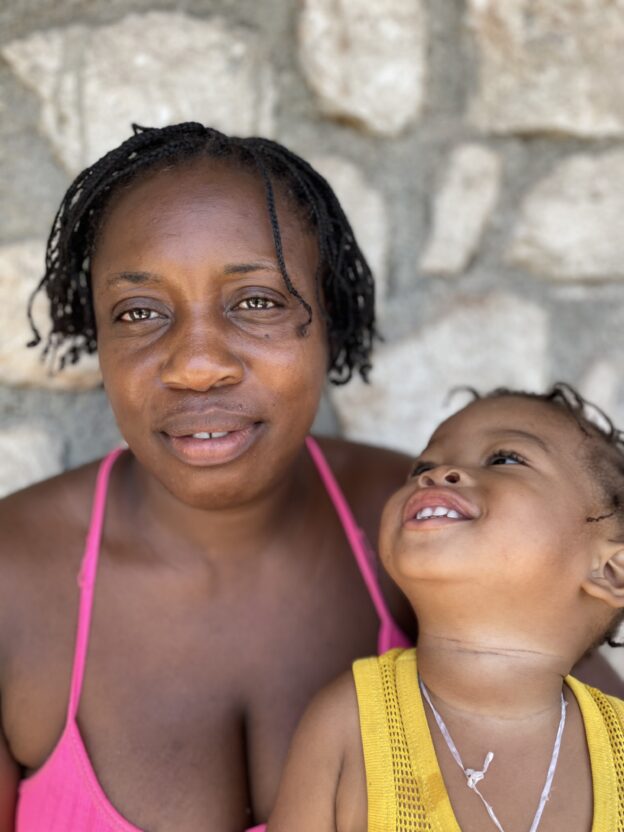
Franceline lives in Zetrèn, a community just off the main road that winds from downtown Bonbadopolis back north through the commune’s second rural section. She lives there in a room with her four children and one grandson.
Up until a couple of years ago, her husband lived with them too. They all shared shack down the hill, behind her current place. Her husband earned the income that the family depended on, cutting trees for charcoal makers or doing day labor for local farmers in their fields. It wasn’t much, but it meant that the family had something to eat and that the children could go to school.
Even then, it was hard for Franceline. She didn’t earn income herself. “You just sit around waiting for someone to put something into your hand.” But her husband died, and then Franceline had to fend for the kids and for herself.
Without capital to invest or any experience at business, she ended up just doing laundry for neighbors. They generally paid her in food, rather than cash, so she no longer had a way to pay the children’s school fees, and she had no way to set anything aside to create a better way to earn. Her children were often hungry. “It was so hard when they would cry.”
Franceline joined the CLM program, but she felt from the start that raising animals, which most members take on as their first CLM-financed business, would be challenging. “I didn’t want to start with a lot of goats because I don’t have anyone to help me look after them.”
Despite her reservations, she decided to buy a single billy goat with 7,500 gourds of the investment funds that the program provided. Buying a male is very unusual for CLM members. Almost all choose females, banking on their producing offspring. Franceline, however, had thought it through. “The females they were selling at the time were from Bòdmè. They are used to being kept tied up.”
Bòdmè is another neighborhood of Bonbadopolis, along the sea shore. Folks who keep goats in that part of the commune don’t keep them tied. They let them wander to find their own food, and what they find along the shore is different from what goats eat around Zetrèn. Franceline decided that, rather than taking a risk with a poorly adapted female, she’d raise a billygoat until it was valuable enough for her to sell it for enough to buy a better female. She does want a female eventually, because she thinks that having a small number of goats is the best way for her to make sure that she has money every year to send her kids to school.
The first payment of her investment fund was 15,000 gourds, so buying the goat used just half of it. She used the rest to start a business. She bought snacks — cookies, crackers, etc. — and began to sell them in front of a large school nearby. She managed her profits carefully. “If I have 100 gourds, I try to eat just 25.” Though she immediately admits the spending just 25% of her profit is an exaggeration, she sticks to her point. “I keep saving something to add to the business.”
With her house falling apart, she wasn’t sure where she was going to live, even with the support that the program promised her. But her grandmother’s house was empty, and she had a talk with her aunt. The house could never become hers. Her grandmother had several children. But her aunt agreed that she could use the materials that CLM would provide to repair one of the house’s larger rooms. That’s where she and the kids live now. She’s thinks of building her own house on her father’s land, where she and her husband had their shack, as a project, but it doesn’t seem close just yet.
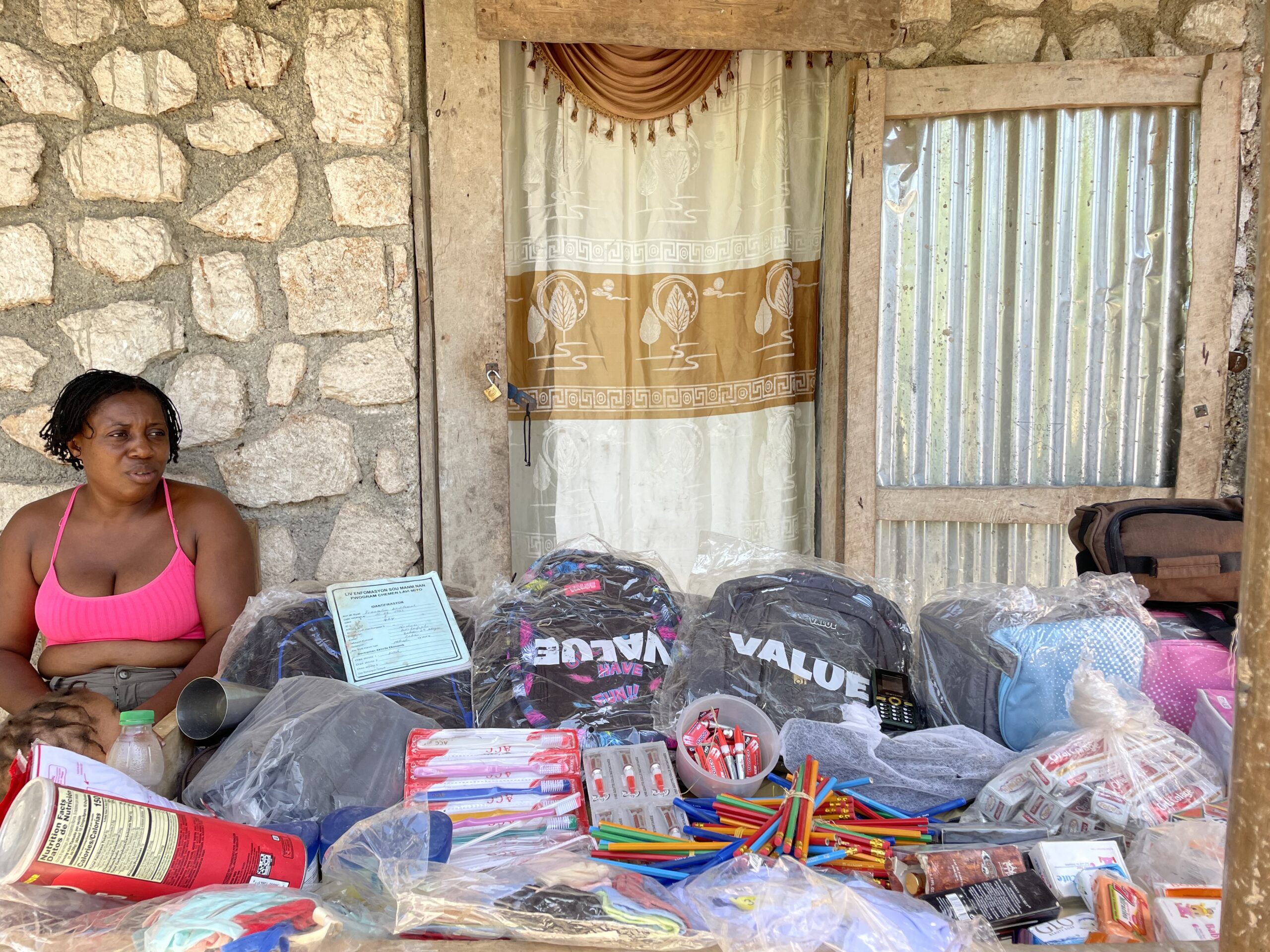
When it was time for her to receive the rest of her investment capital, she knew that she wanted to grow her business. Since she was selling right in front of a school, she stocked up on school supplies: pens, pencils, notebooks, etc. Sales are down right now, because summer vacation is not over yet. But when her savings group ended its 12-month cycle, she took the payout and bought some larger items, like school bags. She is already displaying them in front of her home. She’ll move them to the front of the school, with the rest of her business, soon. Eventually, she would like to be able to sell a full range of groceries.
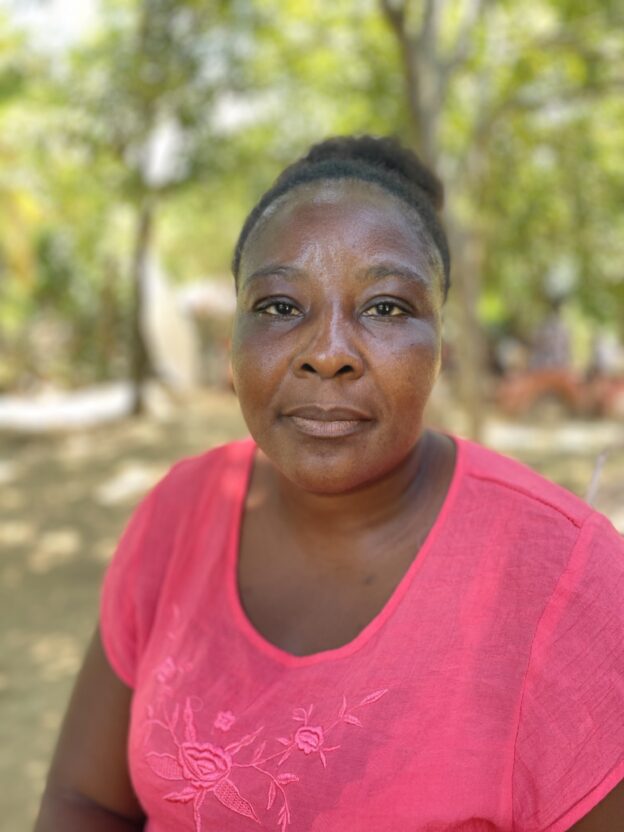
Rose Andre is a CLM member from Hat, an agricultural area between the main road to the Dominican Republic and the Artibonite River, east of downtown Laskawobas. She has four children with three different men, and she lives in a small house with one of the kids. She used to do day labor in the fields along the nearby Artibonit River. Or she would do a day of laundry for someone. She did not have her own business.
She joined a savings and loan association that called for 1,000-gourd contributions each month, which she made with her laundry money. She took out a 15,000-gourd loan, and she went to the border to buy merchandise so she could go into business. She bought household plastics, like washtubs. She used the income to join a sòl, another type of savings club common in Haiti. She bought a goat. But the business stopped working well for her, so she switched to buying and selling onions.
She bought her onions at the border, but she got caught in heavy rain. The onions were soaked. It was nearly a total loss. She was left with just 4,500 gourds, which she paid to the savings and loan association as a partial reimbursement, then she went back to doing day labor.
When she joined CLM, she started saving up her weekly stipend, first to repay the money she owed to the savings and loan association, then to buy support posts for the home that she built with the program’s assistance.
Now she is in the savings and loan association that Fonkoze established for her and the other members of her cohort. She’s used credit from the association to buy extra roofing, the palm wood for walls, and the lumber she needed for her doors. She borrowed 25,000 gourds in all.
She bought goats with most of the investment fund that the program provided. She now has five of them and an adult turkey with five rapidly growing poults. She had already bought a chicken with the stipend she received during the six initial days of training, and that single hen is now eight chickens.
But she also invested in small commerce. She initially went back to onions and tomatoes. She bought 6,500 gourds’ worth. But she quickly shifted back to plastic housewares. She goes to the market at the border to purchase merchandise, and she sells at large markets near her. She sells in downtown Laskawobas, the market in Kwa Fè, farther east down the main road., and the one in Kolonbyè, to the south in Savanèt commune. She was selling in Mache Kana, a large market in eastern Mibalè, but the gangs took over the area, so she stopped going. This week she plans to explore a large rural market in Waysek, northeast of where she lives, as an alternative to Macha Kana.
The business has been thriving. She now buys merchandise for 25,000 gourds per week, almost four times what she started with. And it has been growing even as she repaid her VSLA loans. The current situation in the region has made things more challenging, however. Increases in her transportation costs have cut the profit that she makes by a half.
Despite the difficulties, she wants to push her commerce to continue to grow and to eventually buy a cow. She also wants to pour a concrete foundation for her new home and to live a better life. When she thinks of how things were, she thinks about how she used to work very hard just to maintain her misery. She doesn’t do those jobs anymore. She no longer does day labor in the fields nor other peoples’ laundry.
In a year or two, she hopes to have a much larger business. One worth 50,000 gourds at least. She plans to use regular credit from her new savings and loan association to help her make her business grow.
Rose André has a few months to go before she graduates, but she’s already thinking about what she would say to a woman just starting the program. “Take good care of your business assets, because they are what helps you move forward and keep all that they teach you at the training workshops in mind.”
Marilia is a CLM member who lives in Gwo Moulen, in a neighborhood called Lagon. She has four children with two different men, but neither of the men does anything for his kids.
She used to borrow money from Fonkoze to run a business to feed her family and send the children to school. That’s why one of the children made it all the way to eleventh grade. The others did not get as far.
Marilia’s second husband abused her. Every time she asked him for money to take care of the children or pay for their school, he would hit her. And he was with other women at the same time.
Marilia decided to leave him. She had been selling oranges and chayote in Laskawobas. She had had a bad day. Sales were poor. She had to find someone to give her a little money so that she could buy food to bring it home for her kids. When she told her husband, he started beating her with a stick. She was afraid for her life. If it wasn’t for neighbors who helped her get away from him, he might have beaten her to death.
She left the second man that very day, but she felt she needed help taking care of her children, so she took up with a third man. She hoped that this time would be different. This third man had no other women, but he had grown children, and his children treated her badly because they said she had no children with their father. They wanted to kick her out of the home she shared with their dad, and only local leaders kept them from doing so.
She was okay with the way the man himself treated her, but he always repeated that everything he had was for his children. It got to the point that her own children started to leave. One went to the Dominican Republic to work. Another started her own family earlier than she should have. One of her children won’t even look at her because she could not send them to school.
When she joined CLM, she got to work. She took the stipend the program gave her for food, but she did not buy food. She used it to go back into business because hers had fallen apart. With income from the new business, she started buying poultry to raise in her yard. When she received the money to invest, she added to it by taking a loan from her savings association, and she bought a donkey, which she needed for her business to grow, and a single goat.
She continued to work, and she was able to buy a pig. She’s now been in the program for 12 months. She has her donkey and four goats, and now her pig is pregnant, almost ready to give birth. She has two ducks and several chickens.
She now has found someone in the nearby community of Lospen willing to rent her a small piece of land “sou pri dacha.” That means that her rent payments will count towards eventual purchase of the land. But the seller encountered financial problems, and Marilia needs to speed up her purchase. She wants to buy the land to build a small house on it. She worries that if her husband were to die, his children would drive her out of her current home. She hopes to sell her pig to pay for the land. She’ll add the money she receives at the end of her savings club’s 12-month cycle. She can buy the land for 125,000 gourds.
Her pig is pregnant, though. She thinks that if she waits for it to have its litter, she can sell both it and some piglets, too. The seller has given her until December to pay. Even if she lives in a house now with her partner, she says that her body is there, but her spirit is already out the door. Her goal is to move into a small house built on her own piece of land.
Guerline is not from Hat. She’s from Kas, an important rural market across the river to the north. She was a single mother of three. The children’s father left her to work in the Dominican Republic. Another man, Lonie, came to Kas to see a friend and he saw Guerline as well. The two have been together on land that belongs to his family ever since, and Guerline now has an additional child with him.
She and Lonie got by before the CLM program on his fishing. He worked the nearby river and the cluster of lagoons formed by the hydroelectric dam. She brought his catch for sale to market. It didn’t give them much, but it kept them and the children mostly fed. They did, however, have to live in a room of his parents’ house.
Much of that has changed since Guerline joined the program. She bought two goats with funds that the program provided. Both have reproduced. She now has four, and one is pregnant again. She also invested in a small business selling kleren, or Haitian rum, and cigarettes. “It makes me enough to buy shares every week in my VSLA.”
She and Lonie were also able to finish their new home. She hopes that when their VSLA’s one-year cycle ends, she will be able to use the payout, together with money from the sale of a goat or two, to buy a small heifer. “A cow gives you something you can turn to if something bad happens.” She also thinks about raising cows so that she can eventually sell them to buy land. “The cow isn’t the real point, the land is.”
But Guerline has problems, too, and the biggest one is Lonie. “When he drinks, he is terrible,” she says. She first decided that she had to move her three older children out of the house. “I didn’t want him around them.” Each child now lives with a different relative. She stays in touch with them, and makes sure they are in school, but they are no longer with her.
Her older children’s father recently called from the Dominican Republic. He was worried about his kids because he heard that Laskawobas was under attack from the gang that overran neighboring Mibalè. Guerline patiently explained that the neighborhood where they live has not yet been threatened. But when she got off the phone, Lonie was furious. He said that the other man had no right to call her and that she had no business talking to him. She tried explaining that she was just letting him know that his children were safe. Even Lonie’s parents took Guerline’s side, but Lonie would not cool down, eventually slapping her with the flat blade of his machete.
Guerline’s not timid. She picked up a rock and hit him with it. But the fight gave her a lot to think about. She says she told him that, if he doesn’t stop drinking, she will disassemble their house and leave him, taking the house and their child with her.
Rosemarie lives in Kalib, a neighborhood of Gwo Moulen. She has been struggling to support four children. She says her life was hard until she found the opportunity that CLM offered her.
Before the program, the household had a mule. Her partner had purchased it with money he earned as a day laborer in the fields in the Dominican Republic. She had always planned to use the mule to start a business bringing produce to market, but that never happened because she never had the capital she needed to start.
With part of the investment fund that the program provided she bought two goats, a pig, and two turkeys, and used the rest of the money to begin a business selling bread and sugar, which rural Haitians need to enjoy the bread and coffee they enjoy first thing in the morning, and pig feed.
As a member of her savings and loan association, or VSLA, she was able to borrow an additional 10,000 gourds to invest in the business. With that additional money and the profit that she kept investing, she kept adding different products to the business, like rice and other basic groceries. The business was eventually worth about 55,000 gourds, or nearly $425. And it was growing even as Rosemarie used its profits to buy a second pig, send two of her children to school, and purchase the beans she’d plant as her spring crop.
But because of the gang violence that overwhelmed Mibalè and then threatened Laskawobas, her business fell apart. She was afraid to go to market to sell her merchandise. She used up her stock just feeding her family. She got to the point that she wasn’t sure how she’d repay the balance she still owed on the loan from her VSLA. She had to take the last reimbursement directly from her savings.
But Rosemarie did not get discouraged. She talked with her case manager, and they worked out a plan. Rosemarie decided to sell one of her goats to get a new business started. It was her turn to get the payout from her sòl, a group savings club in which members make a fixed weekly contribution and each week one member gets the whole pot. So, she added the sòl money to the revenue from the sale of the goat, and she invested in cooking charcoal.
The new business is going well. Rosemarie says, “I won’t ever stop struggling forward. I have learned that when you fall, you shouldn’t just stay down. You should make the effort to get back on your feet.”