Monthly Archives: January 2019

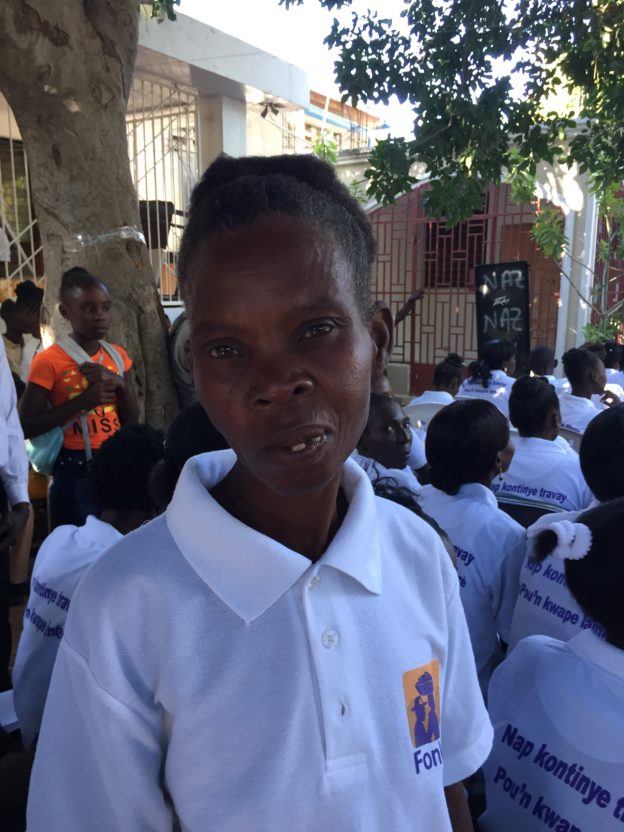
Fidelène Darilien — At Graduation

Fidelène Darilien graduated from the CLM program in January 2019. Starting from nothing, she had managed to build a reliable small business selling groceries out of her home. She focuses on staples, like rice, beans, sugar, flour, and oil.  

She’s now an important contributor to her household. She lives with her mother and two younger brothers, but only she and her mother have steady income. Her brother occasionally drives a motorcycle taxi, but since he does not own a motorcycle, his opportunities are rare. Her mother has a very small business, one much smaller than Fidelène’s. She roasts peanuts and strolls through Gwomòn, the nearest town, selling little bags of the for them five gourds as a little snack. That’s now just over six cents.

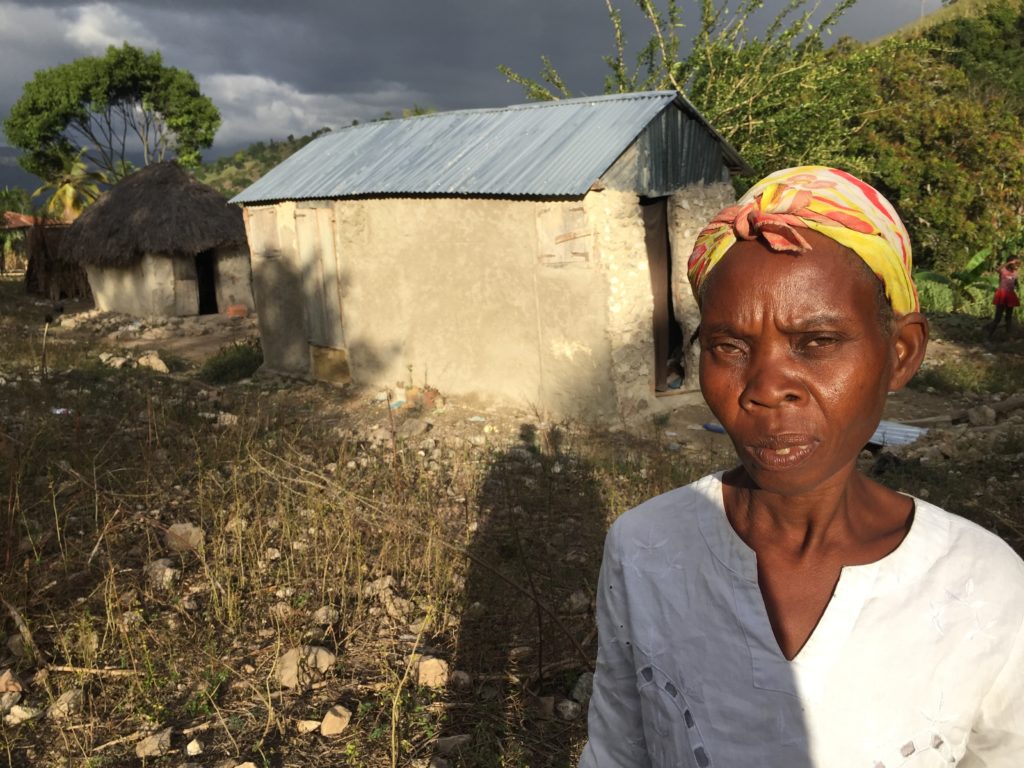
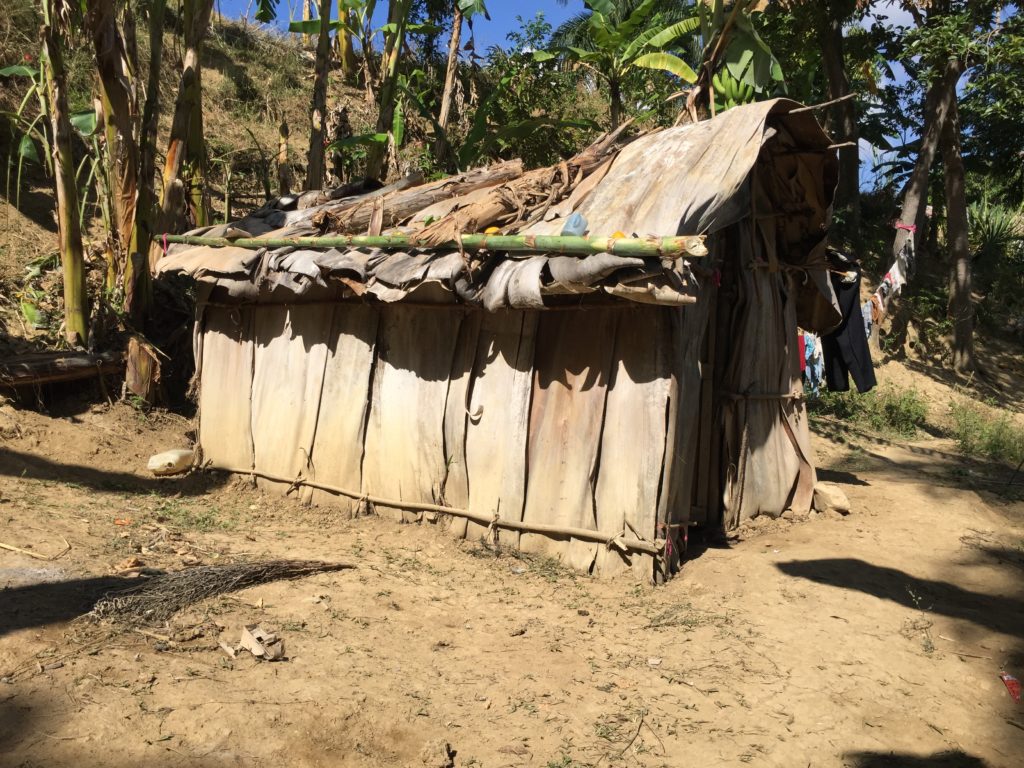
Before she joined the program, things were difficult. They were living in a home that offered little shelter. It had an old, tin roof, but its walls were woven out of coconut leaves. They had trouble keeping themselves fed. 

Fidelène had tried to start a business by borrowing some seed capital, but her customers would buy on credit, and then she wouldn’t always be able to collect. When the capital first disappeared, she tried to keep the business going by looking for wholesalers that would sell her merchandise on credit, but because she couldn’t count on her customers to pay her, she would run into difficulties paying her suppliers, too. By the time she was selected for the CLM program, her business had dried up.

She chose goats and small commerce as the two assets she would receive from the program. With help from her mother and brothers, she has taken good care of her goats. Fonkoze gave her three, but she now has five, with one ready to give birth. She has also invested some of the income from her business in poultry. She now owns 17 chickens. 

But she really depends on her commerce. When she used support from CLM to get it started again, she began with an important decision. “I decided to do what they told me at the CLM training. I wouldn’t sell on credit anymore.”

It wasn’t an easy decision. Selling out of her home means that her customers are neighbors, family, and friends. And since her business is basic groceries, her customers sometimes really need what she’s selling. Some days, a little bit of rice from Fidelène might be all that keeps a neighbor’s family fed. And refusing a close neighbor at a difficult moment can create enmities that last.

So Fidelène has a strategy. “If they really need the credit, they might ask for 100 gourds’ worth and I’ll give them 25 gourds’ worth instead. I try to keep it to amounts I know I can afford to lose.”

Fidelène, in fact, needs a number of special strategies to manage her business because she is blind from birth. She would not have qualified for the CLM program otherwise because she has no dependent children. 

It would be difficult for her to go to Gwomòn to buy her merchandise, so she has her mother do so for her. Keeping control of her inventory might be difficult, but she had a small, narrow room built into her home. It’s not much wider than the doorway that leads to it, and she sits right in front. Anyone who wants to handle her product has to pass by her. And though she cannot see the money people pay her with, she is able to distinguish the various bills they use and give back the right change by touch.

Now that she has graduated, Fidelène is making plans for her future. She knows that if she takes good care of her goats and chickens, they are likely to continue to reproduce. She is hoping to have enough so that she can eventually sell off some to buy a cow. She plans to help herself by always saving something out of what her business earns for her. And she has set her sights farther. Once she has a cow, she will start looking for land she can buy.
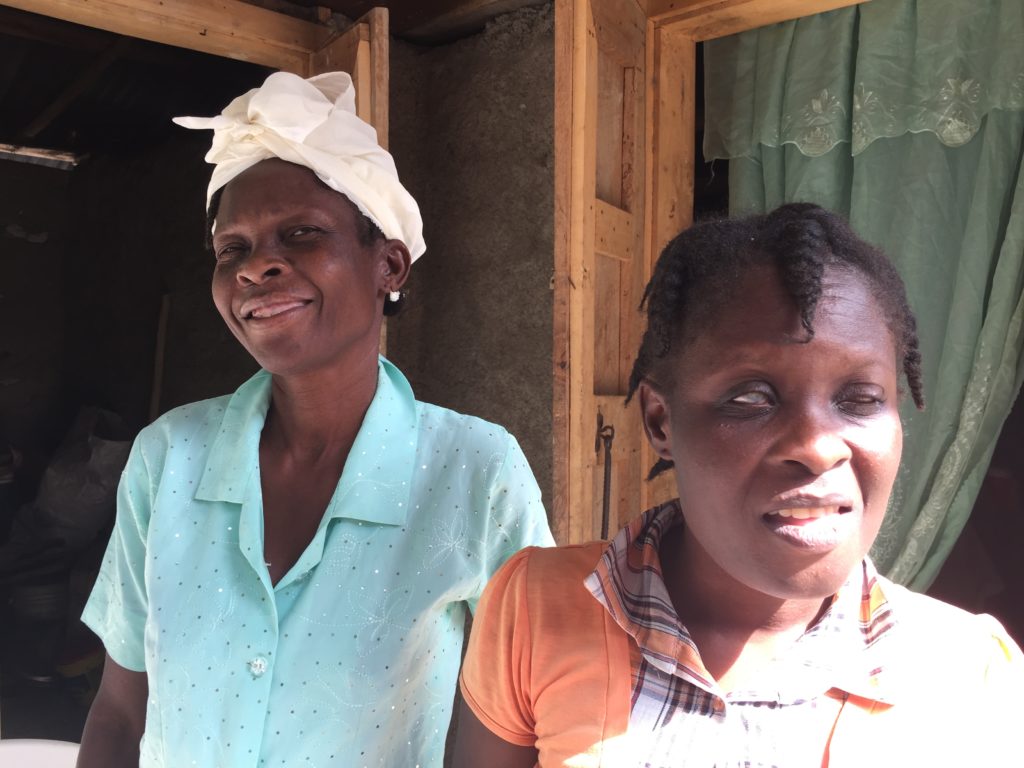
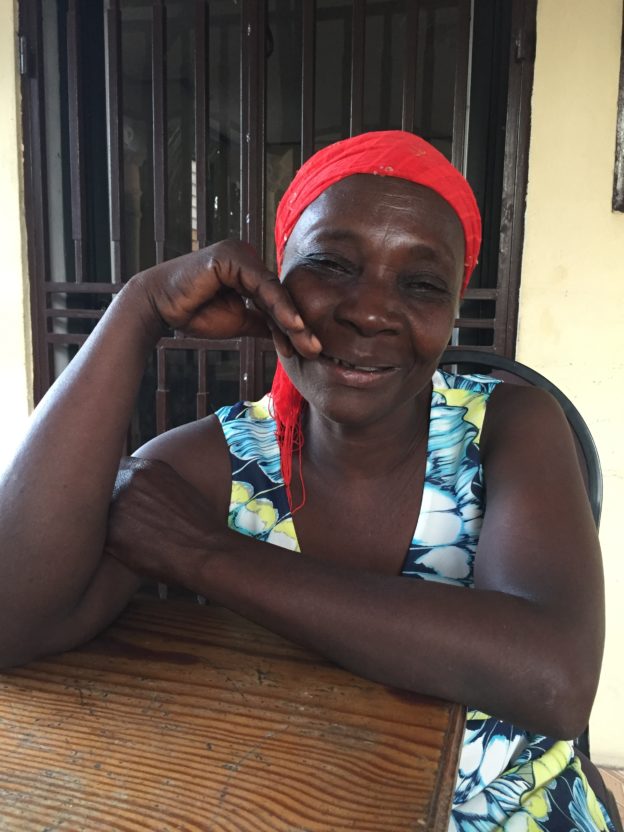
Fidelène with her mother.

Sisters-in-Law

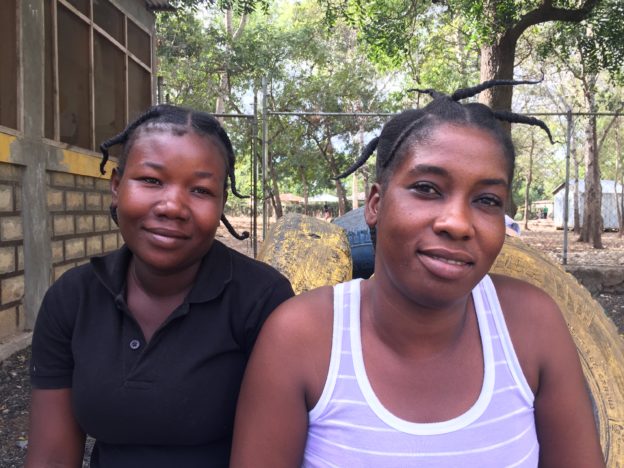
Darline Tanisma is married to Michelène Etienne’s brother. The two women entered the CLM program together. They live with their husbands and children in neighboring houses in the same corner of Gwomòn, and they each have two kids, a boy and a girl. 

Before they joined the CLM program, the two families made their living the same way. The husbands are farmers, working land as sharecroppers and, sometimes, as day-laborers. The two women had small businesses selling used clothing.

Each had only about 1000 gourds of capital, which each received from her husband. They would go to the market in downtown Gwomòn early in the morning to check out the retail merchants, picking through their stock in search of items that they believed would sell well. They’d then walk around town, selling each piece. On good days, Michelène says, they’d earn up to 350 gourds of profit. Normally, they’d make about 200, now less than $3. They’d do this five days a week, taking Sundays and Thursdays off. The latter was their laundry day.

Neither family held productive assets other than the capital in their business. The surveys that were completed during the selection process by the case managers who recommended them for the program show that they owned no livestock whatsoever. Not even a chicken. 

As small as their income was, they would not normally have qualified for CLM. It’s not as though things were easy. There were days when they weren’t sure what they’d feed their families, and they had a lot of trouble keeping their children in school. But CLM is for the poorest of poor Haitians, and the two women’s steady trickle of income would have been enough to keep them out of the program.

But the CLM team saw women like Michelène and Darline as part of a population it wasn’t serving: too wealthy for CLM yet poor enough to need help. In the program’s early days, Fonkoze could have offered the women an alternative. It was called “Ti Kredi” or Little Credit, and it operated together with CLM. It consisted of a series of very small loans with short repayment periods. They were offered without the barriers the institution set for entry into its standard credit program. There was no registration fee and the required savings deposit was reduced to a token just big enough to open an account. It also came with more intense accompaniment than Fonkoze provides to standard borrowers: more frequent meetings with specially-trained loan officers who’d have fewer borrowers to manage. 

But that program no longer exists. After Fonkoze Financial Services (SFF) – the Foundation’s sister organization – took over management of all Fonkoze credit programs, it eliminated Ti Kredi. SFF is a commercial entity, and it judged Ti Kredi to be too expensive. The elimination of the program left the CLM team feeling that there was a gap between the families it was charged to serve and those capable of building stronger livelihoods through the resources available to them. 

So, CLM’s management team developed an approach that it’s calling CLML, or CLM Lite. It’s a nine-month accompaniment – compared to the standard CLM program’s 18 months. It shares some of the program’s key features: careful selection of members, a small cash stipend for a short period, a transfer of assets to build up the members’ economic activities, training, and support geared towards better health, including a water filter and access to free care. But CLML is stripped of other CLM features: the stipend lasts twelve weeks rather than 24, and there is no support for home repair except for help building a latrine.

In early conversations with the team, Michelène and Darline said that they did not need the weekly stipend. They explained that they could manage with the income from their businesses. They asked whether they could receive the money as a lump sum, and program staff agreed. They both used the money to repair their homes.

Michelène and Darline used the 3000 gourds worth of investment capital that the program gave them in the same way. They shifted their business model. Rather than picking through retail merchants’ wares every morning, they buy 4000 gourds’ worth of clothes in an unsorted pile every three days. They get the clothes much more cheaply than they used to, so they make much more off of what they sell. They may sometimes get stuck with something that no one wants, but so far that hasn’t happened often enough to affect their sense that they have taken a big step forward.

Both women diversified their investments, buying livestock. They both reached graduation with multiple goats, and Darline also bought a pig and a sheep. They also made regular weekly contributions to their savings and loan associations, with Michelène accumulating 6500 gourds in savings by graduation.

The added income has changed the way the families live. “I don’t have trouble paying for school anymore,” Michelène says, “and we send our kids to school the right way: breakfast before school, a snack or snack money in their hands, and a big lunch when they get home. They eat three meals a day.”

They have similar plans for the future. They both want to continue selling used clothes. “I like used clothes,” Darline explains, “they sell well, and you can grab something for your family now and then when you come across something they need.” But they would like to move to wholesale, buying the clothes in the large boxes that they are sent in and selling them in small piles to retail merchants, merchants like they are right now. 

The two women will continue to work on improving their lives, and the CLM team will continue to work on CLML. With very limited experience with the program, the team will need to clarify its criteria for selecting women for the program. It will also have to learn from each of the members it serve. Should it, for example, think of further reducing the stipend because these two women said they didn’t need it?

Daniela Cherilien — At Graduation

Daniela Cherilen graduated from the CLM program on Thursday, January 24th. We wrote of her once before. You can find the first profile here.

A lot has happened in the eighteen months since she joined the program. Her life, at the time, had reached a low-point. Her family was trapped in a downward spiral because of her husband’s illness. Various stomach ailments had weakened him to the point that he could not work. As Daniela put it, “Se mwen ki rele, se mwem ki reponn.” She said that in June, and she repeated it the week of her graduation. That’s like saying, “I’m the one who shouts, and I’m the one who answers.” It’s a way that rural Haitians have of saying that everything depends on one person, in this case Daniela.

She continued to struggle, managing to feed her children most of the time and to keep the kids in school, but she and her family were moving backwards. “If it hadn’t been for CLM, I would not have been able to send my children to school this year.” 

When we spoke to her in June, she was feeding her family with a small business she had created with 1500 gourds that she saved from her weekly CLM stipend. She would buy limes, hot peppers, or other high-value produce from farmers, and sell it retail in the Gwomòn market. She had just made an important investment decision. She had taken 1000 gourds out of her business to buy the harvest from a series of mango trees. It meant that she had to run her little business temporarily with only 500 gourds, but it enabled her to make a 750-gourd profit when she sold the mangos. She put that money, along with the original capital, back into her produce business.

She is now facing graduation, however, with no business at all. She spent much of the capital to send her children to school this year, and then spent the last few gourds buying the cement she needed to complete repairs of her home, which was damaged in the earthquakes that shook the Gwomòn area in October. CLM was able to provide special help to the families whose homes were damaged by the earthquake, but Daniela wanted to do more than the minimum that the CLM funds were designed to finance. She wanted to buy extra cement to cover the walls. So she had to raise extra money.

But Daniela has a plan to repedale, which means to get going again. She has a cousin willing to lend her 1500 gourds to re-start her business. He won’t charge her interest. “He just wants to do me a favor.” He can do so without risk now because the six goats she now has can serve as a guarantee. She’ll start next week. She doesn’t plan to repay the loan with income from the commerce itself, though. “My husband and I will make charcoal to repay the loan. That way, the money in the business can stay in the business.”  

Her long-term plan includes a focus on farming. “We rent land to farm, and we eventually want to plant sugarcane.” There’s more money in sugarcane than most other crops, but it’s a longer-term investment and, unlike other crops, it doesn’t directly help feed her kids. Choosing cane depends on her confidence that she can meet the family’s daily needs in other ways.

When asked how the CLM program helped her, Daniela is effusive. She talks about the home she used to live in. “Anytime it rained, I was under water.” She talks about learning to save, too. She uses both her VSLA and a Fonkoze savings account to put money aside.

And she talks about the value of her case manager. “It was great to have some who could give me advice. He was able to shine a second light on the path forward.”

Most importantly, she talks about her husband. “If it were not for CLM, my husband wouldn’t be alive.” She had lost all hope of saving him. He had grown so weak that he couldn’t even get onto a motorcycle to get to the hospital. The CLM team got him to the local hospital, and when that didn’t help they brought him to see specialists at the university hospital in Mibalè, almost four hours from her home. He’s now healthy again, and working with Daniela to manage their household.

Daniela in front of her new house. Her old, straw-roofed home is in the back.

Idalia Bernadin — Ten Months after Graduation

Idalia Bernadin graduated from the CLM program in February 2018. At the time, she was living in Gwo Labou, a hillside community overlooking the river that cuts through Savanèt, a commune in the southeast corner of Haiti’s Central Plateau.

She and her husband, Villon, had moved to Gwo Labou at a low point in their lives. The second of their four sons had just been arrested, and they had felt forced to abandoned their home in Kadèt, in the valley across the mountain from Gwo Labou. Kadèt is in a hard-to-access corner of Kòniyon, the next commune to the south. Villon had been accused of theft. Neighbors said he stole a bunch of plantains out of a garden, and Idalia’s efforts to come to his defense only made things worse. So, they abandoned a home with a good tin roof, on land that Idalia had purchased by selling off some of her inheritance. They moved in with Villon’s sister and her husband.

When the CLM team met them shortly after the move, they were, thus, landless and homeless. They had nothing. Villon tried to continue to work their fields in and near Kadèt, but they are a long hike from Gwo Labou, and his reputation as a thief made it difficult for him to appear in the neighborhood. The couple didn’t have land in Gwo Labou, so they tried to get by working in their neighbors’ fields. 

The CLM team helped them gain access to a small plot of land, so they were able to build a house. Many CLM members work hard to make the biggest, nicest houses they can while they are in the program. Three- and even four-room houses are common, though the program only provides some of the materials for a small, two-room one. Members choose to make the extra expense to take advantage of the opportunity CLM offers them, even if doing so uses up capital that they could use in other important ways.

Idalia was different. She and Villon did as little as they could get away with. They built only one small room. In fact, they had to do so twice, because their first effort was so perfunctory that the CLM director responsible for the region wouldn’t accept it as a bona fidehome. As short as all the members of the family are, even they could barely stand up in that first construction. 

But as glad as Idalia and Villon were that the CLM program had found them, they didn’t want to live in Gwo Labou. Their plan was to remain in the area just long enough to graduate from the program, and then move back across the mountains to Kòniyon. They felt unwelcome in Gwo Labou. The man who made their plot of land available clearly wanted them off of it. He was planting his crops closer and closer to their front door. And they never really made friends there.

It took them a couple of months to prepare their move, but they were back in Kòniyon by June, just four months after graduation. They sold their house for 4000 gourds, or almost $60 at the time, and used most of the money to buy a goat. They sold their large pig as well. Getting it over the mountain to Kadèt would have been a challenge. When they returned to Kòniyon, they bought two smaller ones with the money. There is plenty of good forage where they now live, so Idalia is couting on pig-rearing as a main source of income.

Their new, temporary home.

They did not feel comfortable moving back to their old house in Kadèt. The accusations of theft still haunted Villon there. “That house is still ours.” Idalia explains, “We have four boys, and one of them can take it.” Villon had some land he inherited in Frijè, a neighborhood deeper in the valley than Kadèt, and they built a small shack on it, enough for the couple and their youngest son, Dalison, the only child still living with them. He’s in his mid-teens, and Idalia started sending him to school when she joined the program. He’s in school again this year, though he’s having to repeat first grade. His sickness last year made attendance to spotty.

When she moved to Frijè, Idalia decided that she needed to do something to earn a steady income. Her livestock could increase its value, but she would need much of that money at first to build her new house. She and Villon have farmland in both Frijè and Kadèt, and they would occasionally have harvest to sell, but only a few times each year. Villon works hard. He makes charcoal for neighbors and splits the proceeds with them, but that work is irregular. So, she decided to establish a small commerce.

She started it with 500 gourds from the sale of the house. She made bonbon dous, a kind of gingerbread. It sold well, but she sometimes sold on credit and had a hard time collecting the money that was owed her. “I’m not going to argue with someone about money.” 

As that first money evaporated, she knew she had to come up with a different business plan. So, she went to the market in Pòtino with 1000 gourds of the proceeds from the sale of a crop of beans. She bought basic provisions: rice, sugar, oil, seasonings, etc., and began selling them out of her home. She now makes the trip to Pòtino every Sunday to restock. She still has trouble collecting what people owe her sometimes, but she’s found a wholesaler in the market who will sell her on credit when she needs it, so she’s able to keep her business going. It’s enough to manage her household expenses, at least when it’s combined with their farming and other activities. Her poultry is starting to flourish, too. She just sold two small roosters to buy a cellphone.

She’s optimistic about her future. Her son was released from prison. He behaved so well while inside that one of the guards now pays for him to go to school. He’s now living in Pòtoprens with family so that he can take advantage of the opportunity. She’s focused on building a new house. She knows it will take some time, but one of her goats just had kids, and that’s just the sort of progress she needs to make.

There is one more piece of this story I should share that speaks to Idalia and her relation to our program. It is hard to express just how out-of-the-way Frijè is. I was in Mable, in the mountains near the border between Savanèt and Kòniyon, when I went to look for her. I knew she had family living near Mable, so I was able to get some information there about where I might find her new home. But it was a hike of more than three hours each way, and coming back was uphill. I found the home, but did not find her there. I had a long talk with Dalison, whom I know well from some time he spent in the hospital in Mibalè. I learned a lot about the family and the changes they had made since moving, but I didn’t get to talk with Idalia. She was at the Kourèt market, selling the roosters and buying her phone.

A few weeks later, Idalia came looking for me in Mibalè. It was a hard, four-hour hike for her to get to the taxi stand where she got a motorcycle to Mibalè. But she had heard that I had come to see her, and she was unhappy that she hadn’t been there. “If I had been home, you wouldn’t have hiked backed the same day you came. I would have made you spend the night.” And she added, “CLM did a lot for me. I have goats and pigs now, and a way to keep going on.”

Dalison