Author Archives: Steven Werlin

About Steven Werlin

I moved to Haiti in January 2005. I’ve been writing regular essays since then about the various projects that my colleagues and I work on and about our lives in Haiti.

A Timely Rebellion and Other Signs of Progress

I was talking to Milienne Angervil, the Matènwa school’s wonderful second grade teacher. I’ve written of her work before. (See: StartingWhereTheyAre.) I hadn’t seen her in awhile, so we were catching up. She had recently missed about a week of school, and was telling me about returning to her class. One of the days she missed was the day I spent with the school’s sixth graders, so I was explaining to her how that went.

I told her about the problems I felt I had directing the class. I lacked even the minimal control that I thought I was expected to maintain. We got through the day, and did some good work, but it was more chaotic and louder than it should have been.

Milienne found my troubles funny. I said what I’ve told her before: Sixth graders were hard enough; I cannot remotely imagine taking a group of second graders for a day, much less for a year.

She answered that the younger they are, the better she likes them. She likes to see their progress, and she gave me a clear example. In the two weeks since she had returned to school, her kids had learned to leave spaces between the words when they write sentences. It had been sudden, dramatic progress that spread like a wave through her class. Everyone had learned at once. Except Ronaldo, who still refuses to leave spaces. He says, she explained, that he’ll use up his notebook too quickly, and she accepts his reasoning, at least for now.

Milienne’s words pushed me to consider the groups I work with. Some of my work involves planning, program design, and the like. But there are groups I lead or co-lead directly. I decided to ask myself whether I could report the kind of clear, concrete progress Milienne could. The answer turns out to be as varying as the groups themselves are.

The first group I need to talk about is the Kofaviv group, the victims of rape who have become community organizers, helping new victims find health and other support services. I want to take it up first, because we’ve been working together for a relatively long time: almost weekly for about a year. Several of their lead members had been part of a Wonn Refleksyon group a couple of years ago, and they had decided that it was important for all the field workers to learn how to use Wonn Refleksyon to lead groups.

We went straight through the first volume of texts, and then decided to take on the second volume. These texts are much more difficult, or at least more alienating. For example, they include simple, but technical texts in math and science. Various otherwise-successful groups in Haiti had been consistently shying away from them.

The women were not at all put off by these challenges. In fact, they have barely taken note of them. But this is for a very simple reason: They consistently find some angle in the text that relates to their experience, and they take their departure from it. For example, when we read a text from a Richard Dedekind book on number theory, it became the occasion for a discussion of arithmetic skills, why some educated members can manage numbers while their illiterate mothers, sisters, and aunts handle them with ease.

There’s nothing wrong with that. In fact, it’s very much what the texts were designed to do: give group members a way to raise and address issues important to their lives. There is, after all, no particular reason for the women to study number theory.

At the same time, I felt that the women were ready to make greater use of the texts. The texts can do more than just suggest topics that are important to us. They can give us a way to face them, a tool that furthers our shared inquiry. For example, the Dedekind text suggests a way to understand what arithmetic is and where it comes from. Specifically, it suggests that it’s a series of tools we human create. That challenging claim might be able to help us think about why some of us take to math more easily than others, and why it has little to do with our level of formal education, if, that is, we let it help us.

To let a text do more than suggest a line of inquiry means returning to its puzzles in the midst of our dialogue, to see how they might relate to the questions that interest. This is something the Kofaviv women are not yet inclined to do. Once they hit upon the issue that they want to focus on, they’re off to the races. They’re unlikely to look at the text again.

So I’ve been trying to wrestle with this. I’ve been trying to help them look harder, and more often at the words on the page in front of us. I’ve lead a couple of our meetings personally over the last few weeks, temporarily turning away, with their encouragement, from their routine, which is for them to take turns leading the group. It’s too early to say whether it’s having an effect. But a couple of weeks ago, we spent 90 minutes going line by line through a series of definitions from a geometry text, and when we were finished, they asked to spend a second week the same way. So the least I can say is that they are enjoying our shared effort.

Another of the groups I work with directly is the collection of guys I meet with in Cité Soleil. They are not yet organized in any official sense, though that may change soon. We still meet together as frequently as I can. Since I am increasingly spending nights in my room down there, the same room we meet in, it means we can have several hours together each week.

The experience is very much a new direction for me. The guys and I want to achieve something more than learning to learn together. Though Wonn Refleksyon plays an important role in our collaboration, it cannot be the core of it. There is, for one thing, their desire to learn English. They have been working hard, mainly with Héguel, but also with me, and some of them are improving quickly. Five or six of them speak pretty well, even though their experience of the language is still limited. I had to laugh the other day when Jimmy told one of the other guys, “If you don’t sing with me, I will beat you up.” It was clear as a bell, and though I would worry about the sentiment if I took it literally, the giggle in his voice made it perfectly clear that he was just having fun.

But what we’re really trying to achieve together is a transformation in the way they see and, eventually, live their lives. The centerpiece of this project is a business we’re trying to establish making and selling inexpensive solar power chargers for cell phones. In addition to all the external barriers to such an initiative – among other things: securing needed materials and start-up capital and getting the training we’ll need – there are internal barriers as well: the group needs a clear structure with transparent ways to make decisions. And these must be in writing. The group needs some kind of charter in order for it to open the little bank account that getting started will require. They have already decided that they do not want to leave group money in any individual’s hands, not even as an interim measure.

What has impressed me recently is the clarity and the patience with which the group is discussing these sometimes-complex questions. They are listening to one another and deciding things together, making real efforts to leave no one behind. Just a few months ago, two or three of them were simply shouting one another down, and that in a discussion of a folktale about two mice, some cheese, and a clever but sleazy monkey-judge. Though things will get harder when money, and therefore competing personal interests, enter the scene, for now, I am hopeful.

The last group I want to mention is really two very different groups. It is two sets of employees of the large Irish NGO, Concern Worldwide. One of them, on Lagonav, is close to the beginning of their experience of Wonn Refleksyon. The other, at its Petyonvil main office, is much farther along.

The Lagonav group has been struggling. That’s the main reason I was invited to join them. Its main leaders have been Milienne and Abner. Much of Concern’s Lagonav staff has been reluctant to invest itself too heavily in the process. They don’t yet see the point. Some, however, have been quite engaged. I was sitting with them for the first time.

The group has a lot of work to do. It consists of a wide range of staff members. Predominantly men, there are a few women. It includes engineers, community organizers, administrative, security, and custodial staff, and drivers. Though almost everyone participated in some way – whether just in the small group work or by speaking up, as many did, in the large group discussion – that discussion was very much dominated by three men, all of them higher-level staff.

Strangely enough, I think part of this has to do with the shape of the room we met in. It’s relatively long and narrow for the size of the group. So we sat in what became a thinnish rectangle, rather than in a circle. The two most dominant figures sat in the center of one of the long sides of the rectangle. The other sat in the middle of one of the short sides. I sat opposite him, on the floor. There wasn’t room for enough chairs. The arrangement left spaces in the corners where three or four participants we crowded in a way that very much seemed to take them out of the discussion. It was much easier for them to whisper to a neighbor. They couldn’t always see the face of the person talking, nor could they always be seen.

The constraints of the meeting place weren’t the only problem, however. There are problems in what I would call some participants’ “interest in listening” that the group will have to face. These problems were most evident at two moments.

At one point, a custodian quickly and quietly made a short contribution that he punctuated by saying “That’s what I think” before returning to silence. His remarks were greeting with derision by some of the other men, who patronizingly called him “doctor” after laughing audibly as he spoke. At another point, one of the dominant members made a long and loud point. When I asked what others in the group thought, he asserted, again loudly, that they agree, quoting a French saying that silence implies agreement. I told him he was nuts if he thought that silence in a conversation truly implies agreement, and there was uncomfortable laughter. The words I used were a little harsh.

Both these instances show how far the group is from knowing how to talk together. At this point, it’s not even clear that they want to talk together. But, if we can help them see what they have to gain from listening and help them then learn the patience they’ll need to do so, they will have gained a lot.

The Petyonvil Concern group is at another point of its development entirely. They have been meeting almost every week for over two months, and the consistency of their work is starting to pay off. Within the first few weeks, members of the group were making the space necessary to allow as many as possible to speaking, but more and more, they are now listening to each other, responding to each other. Rather than just politely taking turns – itself an important step – they are starting to work with the ideas that participants put forth.

At the same time, the group has divided itself ever more clearly into two subgroups. One subgroup participates every, or almost every, week, showing upon time almost on time to each of the sessions. The other is increasingly casual about the meetings, often missing meetings entirely. Its members simply aren’t sold on the value of the process.

I led the group personally last week, and I made a point of emphasizing Concern’s goals for the process, the reasons that Concern’s leadership had invited us to work with them. There are two: On one hand, they want to improve the quality of communication within the organization, especially between people who are at different places in the hierarchy, and, on the other, the want staff members who work in the field with grass roots organizations to learn a new way to lead meetings.

Then I talk just a little about the Wonn Refleksyon process generally. I said that there are two very different ways to express its fundamental goal. Usually, we frame that goal in terms of what we want for the group. We say that we want groups to learn how to share authority and responsibility equally among their members.

But there is another way to frame the same goal that takes individual progress as its starting-point. We can thus also say that we want each individual to be, as much as possible, both a leader of the group and a participant. I spoke a little about this second way of framing the goal, saying that a key part of achieving it is encouraging everyone to evaluate their own work as leader/participants. And so I asked members of the group to evaluate both themselves and the group.

That’s when things got interesting. The conversation became an attempt to figure out why some colleagues had been participating less and less in the activity. There was lots of interest in the question because those discussing it were a self-selected collection of folks who had already decided the activity was worth their time. But they wanted colleagues who had caught their enthusiasm to rejoin us.

The more we talked, the more urgent the question seemed to feel. When it became time for us to leave off evaluating ourselves and turn our attention to the week’s text for discussion, I asked whether they wanted to turn to the planned text or to keep working on the question before us, and the answer was clear. They wanted to keep talking about how they might improve the group. It was a kind of rebellion: They were not interested in turning to our planned activity until they had figured out the more important question they had on their minds.

And it led to a larger rebellion. The group decided that one of our problems is that some of their colleagues are thrown off by the texts we use. They might enjoy them – although some of them might not even do that – but the fact that the texts do not relate directly to their work has them thinking that the activity is, at best, supplementary, not really important for their work. I can be sure whether this is really the reason some people are dropping out of the activity, since the participants who have not been coming were, of course, not there to speak for themselves. But most of the folks who were at the meeting seemed convinced.

When I asked them to suggest texts that people would want to talk about, there were lots of very general suggestions – something about this, something about that – but, initially, nothing concrete.

Then I changed my tack. I asked whether anyone would volunteer to meet with me before the next meeting to look at possible texts and to plan how we would use one. I added that the volunteer would then co-lead the class with me. There was a prolonged silence. Eventually, I caught the eye of a member of the security staff named Ishmick. He had been vocal in expressing his opinion that the Wonn Refleksyon discussions are important, but also that they’re not catching on because too many people fail to see their importance. He had suggested a book we might find a text in – a kind of overall policy manual Concern works with – but didn’t name a text. When, however, I asked him outright whether he’d work with me, he cheerfully agreed.

So that’s where things stand: Ishmick and I must meet by Monday to talk through how we will lead the class. It’s nothing like anything I’ve done in Haiti. It’s like turning the asylum over to the inmates, as we like to say, but these inmates may know much better than I ever could just what course they need to take. And even if they don’t, they’ll probably learn more from experiencing the consequences of their intuition than they could ever learn from following mine. My job is to accompany them as they work things out. If I can help assure that they both evaluate their work explicitly and then act on their evaluations, they are certain to move forward.
Living in the Middle of Things

Héguel’s mood dramatically soured half-way through our English lesson. This is extremely unusual, the first time I had seen it in the more than seven years of our acquaintance. But it turned out to be understandable enough.

The class itself could hardly have been the reason. It was a joy. As difficult as it might be to see the good that English classes are doing – even though some of the guys’ English is improving very quickly – the meetings we spend learning songs are always a pleasure. The guys had been working hard to master “I Can’t Help Falling in Love with You”, and the results were encouraging.

We are, however, making more serious progress as well. The Cité Soleil group has begun to focus its attention on an aspiration that is becoming ever clearer: They would like to establish a business. I came across an interesting project that might work well for them while I was visiting Oxford in December on behalf of Shimer College. A British engineer had developed a way to produce small solar electric panels very cheaply. They are large enough to run a little transistor radio.

Or, what seemed more to the point to us, to charge, though slowly, a cellular phone. Cell phones are spreading quickly through Haiti, but electricity is unavailable in many areas and unreliable in many others. The guys are very confident that cell phone owners will snap up solar chargers as quickly as they can produce them as long as we can keep the price down, and I’m pretty sure they’re right. They’ll be a couple of hurdles – getting some of the materials into Haiti, organizing the group in a manner that’s productive, but also transparent enough to prevent misunderstandings, and finding the small amount of start-up capital we’ll need to get the ball rolling. But it’s the most promising possibility we’ve come up with thus far. Héguel is especially excited about it, because he’s an experienced electrician and, so, he knows he can contribute in important ways to making the guys’ dream real.

Héguel and I have been friends since 1999, when he was one of my colleague Erik’s principal Creole teachers. Over the years, he’s become more and more involved in the Wonn Refleksyon education movement that we are part of here. He participates in regular events, and has co-led groups of new participants. He is the one that invited me to begin meeting with his young neighbors in Cité Soleil, where he has spent almost all his life, and is my apartmentmate when I stay there.

On Wednesday evening, I had an interesting conversation that he arranged. We chatted for almost an hour with one of the leaders of the militia that controls Belenkou, the area of Cité Soleil where the apartment sits. He dropped by on his motor scooter, on the way home from playing soccer.

Héguel and I had thought it was important for us to talk. Nothing can happen in the neighborhood without this man’s knowledge and approval. Trying to go around him or behind his back could only lead to trouble. It will be best – in this case, “best” means “safest” – if everything is out in the open, so that we can address any questions or concerns the guy might have.

So he came by, and we had a friendly talk. It was interesting to learn something about his life. Though he circulates freely within Cité Soleil, he cannot leave the area. He would be arrested. Since police don’t enter Cité Soleil, he’s safe there. He talked about a recent trip just outside of the neighborhood a few months ago. It was his first in two years. He talked with energy about how much of what he saw seemed new, how much of it seemed to have changed since he last left Cité Soleil. He made fun of his feeling that he didn’t really know his way around. He was a little discouraged because he hadn’t had the chance to see very much because it was dark – he wouldn’t risk even a short trip during the day.

He was most interested in discussing recent news. Early that same morning, UN forces had attacked the next neighborhood over from ours, an area called Boston. They had occupied an abandoned school, the one tall building left in the area, and thus acquired a vantage point that enables them to control a lot of movement.

Now people in Belenkou were worried about the UN’s next move. That very afternoon, UN soldiers had rolled through in tanks, distributing leaflets in Creole. The leaflets advised folks to go inside and get on the floor whenever they hear gunfire. Such warnings had been the preface to UN attacks into Belaire last year, and so people in Belenkou were scared – and still are.

The man we were talking with had, however, a more specific, a more tactical concern. The second-floor room we were sitting in was my bedroom, the group’s classroom. Héguel and I live in the only two-story building on the intersection leading into Belenkou. It would be the perfect spot for the UN if they wanted to occupy a building to have a good view of Belenkou. So the guy told us that he and his main partner were thinking about what they might do.

In the middle of our musical English class, Héguel heard a rumor that made it sound as though they had settled on a plan. A neighbor came by to tell him that the local militia had decided to tear down the building the next day. They would give residents the chance to collect their things – which is more than can be said for UN forces – but they would then rip the building down.

The move would make some sense for them. Though they have lots of big guns, they do not have the arms to stand up to a concerted UN attack. The UN has tanks and helicopters and is willing to use both. So they can’t hope to defend the building if it comes to an attack. And if the UN were to set up a base on the roof of the building, no one would be able to leave or enter Belenkou – or even circulate much within the neighborhood – without their seeing.

For Héguel and our downstairs neighbors, losing the building would be a real blow. I don’t know our neighbors’ stories, but I know something about Hèguel. He’s been living alone in the apartment for years. It’s inexpensive, and he’s comfortable there. He’s filled it over the years with the books and other personal possessions that shape his life. He’s worried because he doesn’t know where he would go if he loses his home; he doesn’t know where he might find living space he could afford. A simple room in most other neighborhoods of Port au Prince could cost almost ten times what Héguel pays. As they say, “location, location, location.” Not to mention how uncomfortable it would be for him to have to figure out a new life in a new, unfamiliar part of town.

He and I were in touch on and off all throughout the day on Friday, and as of the last time I spoke to him, no move had yet been made to tear down the house. Where there is life, there is hope.

Here’s the Belenkou Boys’ rendition of “I Can’t Help Falling in Love with You”:

A final note about vocabulary: I describe the man whom Héguel and I spoke with as a militia leader, but I’m not sure whether that’s the best term. He and his partners are regularly referred to as gang leaders by some, as community activists by others.

The latter term seems wrong, or at least incomplete, because it overlooks the fact that they are heavily armed. But the former makes it sound as though they are simply criminals, and I’m not sure that’s entirely fair either. In their own view, they are struggling against a foreign occupying force, and there is much in the UN’s behavior to justify such an attitude – whether or not it is, as a description, any more accurate than “gang” is for those for whom it’s used.

I don’t think I should be neutral at the cost of being truthful, but I don’t think I should pretend to understand more than I do. It makes naming things an uncomfortable business.

Ari and a Dose of Reality

The group in Cité Soleil continues to show signs of flourishing, even if, as I have written before, I’m not sure towards what end. The guys will sit with me for three or four or even five hours at a time, engaged in one activity or another: the English class, Wonn Refleksyon, Business Skills Development, or just talking. It can be almost more than I can handle.

But I was a little concerned about one of the group’s members when I first saw him on Saturday. His name is Ari. He’s a dark, slender young man, probably around twenty. I hadn’t seen him for awhile. Just before the New Year, he had told me he would be missing a few meetings because his parents decided to send him to spend the holiday visiting his grandmother. I didn’t think anything of that. It seemed natural enough. I wished him a good trip.

Now that he was back, though, he seemed different: gloomy and much thinner. And though I don’t know his grandmother, I’ve known enough other grandmothers – including two wonderful ones of my own and my mother and aunt, who are grandmothers to an appreciative younger generation – that I was surprised to see that a teenager would lose weight while visiting his.

Saturday things became clear. As soon as I arrived in Cité Soleil, after the long trip from Matènwa, Ari took my backpack and walked up to my room with me. As I went in to greet Héguel, Ari started sweeping my room. I was grateful: I was tired and the pack was heavy. It felt nice to be getting un-requested support from a young friend. I asked him how he was, and then noticed he was close to tears. He motioned me to sit down next to him as he said he wasn’t doing so well.

He asked me whether I had noticed how skinny he had gotten. He lifted his sleeveless basketball short, as though things weren’t otherwise clear enough. I immediately admitted that I had. Though he was already skinny – the “slender” I used above was really just a euphemism – he was now terribly, terribly thin, his cheekbones protruding, the flesh just below his eyes sunken, the skin drawn around his elbows and knees. I asked him whether he was sick, and he said he wasn’t.

Then he told me the following story: Ari earns a few gouds now and then by pulling one of the large transport carts that carry merchandise around Port au Prince. One sees the carts in cities throughout Haiti. They look a little like giant, elongated wheelbarrows, with two wheels on an axel at one end, and two handles at the other. The guy working puts the two handles under his arms, and pulls the wheelbarrow behind him. They’ll be piled high with 30-40 cases of bottled soft drinks, a couple dozen 110-pound sacks of flour or sugar, stacks of crates of used clothing, or various sorts of building materials. For a really heavy load, a second and sometimes even a third man will push from behind. I had heard that Ari sometimes did this work, when he’s not fixing motorcycle tires or washing those same cycles with rainwater he collects for the purpose – anything for a little honest income.

Just before the New Year, someone had hired him to buy and deliver a load of ice. Haitians like their drinks cold, and since electricity is unreliable, they depend on ice companies that make the ice with big diesel generators. Wholesalers drive around in flat-bed trucks with enormous blocks of the stuff selling to retailers. Ari’s client had given him 330 Haitian dollars, which is 1650 gouds, or about $44 US in cash, and sent him off.

That’s when disaster struck. Ari somehow lost the money. He couldn’t tell me how. He simply said that it disappeared in his hands. I didn’t have the heart to press him. Just speaking to me about the matter was manifestly causing him such pain. I had to make it worse, because I could hardly hear him. His usually lively, penetrating voice was down to a bare whisper.

The client was furious, threatening to have Ari killed. The trip to his grandmother’s had been an escape ploy, a way for him to flee to safety while his father, who was willing to stand behind his son, negotiated a repayment plan with the angry client. The father could no more produce $44 US all at once than the son could.

Ari was so upset, about the danger he was facing and the burden he had placed on his dad, that he had stopped eating. And he was withering away. So he got up the courage to ask me whether I might be able to help in some way.

I happened to have a lot of Haitian cash with me, several hundred dollars worth of gouds. This is much more than I would usually carry, but someone had just paid back a for-me-large loan I had made. So, there was no question as to whether I could give him the money he needed. Though money is shorter for me right now than it normally is, things haven’t gotten to the point that I can’t afford to give someone $44 in a jam.

But I was frozen at first. I told him that I would definitely do something for him, but I couldn’t right away say what. He went downstairs, and I went across to Héguel’s room to ask for advice.

What had paralyzed me initially was the following consideration: Ever since I came to Cité Soleil I had consistently told the guys I work with that I would invest all the time I could spare, but that I would not put money into our work, that I simply couldn’t. I was worried that if I became a source of handouts, we would not be able to accomplish anything: The genuine and in some cases even urgent needs of the people around me in Cité Soleil so distantly outstrip any financial help I could hope to bring. Setting myself up as a source of money would uselessly distract us from the difficult but perhaps achievable task of organizing ourselves to make small, sustainable progress together. After the first weeks, the couple of the guys who had initially asked me for money stopped doing so.

So I was worried that I was opening a door that I had only just been able to close. Once it gets around that I gave one of the kids money for something, why wouldn’t others start turning to me as well? So I had decided that I would stick by the principle that I wouldn’t give handouts. It’s a good principle, as principles go.

But it doesn’t feel right. I am living and working in the midst of a community that is terribly poor – poor enough, for example, that $44 can be, very literally, a life-threatening loss. It represents more than a month’s income for many of the Haitian families who live on as little as a dollar a day. A few days earlier, for example, I had spoken with a couple of young guys who were running off at 5:30 in the morning, in their best clothes, to apply for factory work that pays 70 gouds a day, or a little less than $2 US. At that rate, they would not earn the $44 in a month, much less be able to accumulate $44 in savings. And they were very much hoping for the jobs.

The reality is that, whatever I think of my salary, as convenient as it would be to earn somewhat more, I am stunningly wealthy compared with many of those around me. I cannot pretend to be living and working in solidarity with them if I hide this simple truth about our lives.

So I gave Ari the money. He and Héguel then had a long talk about how Ari might be able to handle things so that word does not spread that I’m the one he got it from. I myself am skeptical. I can’t imagine that others won’t hear, or at least figure out, that that’s what happened.

But that’s ok, I suppose. Facing such requests seems reasonably to belong to living in Haiti. To avoid hearing them or, what might be worse, to avoid giving them individual consideration, would be cowardly. Or, at least, unrealistic.

Kou Siplimantè a (supplementary classes)

I was afraid something of the sort would happen.

Two-thirds of the way through my first experience as a fully-fledged substitute sixth-grade teacher, I was separating two kids who were ready to exchange blows. It was easy enough to do. I simply changed seats with one of them. They weren’t very intent on fighting. But that things had gotten that far didn’t exactly show strong great classroom management skills on my part.

I was taking their class because their teacher is a member of a theatre troop. The troop had been invited to perform in another part of Haiti. The teacher had to miss a day of classes, and her sixth-graders, who are preparing for the national graduation exam they will take this summer, couldn’t really afford to lose the day. Though I doubted my ability to manage a class of twelve and thirteen-year-olds, I couldn’t well say no.

Passing the national sixth-grade exam in Haiti is a big deal. Being in school at all is a right that not all Haitian children can take advantage of. Though the Haitian constitution specifies a right to free primary education, and even makes it compulsory, the reality is that a third of Haitian children never go to school at all and fewer than half of primary-school-age children are in school at any given time.

Of the minority who make it through primary school to take the sixth-grade exam, the percentage that passes is not very high. Though there are elite schools that are able to get virtually every student through, there are many schools where only a few or only very few pass. I’ve written before about my godson’s cousin Vunet, who failed the exam for the second time last year – together with his twin sister and all the other sixth-graders from his school. (See: Vunet).

The Matènwa Community Learning Center takes the exam seriously, though it’s an uncomfortable fit for them and it’s not easy. The school emphasizes learning based, at every level and in every way it can, on understanding gained through practical investigation and on the reality the school’s children face every day. The philosophy fits poorly with the exam, which can tend to emphasize skills and knowledge very much abstracted from life on Lagonav. Many of the schools that get high percentages of children through the exam do it by putting a premium on memorization. In Mèt Anténor’s school, near my home, Anténor consistently gets a high percentage through by spending a lot of time throughout the sixth-grade year testing the kids with old exams and forcing them to memorize what they don’t know.

The Matènwa school has been trying to do things the hard way. They work with the kids in the way they think best for their intellectual and social development, and hope that a consequence will be strong showing on the test.

The results have been mixed. Generally, results for schools on Lagonav have been terrible, and the Matènwa children have done better, but they are by no means passing at a rate the school can be satisfied with. And the school’s staff recognizes the fact that, whatever it thinks of the exam, it has to take it very seriously. Like it or not, it is the gateway to further education for the children of Haiti. Kids who fail cannot go to secondary school.

So they really work hard at it, providing the kids all the time and support they can. For one thing, the have the kids come to school at 6:00 AM, two hours before the other children. And they offer extra afternoon sessions whenever they can. All this extra time is referred to as “kou siplimantè”, or “supplementary classes”.

I first started working with the kids in the afternoons. A very bright but mischievous boy named Josias had asked in his class’s name whether I would do some math with them. He had seen me doing math with his teachers. I readily agreed. I enjoy doing simple math with young people. I’ve discovered that I can help Haitian kids through about the eleventh grade. After that, they start getting beyond what I can easily remember.

The Matènwa kids were doing what looked like a kind of pre-algebra. Here is a sample problem: If seven pumpkins cost $35, how many would ten cost?

They have learned a way to set the problems up by drawing a four-square grid. In the upper left-hand square, the write “7”, and in the upper right-hand one the write “35”. On the lower left-hand side they write “10”, and they draw a question mark in the lower right-hand one.

They then make a large “x,” connecting the diagonal values, and they “cross-multiply.” Under the grid, they can thus write:

35*10 = 7*?

They are taught to “get the question mark by itself” by moving the 7 over to the left-hand side. They then have:

35*10/7 = ?

So they can calculate the answer.

The problem is that, though most of them can remember the procedure pretty reliably, it’s not clear how much of it they understand. For example, most do not know that what they’re doing when they isolate the question mark is dividing **both** sides of the equation by seven, and that, in general, they are always free to treat both sides of an equation in the same way. Their teacher wasn’t around, so I wasn’t even sure what I should expect them to understand. Maybe it’s ok for them to learn the process first.

In any case, we spent a couple of long afternoons working together, so by Friday we had a developed a report. The first thing I noticed was that the kids, who for years had been calling me “Steven” or “Estiven” or “Estiv” were suddenly calling me “Mèt la”, or “master”, the standard title for a teacher who is male.

And there was a lot in the group’s dynamics, in the ways in which the kids worked with and related to one another, that I was figuring out on the fly. To take one example: the kids have a competitive edge. They enjoy putting one another on the spot. They liked it when each person who went to work out a problem at the blackboard got to create the next problem and choose who had to solve it. We were able to spend a lot of time cycling through the class, as each put a progressively harder question on the board for the next.

But along with the competitiveness, there is an equally intense sense of solidarity. It is very hard to evaluate what each one can do because they cannot resist working together. As soon as one of them starts to struggle, other will immediately jump in. I very often asked them not to, but my words had no effect. They couldn’t seem to help themselves.

I eventually got around the problem by creating a question that would be different for each of them. I told them to imagine that their mother had bought them sneakers for a certain price, and then asked them to calculate how much it would cost to purchase sneakers for all their other siblings as well. The question wasn’t as straightforward as I had thought it would be: Some of them needed to know whether half-siblings and step-siblings should be included as well. But I left it up to their own discretion. By the end, we had spent an awful lot of enjoyable and productive time going back and forth between work at the blackboard and work in their little notebooks.

The day I finally took them was, fortunately for me, a half-day. The school sends kids home early every Friday to allow for faculty development. I would have been worried about spending a longer day with them, because my bag of tricks is so limited. Without significant preparation, I can do nothing but math with the kids, and it’s hard to make them spend a whole day that way. But I was glad for the time I was with them. I gave me a larger, though still very incomplete sense, of the challenges the school teachers I work with face.

And the kids are very nice. It’s beautiful to watch them get new stuff down. Young people wear their learning so vividly on their sleeves.

An Accident

Some things are handled quite differently in Haiti than they would be in the States. There’s so much less infrastructure here, so much less governance, so many fewer public services. We in the States can tend to take a lot for granted.

I was on the way back to Pòtoprens on Friday from Sodo, a small town in the Central Plateau. I was a little annoyed, because my host’s planning had cost me a day at a very busy moment. I had been in Sodo since Wednesday morning, and had asked my host, at that time, to simply help me get to Mibalè Thursday afternoon, after we finished our work. I would sleep there, and then take public transportation to Pòtoprens early Friday morning. I could use the evening in Mibalè to meet some people I wanted to talk with, and would be able to travel back into Pòtoprens early enough to do most of a day’s work and then still ride up to Ka Glo by a reasonable hour. I needed to get home to make sure everything was ready for the workshop I was to host in my house in all day Saturday.

My hosts would hear nothing of it. They would drive my all the way to Pòtoprens early Friday morning. They had brought to Sodo, and they would take me home.

By Thursday evening, they were telling me that I would no longer be able to leave first thing Friday morning. They were down to only one truck. They would, however, send me to Pòtoprens when their truck returned from an errand in Mibalè.

When the truck got back, they told me that they could only take me to Mibalè. They could not afford to send their only truck away for the half-day it would take to get to Pòtoprens and back.

So I was sitting in the back of a pick-up truck that I had found in Mibalè, and pouting because I hadn’t been on my way half a day sooner. I got the last seat as the pick-up pulled off towards Pòtoprens. I’d get to the Kwadeboukèt station by early afternoon, and would be home by 4:00. Not ideal, but workable.

The road from Mibalè to Kwadeboukèt winds over a mountain, rising out of the Plateau and then descending into the so-called “Cul de Sac,” the coastal plain that Pòtoprens sits in. It’s a dry, dusty part of the country during this rainless time of the year. Water sources can be a long way away for the folks that have to get their drinking, bathing, washing, and cooking water everyday. Young boys often try to shorten their trip by hopping onto the back of trucks and busses that drive by. They stand on the fenders and hang on. Some drivers will chase them off, but most just let them ride.

Of course it’s dangerous. And when we got to a level part of the road just short of Trianon, we saw why.

There was a large flat-bed truck, pointed towards Mibalè, parked in to middle of the road. Its engine was still running. A few yards behind it was a boy, eleven or twelve perhaps, sitting in the dust at the side of the road. He was wincing in pain as two middle-aged women and a pack of smaller children looked on. He had jumped onto the truck for a ride to water – his gallon jug was still in his hand – but he fallen and had, to all appearances, broken his leg.

The truck’s driver had intended to simply drive on to Mibalè. It was not, he thought, his problem or his fault. He had told the boy to get down, but the boy hadn’t listened. The two women were market women who had hired the truck to take them and merchandise they had bought in Pòtoprens back home with them. When the driver started to continue on his way, they had gotten of the truck, refusing to go on. They wanted him to take the boy back to Tè Wouj, where he could get medical attention.

It was a stalemate. The driver wouldn’t turn around, but he wouldn’t continue without the two women either.

The women explained the situation to our driver. They asked him to take the boy to Tè Wouj, but he said that it wouldn’t be right. The boy should not have jumped on the truck, but the fact that he did made him the truck driver’s responsibility. He took out a notebook, and went to talk with the other driver.

There was a lot of yelling between them. It turned out that one of the reasons that the truck driver was reluctant to return was that he was driving without license plates on his truck. He was worried that stopping in Tè Wouj – a market town he had just driven through where there is a UN military base and a Haitian police station – could mean no end of trouble.

But they argued and they argued, and finally the truck driver gave in. He turned his rig around, and headed back to Tè Wouj, about 45 minutes away. Our pick-up could have made the trip much more quickly, but our driver refused to pass. He didn’t really trust the other driver to keep his word, so he followed him all the way.

There’s an amusing scene at the beginning of //The Man without Qualities//, Robert Musil’s massive unfinished novel. A couple, strolling through pre-World-War-One Vienna, is witness to a traffic accident. They see a man struck by a speeding truck. The couple looks on in awe as a crowd of witnesses makes way for the clean, professional-looking ambulance attendants who whisk the victim swiftly away in their bright, new machine. The narrator can only remark, “How admirably everything was functioning!”

That was 1913. Here, it is 2007, and the boy on the road through the Central Plateau – National Highway #3 – has nothing of the advantages of the book’s nameless victim. Here in Haiti, not everything is functioning so admirably.

At the same time, the market women and the pick-up driver handled things very well given the means available to them. I certainly would not have known how to accomplish what they managed to do.

A Long Tuesday

My alarm went off at 4:00 AM. Not that I had to get up. Byton had taken it, and set it. I’m not sure why. He didn’t need to leave until 6:00. It is very loud – an old-fashion wind-up model – but it’s not able to wake Byton quickly. He seems to sleep very, very soundly. What’s more, he puts it all the way across his room, rather than next to his bed, so even when it wakes him, it takes him some time to turn it off.

In other words, long before the noise was over, I was awake enough to know that I wasn’t going to be able to doze off again. Not awake enough, however, to overcome my exaggerated resentment. That came later.

So I lit a candle, and put a pot of coffee on the propane stove. My laptop was out off charge, so there was no question of working. I grab a book and sat down to read. I’m within two hundred pages of the end of a novel called //The Man without Qualities//, so I don’t lack for something to do. I didn’t need to be out the door until 6:30. I had a full schedule planned for the day, but nothing was starting very early.

My first meeting was in Petyonvil. The meeting is part of a contract that Frémy arranged with an NGO called Concern Worldwide. (See: http://www.concernusa.org/news/item.asp?nid=139). It seems to be an interesting organization. Concern works in three different regions of Haiti, with programs in microfinance, health, education, food security, and disaster relief.

Frémy arranged for our team to lead Wonn Refleksyon and Open Space training for Concern’s staff at all three of its locations. Concern’s goal is to improve communication, both within its staff and with its partners, the community organizations it works through. The work at the office on Lagonav is being led by Abner Sauveur and Millienne Angervil, two teachers from Matènwa. I’ll join them whenever I visit their school. There is a group in Sodo, a town on the Central Plateau, and we are working with its staff by visiting for a couple of days’ intensive work each month.

But the main group is at Concern’s central office in downtown Petyonvil, about an hour’s walk downhill from Ka Glo. Tuesday was the seventh meeting. I had missed the last two, so I was anxious to see the progress the group had made.

The group at Concern is big enough that we decided to separate into two sections. This was good for us, because it offered Frémy and me the chance to work with two less-experienced colleagues. It’s a great opportunity to strengthen our team. Frémy leads one section together with Kerline, a woman whom we know through the Kofaviv group. I lead the other with Abélard, Frémy’s next-door neighbor and friend for over thirty years. Abélard decided to run our discussion on Tuesday.

Our room meets in cramped, but comfortable quarters. It’s the second biggest space Concern has available, but it’s just a little too small for the 22 of us that were there on Tuesday. We squeezed in as best we could. I sat on the floor in front of someone, and Abélard sat on a stairway.

The group includes some of Concern’s leading program consultants, a couple of administrators, but also a couple of members of the cleaning staff and a driver. It is, thus, a pretty mixed group, and the fact that its members represent different steps on Concern’s hierarchy can make for interesting tensions. From the very start, our conversations have been dominated by a couple of very strong women.

The activity Abélard was leading was designed to begin to address such and imbalance. It involved a conventional Wonn Refleksyon discussion. After that, however, there was a short evaluation when each group member chooses from a short list of virtues of a good group member, explaining which they see as their strengths an which they see as there weaknesses. The list includes things like: listening well, encouraging others, helping others clarify their thoughts, and speaking clearly. The group took to the evaluation well. For example, Joanne, the most dominant of the women, said, quite correctly I think, that she was good at the work in small groups, but that in the large group discussion she talks much too much. It will be interesting to how that realization plays out in the weeks to come.

From Petyonvil, I had to get down to Pòtoprens quickly. So I took a motorcycle. It’s expensive, but a good driver can avoid traffic, so it’s fast. I had learned from Kerline that the Kofaviv women would be meeting – I had thought they were planning to restart the following week – and I was very anxious to see them because I hadn’t met with them since the beginning of December.

In addition, I had a specific question for them. The guys in Cité Soleil had told me something I could scarcely believe. They had said that violence against women had pretty much stopped in Cité Soleil because the heads of the gangs had said they would execute any rapists.

When I got to the Kofaviv office, I looked for Suzette. She lives and works in Cité Soleil, in a neighborhood called Dwiya. She said that what they had told me was partly true. In the guys’ neighborhood and the ones surrounding it, the head of the gangs had done just that. Since no one doubts his word in such a matter, he was able, with such a threat, to eliminate at least some types of violence against women.

But he is not the only gang leader in Cité Soleil, though he has influence in more neighborhoods than just his own. One of the others is a man of quite different inclinations, who still permits members of his gang very wide latitude. Where Suzette lives, there are still some dangers, and the neighborhood below hers is as bad as it’s ever been. This apart from the violence against women and others – intended and unintended – connected with the presence of the UN’s military mission.

The women’s discussion on Tuesday was to be led by Edith and Adjanie. The group’s members take turns, and they had volunteered. It was an interesting day, because for the first time they were going to by talking about a picture rather than a text. The one in our book is a print by Kathë Kollwitz called “Prisoners Listening to Music.”

The group has a lot of experience in Wonn Refleksyon discussions by now. They even have a fair amount of experience at leading their discussions themselves. They talk comfortably and seriously with one another, whether they are in small groups or are sitting in the large circle. What’s more, in working with the second volume f texts that we use here, they’ve show flexibility and imagination in working out the lessons plans they follow each week. Adjanie’s leadership when we were discussion Newton’s Laws of Motion was just one example. Generally, they show a willingness to mix the standard strategies they have learned from Frémy and me over the last year or so with other group leadership practices – liking singing and playing games – to create a constructive environment that everyone enjoys.

But as I watched Edith and Adjanie work with the group on the Kollwitz drawing, I had to admit that I felt there was something missing. They gave good instructions for each step of the process. They even had lots of interesting things to say about the drawing and the issues that it raised. In fact, they were the two most vocal contributors to the conversation. But they didn’t really work on drawing out their fellow members’ thoughts. They didn’t ask for further explanations. They neither pressed anyone nor encouraged anyone.

It’s not as though the group needs a lot of leadership. Its members do pretty well. At this point, they would be able to accomplish a lot if a leader just suggested a topic and said, “Go.” But it’s always wrong to be satisfied with a group’s progress. A group’s leader has a special charge to keeping pushing a group’s members to new heights. I spent a few minutes after the meeting sharing my feedback with Edith and Adjanie. I’ll be with the group again in two weeks, and I hope I’ll be able to make the point again for everyone.

From the Kofaviv office, I went to Fonkoze. The organization has been invited to submit a small number of very large funding proposals. I have slid into a role as the one who write initial rough drafts of many of the proposal that Fonkoze submits, so I had a lot of work to do to get a set of drafts out quickly. What’s more, the proposals are more closely connected to the financial aspects of Fonkoze’s work than to the educational ones, so I writing a little bit out of my element.

I spent the afternoon writing, but it was crucial that I have the chance to go over the drafts with Fonkoze’s director, Anne Hastings. She’s the one who can be really clear about what the proposals need to say. So I needed to meet with her whenever she became available. We finally got together a little after 4:00, and worked hard until at little after 5:30.

This presented a problem. This time of the year, Pòtoprens is starting to get dark by then, and my plan was to head from Fonkoze to Cité Soleil. That was where my last meeting of the day was scheduled to be, and that was where I planned to sleep. But it’s not customary to enter Cité Soleil after dark.

Anne arranged for a Fonkoze driver to drop me of at the Gonayiv bus station, at the edge of Cité Soleil. There was no question of asking him to bring me all the way in. Instead, I arranged with the folks in Cité Soleil to meet me at the station and go in with me.

Getting to the Gonayiv station after dark is spooky. During the day, it is one of the liveliest, most crowded intersections I know of. In Haiti or elsewhere. What I discovered on Tuesday is that, after dusk, it is entirely empty. It becomes, as they say, “a vast wasteland.” No signs of the vehicles and people that fill it during the day except the rubbish they leave. Because there are no streetlights, it’s also dark. I was grateful that I saw Farid running up to meet me almost as soon as I got out of the pick-up truck. We walked quickly into the Cité. Héguel, who leads the group with me and whose apartment-mate I have become the once or twice a week I stay there, was just behind him. He said he sent Farid, who’s much younger, running ahead, because he realized the intersection would be empty and knew that I’d be nervous until I met up with a familiar face.

When I arrived, I was thoroughly scolded by everyone for arriving so late. I promised that I wouldn’t do it again, and I won’t. Then we got to work.

We decided to work on English. The last couple of times I’ve met with them, I’ve taught them songs. I’ve felt that, especially when they learn English songs that are already familiar to them, it will help them get words down. It will help their feel for the language.

And even if I’m wrong, what’s already clear is how much they enjoy singing together in English. It creates a wonderful environment. It brings them together. The song we worked on Tuesday was “How great Thou Art.” They are all devout Christians, and there’s hardly a Haitian who doesn’t know the song well in French – even among those who speak only Creole. So I figured that learning it in English would be easy enough.

Here they are, the kids of Belekou: WS_30121

After we taped that, they wanted to work on the song we had learned last week. It’s a duet that came out last summer by Haitian hip-hop artist Wyclef Jean and Colombian singer Shakira. They spent the next hour and a half singing and dancing:

shakira

By the time they left Héguel and me to our piece, it was late, at least by my standards here. Héguel when off to bed. I lit a candle and read for awhile before I did the same.

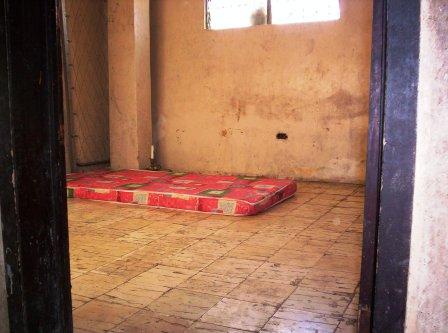
Here’s a picture of my room in Belekou. It has all the comforts of home. Or, to be more exact, both the comforts. It has a mattress, hand-sewn by one of the members of the Belekou group, a young guy named Ewol. He used to have a business making mattresses, but lost the space he was making them in, so had to stop. It also has a candleholder, courtesy of Zach Rasmuson, one of the premier pinot noir makers in America, and a wonderful long-time friend.

3

Driving the Dog Away

Wonn Refleksyon depends on three elements.

That it depends on participants goes without saying. It needs a group of people willing to try to be at least reasonably good to one another.

It also depends on a discussion leader, someone who wants to lead by listening first, speaking second. Someone who strives to nurture the discussion’s shape, but who also enters into it with curiosity and openness.

The third element is the text. It needs to do two things. The first, the most urgent, the most obvious, is that it must interest those who are asked to read and discuss it. It must invite them to share their thoughts, their experiences, and their questions. Wonn Refleksyon aims, in the first place, to help people accustom themselves to sharing their own thoughts and to listening to others’. It needs to make it easy for someone to speak up, and the most important tool it has is a text that engages.

The second thing a text must do it support participants as their inquiry deepens. The goal Wonn Refleksyon sets for itself goes beyond just creating occasions for people to express their thoughts, beyond nurturing the habit of listening. Expressing one’s thoughts and listening to others both aim at a further goal: learning to learn together.

It’s impressive enough to watch a group whose participants have learned to share the time they spend together. It’s so common in most groups we work with for one or two members to dominate, for them to interrupt each other, for several to talk at once.

But the fact that participants take turns speaking doesn’t mean that they’re really listening to one other, much less learning from one another.

A well-chosen text can help. It can introduce complexities into a conversation, puzzles that give those talking about it something to chew on. It would, of course, be possible for a group of people to jump directly into questioning one another about the thoughts and experiences that they decide to share, but it can be hard to decide to do so.

But what do you do when you’re working with a group of people who cannot read? We thought we had found a good answer when we created a book in which discussable images alternate with Haitian proverbs. The proverbs engage Haitians, especially rural Haitian adults, quickly. They are so present in Haitians’ everyday speech. And the images do what the proverbs can’t: They provide perplexing details that participants can ask one another about, that invite them to try to search for answers together.

The problem is that we have not yet found a way to mass-produce that book. All the copies that we have so far were made by hand. Two women, Donna Struck and Tina Shirmer, used a first-rate photocopy machine at Dynapace Corporation, Donna’s company, to produce them one-by-one. They’ve sent us a couple hundred of the books, but as generous as they’ve been with their time and money, it cannot solve the problem over the long-term. We need a way to reproduce the books in Haiti and the funds to do it with. We will be working on the problem in the months to come.

But in the meantime, we need to be able to continue to work with non-readers. The literacy rate in Haiti is low, about 53% according to a CIA website. I don’t know how to estimate the percentage of non-readers among those we aim to work with and among who would be interested in working with us, but it’s certainly much higher. So we need to have a good approach to offer them.

And that’s why I find myself on Lagonav this week. I’m participating in a workshop for literacy teachers who work for AAPLAG, the Association of Activists and Peasants of Lagonav. These literacy teachers, most of whom are new to the field, have been working four days each week with new literacy learners since late August, and they came to AAPLAG’s center in Nanjozen for two days of meetings and further training. In January, AAPLAG’s leadership wants them to begin holding Wonn Refleksyon discussions with their students, and they asked me to figure out an approach I could teach them to use.

As much as I would like to offer them the book of proverbs and images, it’s not available. And that’s where driving the dog away comes in. One popular Haitian proverb is “//Se ak baton nan men ou, ou pouse chen//.” That means, “It’s with the stick you have that you drive the dog away.” It’s like saying that you play the hand you’re dealt. You can only use a tool that you have. We don’t have the book, and we’ve found no other way to introduce large quantities of appropriate images.

But proverbs are everywhere in Haiti, so I decided to see whether groups that use nothing but Haitian proverbs could flourish. With help from some friends, I assembled a short list of proverbs. There are thousands of them, but I settled for 22. I organized them according to increasing length and complexity of language. The first is “Fè koupe fè,” which means “iron cuts iron.” The last is “Se lè koulèv mouri, ou wè longè l,” which means “it’s when the snake’s dies that you see its length.” I imagined that such an order would mean that they could do double-duty as texts for Wonn Refleksyon and reading lessons as well. The teachers will write a proverb on the blackboard and help participants decipher it. She or he will then lead the group through a Wonn Refleksyon activity based on the proverb.

The workshop itself seemed promising. The literacy teachers took to talking about the proverbs right away, even though they themselves reported that they were surprised that they had as much to say as they in fact did. Not only that, but one of them led a sample class for a group of literacy learners while the rest of us observed. It went swimmingly. The women in the class – it was, in fact, all women – spoke fluidly and revealingly about the proverb.

The one we had chosen for the experiment was “Dèyè mòn gen mòn,” or “beyond mountains there are mountains.” It brought out detailed descriptions from two of the women about how they had been struggling to raise their children once they had been abandoned be men who immigrated to the States. Other women had other experiences to share. We were all excited about the results.

On the other hand, there was very little sign that the women wanted to move from simply sharing experiences to questioning one another and, so, learning together. And I don’t have much hope that they will take this next step this year. The proverbs don’t really support it, and the short time I spent with the literacy teachers wasn’t enough to help them see how to encourage it.

But that might not be so bad. Haitians also say “Tipa tipa zwazo fè nich.” That means “step by step the bird makes its nest.” We should probably be willing to take one step at a time.

Progress without Direction

We may have lost the space we were using for the larger English class in Cité Soleil. We had been holding the class in a school whose owner had been willing to let us meet in one of his classrooms. It is a very serviceable space: large and open, and therefore flexible. It’s on the second floor of a school building right on the main road between Belekou and Boston, two of Cité Soleil’s major neighborhoods. The road is partially paved in places, so it’s often possible to get there without trudging through the ankle-deep mud that’s almost everywhere in Cité Soleil.

When I was down there the other day, the guys explained that there is a problem. The owner isn’t sure that he wants to continue to leave the keys with one of his students, the kid who then lets us in. He himself lives more than an hour away, in Kwadeboukèt, so unless he leaves the keys, we won’t be able to use his school.

I can’t much blame him. On one hand, it’s probably hard for him to believe that there’s no money changing hands around our class, and he might reasonably figure that, if there’s business being done, the owner of the site should get a share. He might also be worried about having thirty or so assorted young men using his building when he’s not there. Though he doesn’t seem to store anything of value at the school, the building itself must represent a large investment.

As we were talking about the problem, one of the less regular members of the class approached us. He seems nice enough, but I rarely have spoken to him. I tend to shy away because he’s often heavily armed. This time was no exception. His handgun was not the least bit concealed.

We explained the situation to him, and he said that it wasn’t a problem at all. “For example,” he said, “the lock on the door could be lost. It might just disappear. Of course, we’d have to buy another one to replace it, but then we’d have a key.” It was the kind of conversation you might expect to hear on a TV show.

The usual procedure when I am to enter Cité Soleil is for me to call when I get to the Gonaïves bus station to confirm whether it’s safe to come in. If Héguel says it’s alright, I take a motorcycle from the station to his house, less than a five-minute ride. I could walk, but an experienced motorcycle driver is more likely to notice and be able to avoid any problems. It seems like a prudent way to go about things.

Saturday when I got there, I found a bunch of guys I didn’t know working on the street. They were being supervised by a couple of very big men dressed in camouflage fatigues. I greeted them, and walked straight up to Héguel’s apartment. I would usually spend a few minutes on the street corner first, chatting with the guys who hang out there, but the work being done seemed to have driven the usual guys away.

I told Héguel how glad I was to see them working on his street, and he just smiled. I asked who was supervising the work, and he confirmed my guess. Still smiling, he mentioned the name of the man who leads the local armed force. I asked Héguel why he was smiling, and he said that I had misunderstood what was happening. There was no street repair going on. The guys were, instead, ripping up the pavement to dig a ditch across the street that would, they hoped, block UN tanks. Just a few days earlier, armed irregulars in another part of Cité Soleil had somehow overrun a UN tank, chasing off the soldiers inside it and stripping of it of weapons and other supplies. The UN was said to be displeased. There had been heavy fighting, with lots of casualties, in Bwa Néf, an area on the other side of Cité Soleil – a long way from where I was – and local leaders were nervous.

My work in Cité Soleil continues. In a sense, I meet with two distinct groups there. One is made up of about thirty guys, many of whom attend only irregularly. They come with varying frequency to free English classes that Héguel, a long-time Haitian friend, runs three times a week. I try to attend at least once. Then there is a smaller inner circle, about fifteen consistently-unarmed guys whom I meet with before Héguel’s English class. We sit in a circle in a small room across from Héguel’s apartment. We sit on the floor because there’s only one chair. We do various things together: additional English work, unstructured group discussions, Wonn Refleksyon, and more.

The whole thing started because Héguel had spent years talking casually with the young guys who hang around in his neighborhood. He likes them, and they seem to look up to him as an older, distinctly upright man. He asked me to talk with them because they were expressing to him their sense that they lack direction. He felt sorry for them, because he came to see them as nice kids who are managing to stay out of gangs but who aren’t figuring how else to move themselves forward. They seem stuck. And he doesn’t like the way that locals look down on them.

He thought that meeting with them might help me better understand an important side of Haiti that I’ve had little contact with and that, if the guys and I hit it off, our conversations might help them find some of the direction they need.

From the very start, I’ve been reluctant to approach them with much of an agenda. Their lives are very different from anything that I have ever experienced, and it would be crazy for me to believe that I know what they should do. But I was a little surprised and a little disappointed when they told me that their first interest was in learning English. On one hand, it’s a little hard for me to see just what it will do for them. They are unlikely to have tourists around them any time soon, and jobs that require English are likely to require other things they don’t have: like advanced education, good connections, and decent clothes. On the other, English teaching is not a kind of teaching that I’ve enjoyed. But the guys were clear enough about their interest in English, so Héguel and I – mainly Héguel – put something together for them.

We also just started a Business Development class. I had told them about Fonkoze, and about the various educational programs it offers, and they were particularly interested in Business Development. Several of them have little businesses they depend upon to keep money in their pockets. One is, for example, a candy maker. Another raises pigeons. A third makes gas lamps. Two of them work as a team, fixing motorcycle tires. Others who have no work would be very happy to start something.

Fonkoze’s Business Development program emphasizes control of one’s business: how to keep track of investment, inventory, income, and expenses. Such control is unusual in Haiti, where it’s much more common to run a small business straight out of one’s own pocket, without a clear sense of where money comes and goes. The guys were surprised to see how much money the candy maker has invested in his business, and they were interested to see just why it’s important for him to keep track of such a thing.

Their initial reaction was that, since it is his business, there’s no reason to set his personal money apart. I found myself in the for-me-surprising position of explaining how businesses work. I spoke of how easy it would be to be wrong about whether a business is actually helping its owner unless the owner knows how much money they have invested and how much they have removed. When he realized what I was saying, Harold, who used to have a small business making mattresses, chimed in his support. His business had, to all appearances, been going swimmingly. His mattresses sold well; money was coming in. Then he discovered that rent on the space he was using was eating up everything he had. Before he knew it, the business died because he couldn’t pay the rent.

When members of the inner group said that they wanted to know more about my work in Haiti, Héguel and I took that as an invitation to introduce them to Wonn Refleksyon, too. We’ve been holding regular Wonn Refleksyon discussions with them ever since. These discussions are designed to help them learn to work together more effectively. The guys enjoy them and are, I believe, benefiting. Though they still like to argue more than is to my taste, they’ve already gotten better about encouraging one another to speak.

And getting better at working together is important if we are to make progress in what still seems to me to be our most important activity: unstructured conversation. I try to make sure that we spend a certain amount of time whenever I am with them just chatting about whatever is on their minds.

They usually want to talk about stuff that’s going on in their families and about the always-shifting security situation. They have all grown up right in Cité Soleil, so they’ve lived all their lives around rape and shootings and other violence.

Let no one imagine, however, that they are, as we might say, “used to it.” Nothing could be clearer than how hard they find the periods – sometimes more frequent, sometimes less – of heavy gunfire to bear.

Saturday, we spent a lot of time talking about two t-shirts. My main collaborator in Haiti, Frémy, and I had created a t-shirt that says “Let’s destroys the guns.” He had printed several of them, and I wore one once to Cité Soleil. The guys liked it, and I agreed to give them the two other I had. So I brought them with me on Saturday.

When it came time to distribute them, Salomé made an important point: The armed guys who are all around them might be upset to see the t-shirt. They might think that we were judging them. This partially echoed Héguel’s concern: Our activity had been accepted by the local leader as an educational activity. If he thought we were creating a political movement, he might think differently.

As the dialogue continued, the general feeling was that the higher-level members of the local force were unlikely to be too worried about t-shirts. On the other hand, lower-level members were something different. These lower-level soldiers are young men, not very different from the guys in our group. Except that they had chosen to take up arms, to join the local militia, in order to get ahead. Farid and Lele both reported their sense that guys like that resent them because they manage to stay away from such things, and they thought that wearing anti-gun t-shirts would only aggravate that resentment. And they are understandably reluctant to aggravate young men who carry guns. After much discussion, we decided to put the shirts away.

I’m not sure what I’m looking for in these conversations. I’d like to say that I’m hoping that they’ll eventually use them as a path towards organizing themselves to change their neighborhood and their lives. But I need to be careful. More than anything, I’d like for them to feel better about themselves, for them to develop some confidence, a sense of where they want to go and how they might get there, and anything I do to share my own vision could very easily undermine their initiative.

And so I wait. We keep chatting, and I keep hoping.

I think we’re moving forward. Our conversations get more serious, more quickly. More of them speak more freely. They listen to one another and encourage one another more than they did at the start.

But it’s hard to tell. Progress depends on having a goal. Without a clear sense of where you’re going, it’s hard to know which direction is forward and which direction is back. The guys and I are very far from knowing what our objective really is, and the environment in which the work is progressing – that is, at least, what I want to say it’s doing – the violence, the poverty, makes it difficult to hope for very much.

On the other hand, on a day when a tank barrier was being constructed in front of our classroom, 25 young men spent fours hours with me learning more about how to run a business, working on their English, and talking sensibly about the possible effects of t-shirts. The preparations that were being made for a possible military invasion – I don’t know what else to call it – might seem as though they ought to have been a distraction, but they turned out to be nothing of the kind. The guys’ untiring interest in learning and their openness to discovering something new are considerable lessons to me. If nothing else, I am making progress in their hands.

Inivèsite Fonkoze

Fonkoze’s approach to its educational programs distinguishes them from other adult-education programs I’m aware of. Even their objectives are unique. It sees providing educational programs as a route towards helping its members improve their lives. That might sound conventional enough. But for Fonkoze, the route depends, first and foremost, on effective microcredit programs that help members increase their financial independence and security and to become less poor. Fonkoze’s educational programs are designed to complement and even serve microcredit. The institution is not, after all, a school that lends money. It’s a bank that offers education.

The educational programs serve microcredit in a number of ways. Most directly, and obviously, are the ways that Basic Literacy and Business Development students acquire skills that help them make better use of their loans. Keeping track of inventory, expenses, and sales is much easer for women who can read and write. And these are all skills specifically covered in the Business Development class. Health Education students can reduce sickness – their own and their families’ – that can drain their resources.

But these direct effects are, in a sense, less significant than another that is, perhaps, less obvious. Educational programs strengthen microcredit by strengthening the centers that the credit works through. It strengthens these centers by bringing their members together for more frequent meetings.

Centers without educational programs generally meet every two weeks. Every four weeks, they meet to make loan repayments. They have a second meeting each month for discussions. Centers with educational programs, however, meet once or even twice each week. The women end up working with one another more closely, more regularly, and so a sense of community, of solidarity, develops among them.

But credit centers can have forty members or more, too many to participante effectively in a single class. So Fonkoze has been developing an approach one might call “Inivèsite Fonkoze”, or Fonkoze University. Credit centers are organized to offer two or three classes simultaneously. Women can sign up for the class they want. It is as though they are university students choosing from among elective offerings.

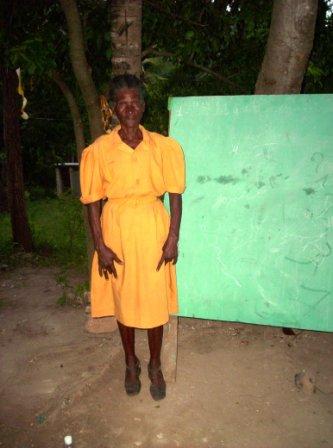
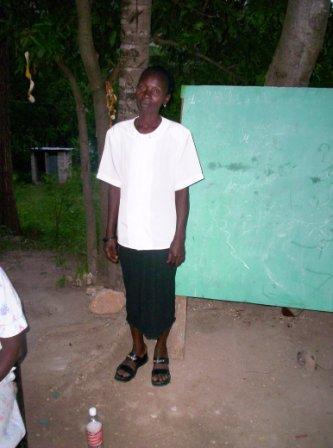
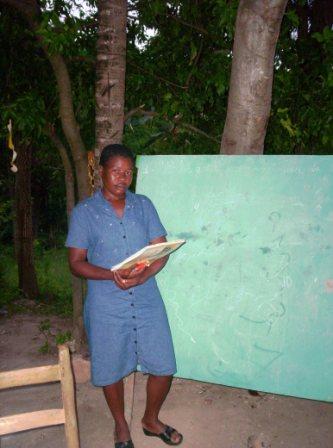
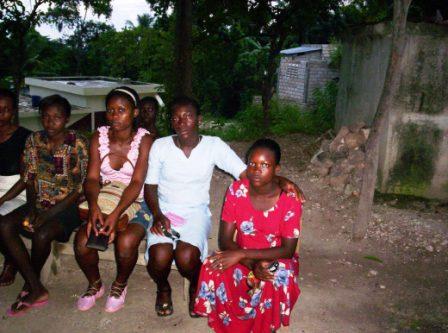
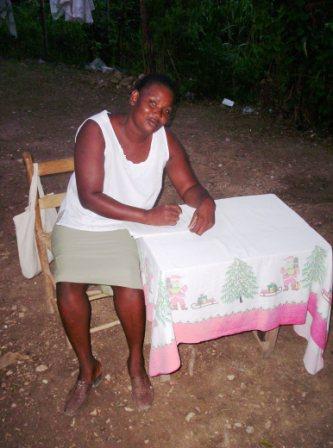
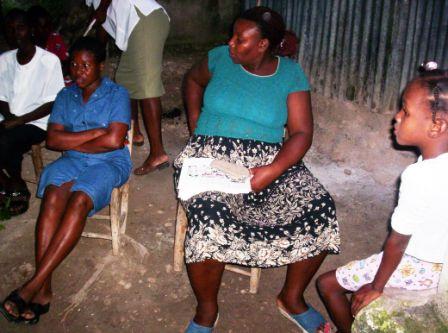
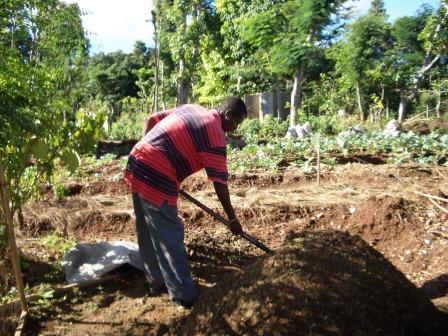
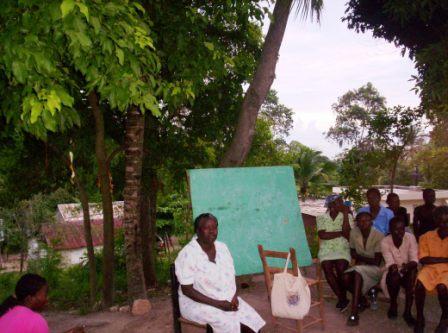
Here are some photos from one Fonkoze University, at a credit center in Zoranje, a rural community in the mountains outside of Jakmèl.

The center is located in the yard behind one of its member’s home, under a cluster of trees:

One important aspect of the new approach is the Fonkoze no longer hires outside professional educators to run the classes. They are instead taught by credit center members who receive a week of training to prepare them. This not only develops a sense of solidarity within the centers, as participants teach and learn from one another, but it also develops leadership skills in the women who take on the task. Here are the three member-teachers at the center in Zoranje. The woman on the left teaches Basic Literacy, the one on the right teaches Business Skills, and the woman who’s seated teaches Reproductive Health.

Participants in the Basic Literacy class felt strongly that they should be able to pose to have their photos taken. Here are two of them:

The Business Skills class uses a book that Fonkoze created. Here is a participant at the board, working out a problem:

Here, some of her classmates watch:

The instructor works it out at the table. She is learning together with her students:

The Reproductive Health class is based on wide-ranging conversations about stories that were collected because they raise important issues. Here, the teacher leads the discussion. Her young daughter looks on:

The more Fonkoze is able to provide these programs to its credit centers, the stronger those centers will grow. They will gradually become long-term associations of women who meet to learn together. Leadership skills will spread and strengthen among them, and so their communities will move forward as well. It is hard to imagine a more certain means towards progress in rural Haiti.

Leadership in the Garden

“The Matènwa Community Learning Center” is incomplete as a translation of the name of the school there. The full Creole name is “Lekòl Kominote Matènwa pou Devlopman” or “The Matènwa Community School for Development.” It would make awkward English. Hence the shortening. But the “for Development” is important nonetheless. The school aims to do more that provide strong educational programs for local kids and adults. It is committed to the development of Matènwa, of the island of Lagonav, and even of Haiti.

This commitment is evident in any number of ways. It’s clear when you see the school receiving teaching interns from other parts of Haiti. It’s clear when you see teachers at the school traveling in Haiti to share their experiences with other teachers. It’s clear when you follow the school’s leadership of the network it created of small schools around Lagonav, schools who have decided to join its decisions to teach in Creole, to teach without violence and humiliation, and to develop vegetable gardens and tree nurseries.

And those decisions are more than just words. They lead directly to action. Wednesday’s meeting was an example. Fifth and sixth graders from another school in its network, the Baptist School in nearby Gransous, came to Matènwa to watch how the kids at the Matènwa school work in their garden. The teachers in Gransous had already met and had decided to give schoolyard gardening a try. But they felt that, rather than just making their students take on the project they would seek their agreement, and the first step they chose was to bring them to Matènwa to observe.

Though the lions share of the gardening at the Matènwa school is done by the children, there is nevertheless plenty of work to go around. The school’s principal, Abner Sauveur, is also the head gardener, and he prepares for the Gransous visit:

Here the students arrive, two full classes from each school:

The first thing that caught their interest was the school’s large fish tank. It’s filled with tilapia, a fish that survives well in a closed tank with only minimum attention. The tanks water becomes an extra source of plant nutrients when it’s used to water the soil.

Abner begins by talking to the students about the different tasks they have to accomplish:

Here, the kids from Gransous are listening in. They wore uniforms for the visit, but the Gransous school has imitated the one in Matènwa in its decision not to require uniforms any longer. One sees here that, even when the kids wear uniforms, they don’t pay too much attention to whether their uniforms are all alike.

One of the tasks for the day was to fill small black bags with soil enriched with donkey dung.

The bags are used to plant tree seedlings, one of the garden’ most important products in an area whose trees have been decimated by years of charcoal production. The bags are lined up outside of direct sunlight. They’re ready to be part of the school’s nursery.

Meanwhile, another group of students is preparing a bed for planting. The beds are shaped out of enriched soil.

One of the school’s teaching interns lends a hand.

Boys and girls participate as equals in all part of the garden work.

A number of the students were sent into the cabbage patch to remove snails that can ravage their crop. Simple measures like this eliminate any need for insecticides, which would be expensive and dangerous.

A couple of students water.

The students from Gransous had been brought to observe the work, but as is clear from all the photo, that plan didn’t last. They wanted to be part of the work and, so, joined right in.

Before they left, they all met together to discuss the experience. Such closing conversations are always part of the work Abner does in the garden with his own students, but on the day of the visit the group was especially large: over sixty kids and their teachers sitting is as much of a circle as they could.

The kids from Gransous had lots of questions about the advantages of gardening at the school and the resources they’d need to get started.

Most of the answers came from the Matènwa kids themselves.

Abner said a few words at the end, but they were mostly words of thanks — both to his own students and to his guests: