Monthly Archives: March 2008

A Pleasant Little Tale

Monday was an unusually hard day of travel. It started at about 2:00 AM in Hinche, a city in the middle of Haiti’s Upper Central Plateau. Job and I boarded a pick-up truck to head back towards Port au Prince. I had come to Hinche Saturday to attend a friend’s baptism. Job had been in nearby Cerca Carvajal, planning some work he had to do there. I had wanted to leave Sunday afternoon, but it was Easter Sunday, so no transportation was available.

The truck had found us on our way to the station. It was roaming the streets, beeping its horn and revving its engine, looking for passengers. It wouldn’t leave for Port au Prince until it was full. Job and I got seats, but they were on the roof rack above the cab. In some ways, they were good seats. You get less dust up there. But you have to hang on tight. The truck left at about 3:00.

Job was going all the way to Port au Prince, but I had to get off in Mirebalais, about halfway there. I met the manager of Fonkoze’s office in Belladère. He spends weekends with his wife in Mirebalais, but then heads to his office on Monday. I had some work to do in his branch, so I got on the back of his motorcycle and made the hour-and-a-half long trip with him.

When I got there, I found out that they wanted me to do my work in Baptiste, a mountain community outside of Belladère. It’s another hour or more away on motorcycle, up a hard, mostly-unpaved road. Worse than unpaved, it’s formerly paved. Chunks of pavement combine with rough gaps to make the ride especially bad.

A Fonkoze credit agent drove me up the hill, and accompanied me as I did my work. We got back down to Belladère mid-afternoon, and I finished what I needed to do by about 4:00.

I had planned to spend the night in Belladère, but it’s really better not to. The first trucks don’t leave the city until after 8:00 AM, so you don’t get to Port au Prince until noon. Half your day is shot. Usually, however, trucks don’t leave Belladère late either. The last ones load for neighboring Lascahobas in early afternoon. Belladère is on the Dominican border, and so it’s not that oriented towards Port au Prince. There just isn’t a lot of traffic in that direction.

But I was in luck. Monday is market day in Elias Piña, Belladère’s Dominican neighbor, so there are more passengers looking to head back towards the rest of Haiti on Monday afternoons. I was on the back of a pick-up, headed to Lascahobas by 4:30, and it was loaded and ready to go by 5:30. I had another long wait in Lascahobas, waiting for a truck towards Mirebalais to fill, and by the time I got to Mirebalais it was 8:00. I was tired and hungry, so I slept well.

I left early Tuesday morning on the back of a pick-up headed on the very dusty road back to Port au Prince. The other passengers and I joked that we’d all be the same color by the time we arrived.

We got to Croix des Bouquets by 7:30, but the driver stopped there instead of going all the way to the downtown station. It was a nuisance, and my fellow passengers were furious, but he was not going to change his mind. I walked 20 minutes to an intersection where I thought I would find a pick-up or a bus headed downtown, but I didn’t see any. I settled for one headed to the Shada intersection. There I knew I’d find one.

Or I thought I knew. I had no luck. I started strolling, looking over my shoulder to see whether I’d find the ride I needed.

When I got to Croix des Mission, I came across a familiar smile. It was Marie Ange, one of the women from the KOFAVIV group that I met with regularly over the course of about two years. KOFAVIV is the Commission of Women Victims for Victims, an organization of rape victims who offer support to other rape victims. I no longer meet with them, though I see some of them now and again. I hear about them often enough because a couple of them have gotten jobs with Fonkoze as the agents that offer Fonkoze credit to the others.

We each spoke some about our work. We hadn’t seen each other in quite some time. She too no longer attends the KOFAVIV meetings, but she still works with victims in her neighborhood. She was curious to know about the various parts of Haiti that my work takes me to and about the different groups I see.

She asked me what I doing, and said I looked kind of lost. I explained that I was trying to catch a ride downtown.

I was tired and dusty. I must have looked pretty ragged even by my own, rather low standards. But I had no idea how ragged until she reached into her purse and gave me 50 gourds. It was an event entirely without precedent in all my years here. She must have thought that I lacked even the ten gourds for bus fare, though I told her I did not.

I’m not used to thinking of myself as a charity case, and part of me was sorry to be taking her money. She can’t have much to give. But, for what is, I think, the better part of me, her generosity simply made my day.
Intervening Is Awkward

I was pretty pleased with my plan. Léon had just finished putting a roof on his new house. He, one of his sons, and some neighbors had built cinder-block walls around the previous house, a structure that had been made of sheets of corrugated steel roofing material. They then took the used sheets and made it the roof of the new, larger home. (See: HomeImprovement.)

His son Mackenson spoke to me about his excitement. “Now,” he said, “I have a home I can receive friends in.” And they really are ready to welcome guests. Even if there’s still work to be done.

There is, for example, no door. They simply use a leftover piece of the roofing. They block the doorway with it, and move it back and forth as they need to go in or out.

I learned that a door could be purchased for about 2000 gourds, less than $55. So I decided to help them buy one. Mackenson is one of the kids who does math with me, and he helps me around the house all the time. Léon is a great guy, always doing people favors. So I knew it would feel like a treat to do something for him. I was a little short on funds, so I had to wait until payday. But wait I did. Then I organized the cash so that I could go up to Kaglo with it on my first trip home after an extended period of work in the field. I thought it would make for a nice surprise for them both.

Before I could get up to see him, Léon stopped by to say “hi”. He came by while I was unpacking. It’s not something he ever does. He’s too busy. He’s out doing farm work well before sunrise every day, and he rarely takes a break before nightfall. But he had just finished some work for a neighbor of mine, and was on his way up the hill to water his own field. He happened to see me step in, so he decided to stop by. He looked tired, and a little thin, but otherwise all right.

As it turned out, he had a problem. A few days earlier, he had finished some farm work in the fields below where I live. He was ready to head home to tend his own fields when he found he simply couldn’t. His home is a short but steep uphill walk from the road I live along, and he just didn’t have the strength to climb that hill. He sat down next to the footpath, and called to a passing neighbor. She’s a cousin of his, and she quickly put him to bed in her home. Then she sent for his wife.

Léon and his wife live separately, each with a couple of their younger kids. She’s with their daughters, and he’s with their sons. They don’t seem to be separated in our sense of the word. They maintain, to all appearances, close and good relations. Visits, in one direction or the other, are frequent, often daily. They are close business partners: He grows produce, and she takes it to market. And Mackenson has told me a lot that suggests they work together to raise their kids. They just live in two different houses, in two neighboring communities.

It was about noon when she got to him and, according to the account he gave me when I asked him about it, it was well after 3:00 before he knew what was going on around him. Eventually, he was helped home. He was back working the next day, but Mackenson says that his mother has been spending more time with them ever since.

Now I don’t know what was wrong with Léon. I hope he sees a doctor soon. My friend Dr. Job plans to visit over the weekend, and I’ve already asked him to bring his black bag.

I do know this: Though Mackenson appears to be a healthy, well-fed young man, Léon cannot be getting three square meals a day. In the best of times, he would have nothing but a cup of coffee and a roll before he leaves in the morning, and then nothing more until he gets home after dark. I asked him about that cup of coffee, and he told me that it’s been up and down. As the price of sugar has increased, he’s found himself going without at least some of the time. Thanks to the price of flour, the roll has become a rare thing too.

So here I am, handing him cash to buy a front door. His poor health is probably related to hunger, hunger directly connected to lack of funds. He rarely has much money to buy food with. This time of year, at the end of the dry season, with his main harvest still a long time away, his cash would typically be especially low. Normally, his staple right now would be the yams he grows and can dig up whenever he wants. But for reasons he can’t explain, this year’s crop didn’t amount to much.

So he should probably just buy some food, but the money in his hands is for a front door. I wish there was away for me to ensure that the door is really his priority, but it’s too late for that.


Mackenson’s partner in the schoolwork we do together is Ti Kèl. They’ve been bench mates in class after class for the last few years, two 18-year-old sixth graders. They both started school late, but have been making good progress since. They’re business partners as well: They farm together and split the profits. They’re also great friends. One other thing they have in common is that, since last year, I’m the adult who signs their report cards. Their parents can’t. Before they first asked me to do this, they had been signing the report cards themselves. I was reluctant initially, but eventually agreed. Now, at the end of each term, I meet with their parents – usually, with Léon and with Ti Kèl’s mom – and we talk about how about how they’re doing. I tell the parents what grades the guys have earned, where their strengths have been and where they are weak. I suggest what we might do to help them. After that, I sign. About a week ago, they brought me their third term report cards. Mackenson had done wonderfully. He was first in their class with an average of 7.2 out of ten. It was a great sign. He’ been first most of the time for several years, but earlier this year he wasn’t working as hard as he always had, and his grades slipped. This term’s grades showed that he had gotten himself back on track. Ti Kèl’s card was marked 6.7, very good as well by standards here. When I looked at the “6”, however, I immediately saw something was wrong. The left side of it looked as though it had been written over. I looked at the actual totals, and saw that he had scored 114 out of 200, or 5.7. He had doctored the “5” so that it would appear to be a “6”. It took my breath away. I confronted him right away with the strange appearance of the “6”, and he tried to claim that that’s the way the teacher had written it. When I explained the way that I could calculate his actual average, and that I had done so, he immediately confessed. He had changed his grade because he felt that 5.7 wasn’t good enough. Before proceeding, I want to say two things. First, 5.7 is good enough, at least in a general sense. It’s much better than a passing grade, which is 5.0. What’s more, his teacher cribbed the exam from a previous year’s national sixth grade graduation exam, so Ti Kèl’s score gives reason to hope that he will pass this summer. Second, Ti Kèl has shown over and over that he is generally a trustworthy and reliable young man, both generous and considerate. I trust him with a lot when he does chores for me, and he’s never shown the least sign that he doesn’t deserve that trust. In other words, changing his report card seems to be an aberration. The obvious question is “Why?” What pushed a generally honest young man to try changing an acceptable grade so that it would appear even better? When I asked Ti Kèl this very question, he gave the obvious answer: He didn’t think the grade he had earned was good enough. I knew what he meant. Like Mackenson, his grades had dipped considerably from last spring to this past fall. They had not dropped below passing, but they were much above it either. I had made a big deal about it in a couple of ways. On one had, I worked harder to make myself available for our little math class. On the other, I bought some Haitian, young-person’s novels in French. Both guys have particular trouble in French, and I thought it would help if they had something to read. I also talked about the difficult position they both are in: It will be hard, and may even be impossible, for them to get into the public secondary school in Pétion-Ville, but neither of them comes from a family that will be able to afford to pay for their school. The best chance they might have is if they can keep their grades very high so that, against all odds, they can continue in public school nonetheless. I must have gone too far. Somehow, I gave Ti Kèl the impression that he must have excellent grades come what may. I am glad that he’s come to take achievement in school seriously. It could end up making a difference for him. But obviously I overdid it. I led him to create so strong an expectation for himself that, when he saw that he hadn’t achieved what he thought he was supposed to achieve, lying appeared to be his one way out.


Mackenson, Ti Kèl, and I are going to keep doing things together. Math, for one thing. But there will be other things as well. Our latest project is animal husbandry. We bought a couple of female goats. We all know that, if they want to stay in school after this year, they’ll need to find a source of income beyond the farming they already do. We’re hoping that goats might be at least part of the answer.

But it’s hard to be very sure. When you intervene as an outsider in someone’s life, it’s much easier to get things wrong than to get them right. The beginning of the Hippocratic Oath is “First do no harm.” It’s a good principle, but not as easy as it sounds.

The Graduation Speech

graduation

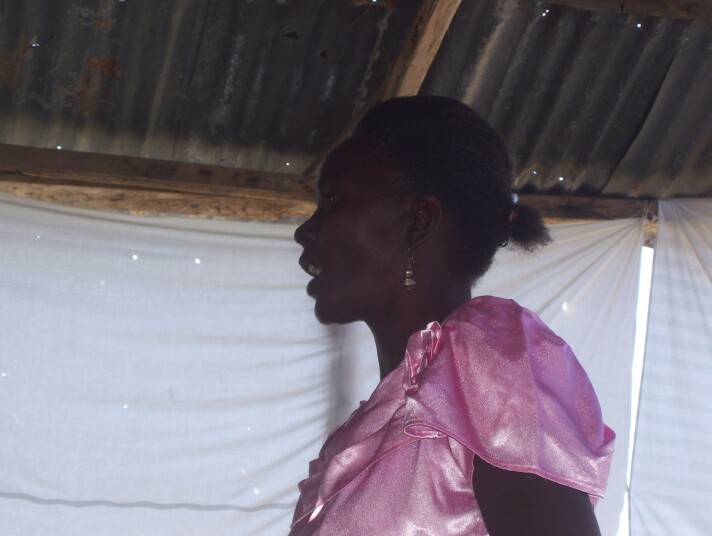
I recently wrote about a group of women who were graduating from Fonkoze’s Ti Kredi program into its standard Solidarity Group credit. (See: Boukankare Graduation.) What follows is the full text of the speech that one of the graduates made that day.

Good morning everyone. Good morning everyone.

I’m Lorise Viergella, from Pajès. I’m the leader of a solidarity group called “Canaan”. My heart is full of joy because of the help Fonkoze is giving us. Fonkoze is helping us free ourselves from the humiliation we suffer from the men in our lives.

Men look down on us. The say they have to buy even the gas for our lamps. They have to buy even the salt and the oil for our food. But we want to move forward. If the men provide beans, we want to buy the rice. If they buy us our panties, we want to buy their briefs. And we will do it.

When Fonkoze first showed up, it frightened me. I was a little bit afraid. But little by little, as I would go around, the women who were already members spoke with me. They shared what they had already learned. I said to myself, well, I want to make progress so that if my husband gives me the beans, I can buy the okra.

So I joined. And Fonkoze began to do a lot for me. Today, I am raising a small pig at the edge of the field. And it’s thanks to Fonkoze.

I’m making profit. I sell candy. I sell cold drinks. I buy my sodas for six gourds, and I sell them for ten. I buy my Cokes for 15 gourds, and I sell them for 20. I buy my King Colas for fifteen gourds, and I sell them for twenty. I buy my Maltas for fifteen gourds and I sell them for twenty. Now I’ve bought a little pig and a few little chickens. I pay into my savings club and I make deposits into my account. That’s just to say, I want to move forward. I want to become fat.

If my husband gives me 100 gourds for our household, I can reach into my candy box and add another hundred gourds, thanks to Fonkoze’s Ti Kredi program. Thanks to Ti Kredi Fonkoze.

Our Fonkoze credit agent, Doudou, would talk with us. He would say, “Don’t just go off and spend the money you make. Don’t just spend on pretty new clothes. Don’t make other purchases that could wreck your business.”

He never told us not to eat, but said we should eat economically. If we prepare food with just a little inexpensive fish seasoning one day, we can prepare meat the next. Then we should go back to the fish seasoning again.

All that makes me want to thank Fonkoze and its leadership, the folks that are helping us move forward. I thank them because now I can buy things like little notebooks for my kids.

Thanks to Fonkoze, we can buy a book or two as well. If dad buys a book, we can buy a notebook. If dad buys a pen, we can buy a pencil.

I thank everyone who’s graduating with me today, and those who aren’t yet graduating as well. We’ll pray with you so that tomorrow you can stand where we now stand. That’s all I want to say.