Category Archives: Chemen Lavi Miyo

Making Choices

Mirlande is a young mother of five. She lives on a hillside outside of Saut d’Eau. Her home is made of woven strips of wood that are covered with a layer of mud, and a roof of leaves. The house has a dirt floor, and lacks even a very basic latrine. She shares the home with her kids and the man who is father to the four youngest children. The seven of them live on what the father brings in by farming and by buying pigs on credit and selling them quickly at a profit. They don’t have the means to get into the more lucrative business of raising the pigs. That would require the capital both to buy the pigs clear and invest some extra money in feed.

Before Fonkoze can begin to help Haiti’s poorest families lift themselves out of misery, we have to identify those families. Good selection is the cornerstone on which the CLM program is built. It’s a three-step process, and we’re in the middle of it right now.

The first step is Participatory Wealth Ranking (PWR), which I’ve written about before. It’s a process we saw a lot of during our month in Bangladesh. (See: The Right People.) Fonkoze staff members go into the communities we’re planning to work in and hold meetings at which community members provide initial information as to the economic status of each household. Staff members leave these meetings with maps of the communities and lists dividing the households into between four and seven classes, ranging from the richest of the rich – whatever that might mean for a given community – to the poorest of the poor.

The information is useful. It introduces us to a community and teaches us something about how to approach it. We could hardly do without it. But it is neither sufficiently detailed nor 100% reliable. So Fonkoze adds to and verifies it through two more levels of field research on its way to selecting the families who will be invited to participate in CLM.

The first is a set of detailed field surveys completed by the men and women who will eventually serve as case managers for the families we select. Teams of two-three case managers go door-to-door, filling out multiple questionnaires for every family that the PWR meeting has placed in one of the bottom two economic categories. We collect information about the households’ income sources, assets, and their ways of life. These surveys give us extensive baseline data about the families we will eventually work with, and they allow the case managers to make their preliminary recommendations.

Fonkoze has distinct programs for very poor and extremely poor families. They are very different approaches, and it’s important that we get families into the one most appropriate for them. For very poor families we have Ti Kredi, or “Little Credit”. As its name suggests, it is a loan program that provides a more supportive framework than our regular credit programs do so that poorer women can get their businesses onto solid ground. The program lasts six months, includes a supportive repayment calendar and extra education and accompaniment, and prepares participants to move forward through regular solidarity-group credit.

But credit won’t work for the poorest of the poor, because they cannot sustain a business without significant additional support. Their immediate needs would inevitably consume any assets that they might try to invest. Even the very poor are hungry most of the time, but the extremely poor might go for days at a time with nothing substantial to feed their kids. It would be foolish to expect those who live as they do, on the edge of starvation, to set aside resources that could easily be converted into food.

Case managers use the data they collect in these surveys, but also their own good judgment, to confirm that the families they visit truly belong to one of the bottom two groups and to recommend them for either Ti Kredi or CLM. But they only make recommendations. Final selection is made by one of our five field managers. We revisit the homes that our case managers have recommended for CLM to talk with the women who would serve as our program’s link to them, to the women who would participate in the training we offer and take responsibility for the assets we give. We establish how many children the women are responsible for, what other people they have to share their responsibilities with, and how they feed and otherwise care for those who count on them. Our object is to answer a simple question: Could the woman we are talking with succeed in Ti Kredi? Only if we decide that she could not do we select her for CLM.

Most of the judgments are easy. We visit home after home after home with five or six or eight or nine children, all of whom are terribly, visibly hungry. These children might have absentee fathers, or they might have hardworking, but landless ones, who can’t get much more than a dollar for a day’s labor in the field. The families might live from sharecropping, typically receiving two-thirds of what they can scratch out of the fields they farm, enough perhaps to eat a meal a day for a couple of months each year. The women themselves have no small businesses because they have no ability to set aside assets for sale. Many of them labor in the fields next to the men, earning only about 75 cents a day. Some of them just sit at home and rely on their neighbors’ occasional charity, neighbors who are, themselves, far from well off. So when you’ve talked with these women for a few minutes, it’s easy to sign the form that authorizes their participation in CLM.

But then there are cases like Mirlande. She has a working, though volatile partnership with her husband. They do not own the land they live on right now. They rent the house and the land it’s on, which includes a small plot that they farm. This year it cost about $5, up from $3.75 the year before. But they also own two pieces of land, a smaller one her husband inherited from his father, where they are starting to build a house, and a larger one they bought this year when her husband sold a cow. Her three oldest children are in school. The first has his tuition paid by his father, who supports him in no other way, and the other two through a kind of buy-one-get-the-next-two-for-nothing arrangement. They regularly eat about once a day, feeding on the millet and corn that they harvest for as long as that lasts and then on what they can buy through the income of her husband’s pig trade.

I doubt neither Mirlande’s poverty nor her need. I know that she and her family are hungry most of the time. They lead a terribly hard life. But the structure of support that her husband provides, including a regular if inadequate source of income, and the capacity for future planning that their purchase of land demonstrates at least suggest that credit might work for her.

So I went against the case managers’ recommendation and put Mirlande on the list for Ti Kredi. It isn’t the kind of decision one can feel good about because it robs a very poor family of resources that could do its members an awful lot of good. But we need to reserve those limited resources for the families who need them most because, as it stands, there are many more of them in Haiti than we can possibly serve.
It’s Not Easy

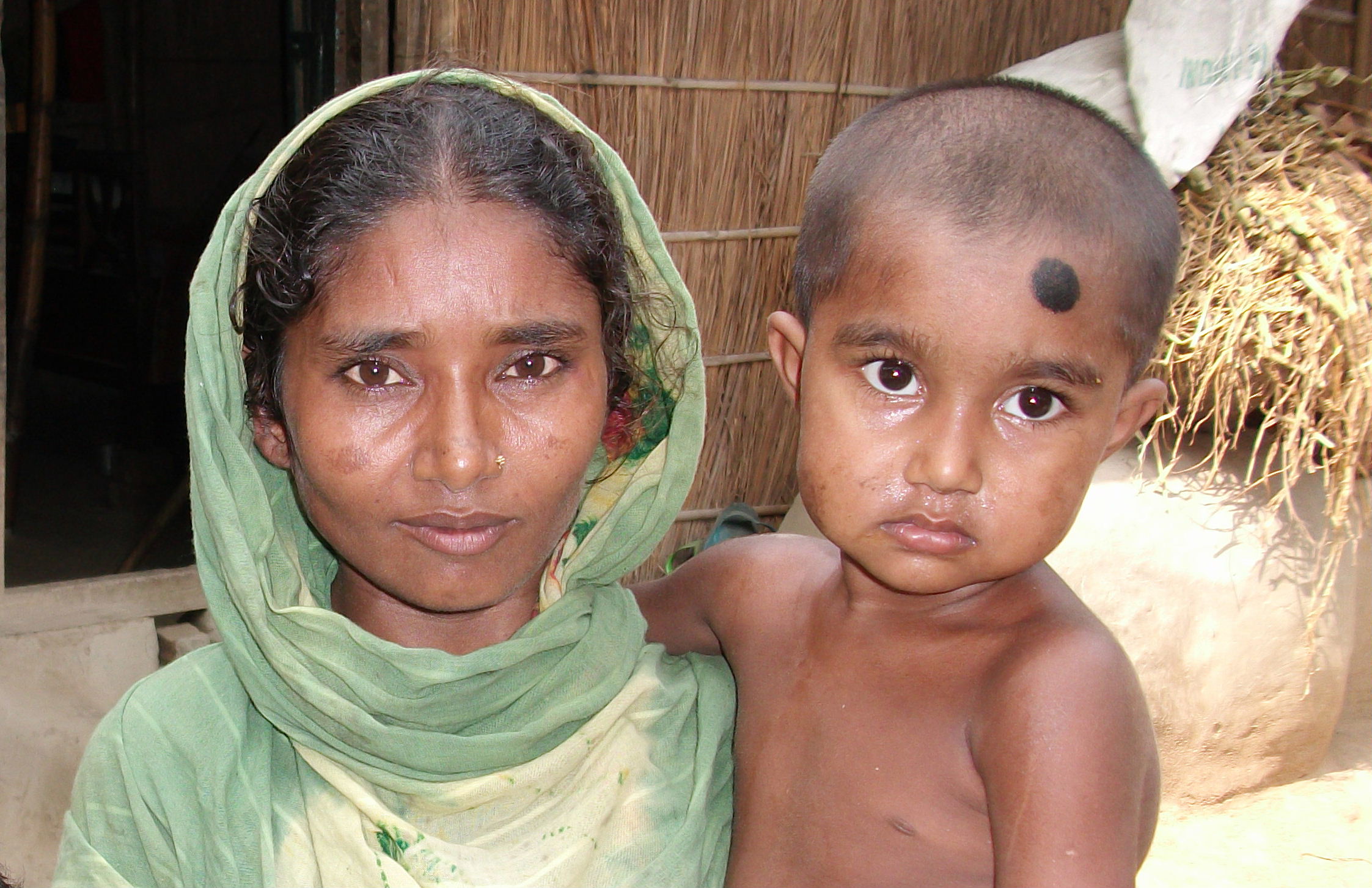
Azuba is a young mother of three from a village outside of Mithapukur, a town in northern Bangladesh, one of the poorer parts of the country. Mithapukur is home to a large BRAC office, where BRAC began offering its program for the ultra poor early on, back in 2002. The BRAC team reached Azuba’s village in 2004, and Azuba was selected to participate.

When women enter the program here, they are given a choice among productive assets. BRAC now offers something like nine or ten options, including several different combinations of livestock, a couple of agricultural possibilities, and non-farming commerce. Like many of the women we have met here in Bangladesh, Azuba chose to receive two cows. Cows can take longer than some of the other options to produce income, but they are thought to be reliably profitable. She was given about a week of classroom training, and got her cows shortly afterwards.

Within three months, disaster struck. The two cows very suddenly grew sick. Azuba contacted her caseworker, who notified the branch’s manager for the ultra poor program right away. He rushed to her with a veterinarian, but there was nothing they could do. The cows died.

BRAC’s selection process is designed to involve community members, and there’s a reason for this. BRAC knows that it can’t provide all the material and social support that the ultra poor will need to change their lives. They will need help from their neighbors as well. The BRAC team formalizes this help by organizing community anti-poverty committees shortly after transferring assets to program participants. These committees are made up of the community’s leaders, the very people who might once have supported the poor through offering domestic employment or occasional handouts. Getting them onto a committee takes their habit of charity and applies it towards eliminating the need they are already used to addressing.

So Azuba and the staff of BRAC’s local office made two applications for special support. They appealed both to BRAC’s central office and to the local committee, and both answered the call. A new cow that was pregnant or ready to become pregnant would cost about 8000 Bangladeshi takas. At the current exchange rate, that’s about $112. The BRAC program head authorized 7000 takas to go towards buying Azuba a new cow, and her local committee came up with another 1000. So her caseworker purchased a replacement cow, and Azuba was able to get started again.

Thanks to the second chance that she received, Azuba graduated from the program for the ultra poor. In a sense, she’s begun to flourish. She has a hygienic outhouse and a well that provides safe drinking water. She now has two cows, and one is pregnant. She’s already sold four others. She covers most of her family’s daily expenses with income from a rice business that she started with some of her profit. She and her children live in a house she built with 10,000 takas of her own money, and she farms land that she gained access to by depositing 15,000 takas with its owner.

Azuba is a success story, but also a lesson. Given a chance, poor women can be counted upon to lift their families out of poverty. But it isn’t easy, and those that would help them along that journey must be prepared for bumps in the road.

Choosing the Right People

The BRAC program for the ultra poor begins, just as Fonkoze’s version does, with a careful selection of the women who will be invited to participate. The program is both resource and labor intensive, so you want to make sure that the people you’re serving really need it.

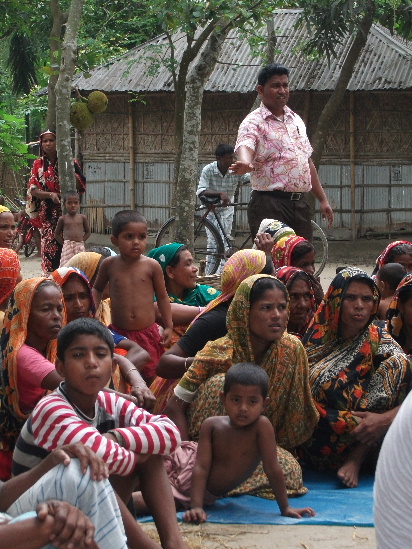
The selection procedure that’s used is called “participatory wealth ranking” (PWR). Just as its name suggests, PWR invites the residents of a community to collectively provide the initial information that will guide eventual selection. PWR involves three staff members: an organizer, a facilitator, and a recorder. And it unfolds in three steps: an initial visit, mapping, and wealth ranking.

The first member of the PWR team, the organizer, undertakes the initial visit. She goes to a village that the BRAC ultra poor team has identified as needing ultra poor services, and she does two things there. She walks around, meeting the community’s members, especially its leaders, and gaining a sense of the number and types of households the village contains. And she invites residents to a meeting to be held the next day. She doesn’t say much about the purpose of the meeting, but just asks them to come because BRAC needs to collect information about the community for a program it hopes to offer.

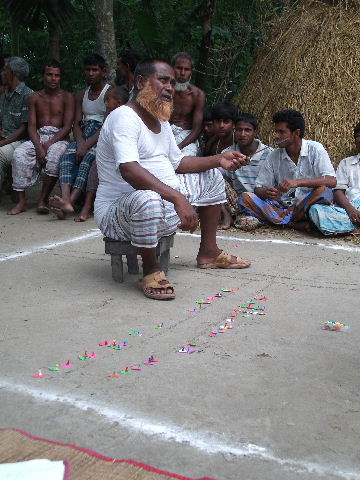
The next day, all three BRAC staff members come to the village. They will lead the village’s residents through a two-step process. The first step is to trace a map of the community on the ground. They ask for a volunteer from among the participants to help them with this, but work hard to make sure that as many participants as possible are contributing their opinions. This can involve a lot of discussion as to just where to put the roads, and it can take several attempts to get it right. One of the reasons for tracing the map on the ground, rather than directly onto paper, is to make erasure and correction as easy as possible.

After tracing the roads, the volunteer adds symbols to mark important landmarks – schools, Muslim mosques, Hindu temples, government offices – then places small numbered cards everywhere that there is a household.

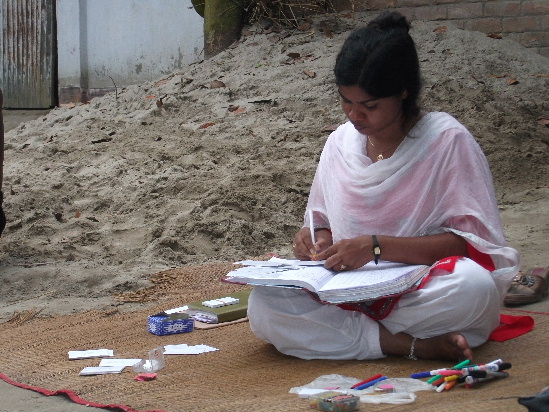
As each small card is placed, the PWR team is collecting information. They ask the name of the principal member of the household, his or her father’s name, and his or her occupation. This information is gathered by the second member of the PWR team, the facilitator, and written down by the recorder both in a notebook and on larger cards, with each household getting its own card. The notebook will be the official record of the day’s activity, but the cards will be the tools that permit the team to move the group to the next step in the process.

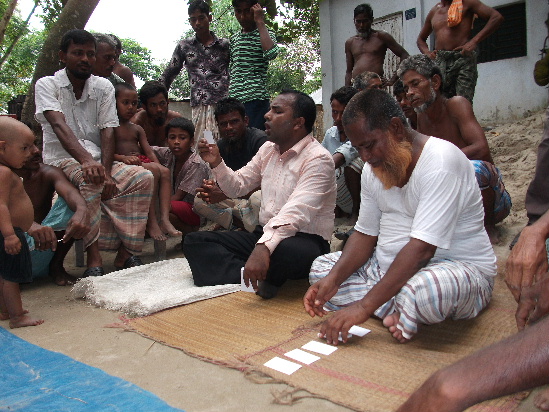
That next step is the actual ranking process, where the team learns the relative economic status of every household in the community. The facilitator will begin by choosing three of the cards and asking participants whether the three households are equally well off. If they are, the facilitator will have to choose another couple of cards and ask the same question. If they are not, the facilitator will ask a volunteer from the community to put them into separate piles. The group will then go through the whole stack of cards, one after another, deciding which pile to put each of them into. In the course of this work, they are likely to come across households that do not exactly fit into any of the piles. For example, they might come across a family much wealthier than any of the initial three. In such cases, they will simply add a new category, or pile. By the activity’s end, they might have five or six or even seven separate piles, each of which represents a distinct level of wealth.

If, at the end of the activity, the facilitator feels that there are too many cards in any one of the piles, he will go through that pile again, asking participants to split the households it contains into two groups. What is most important, at least for the program for the ultra poor, is that all the poorest households in the village end up in one of the bottom two piles, because it is those two piles that BRAC field staff will concentrate on for initial and final verification.

While almost everyone is ranking the households, the team asks another volunteer to copy the map that they have drawn onto paper, so it can form part of the meeting’s permanent record. The map will be filed in the office, and can help BRAC staff, especially supervisory staff, to find members’ households.

The information that’s gained through PWR is not 100% reliable. Program staff will have to follow up with two sets of home visits to gather and verify the detailed information necessary for selecting program participants well. But the PWR is a valuable step in the process nonetheless.

First, it is a valuable starting point. The team collects information that can guide their further work. They don’t have to start from zero. They don’t have to go to every house as they would if they had to start the process with home visits directly.

Second, it helps protect the program from the jealousies it inevitably engenders. A certain few households in the community are being selected to receive substantial support. Having defined people’s level of wealth at a public meeting can make it easier to explain why some people receive support and others don’t.

Finally, it usefully raises the presence of extreme poverty as an issue before the community’s eyes. BRAC will not be able to provide all the support and protection that the ultra poor will need to lift themselves out of poverty. The women who are finally chosen will need their neighbors’ encouragement and support as well. Eventually, BRAC will help the community organize a poverty reduction committee, whose mission will be to provide the extra support and advice that program participants need. In including everyone in the selection process is one way of reminding them that there are terribly poor people in their midst.

Black and White

May 27, 2010, Rangpur, Bangladesh

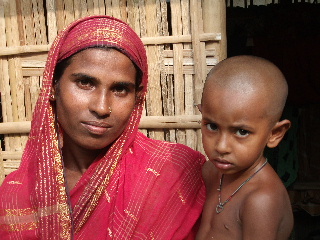
Nomichha used to work as a servant in her neighbors’ households. They wouldn’t really pay her, but they would give her some food, and between that and the few taka her husband could earn working other people’s land, they would do the best that they could for themselves and their child.

Then BRAC came into their lives.

BRAC is the world’s largest NGO, a comprehensive development agency that was formed in Bangladesh in the wake of independence in the early ‘70s. It now employs over 100,000 people in countries across south Asia and Africa in its broad array of anti-poverty programs. Fonkoze sent three Haitians and me to Bangladesh for a month to study one of those programs – it’s called “Targeting the Ultra Poor” (TUP) – because it is the model for CLM, Fonkoze’s approach to addressing extreme poverty. BRAC will be providing extensive technical assistance as Fonkoze scales-up its program to reach many more families. BRAC is especially known for its capacity to do things not only well, but on a large scale.

BRAC’s TUP team came to Nomichha’s village just over a month ago. They held an open meeting, inviting the local population to help them identify the ultra poor households among them. After verifying what they learned at that meeting, they sent a caseworker to each of the selected households to describe the program to the prospective participant. She would receive training in running an income-generating activity and then be given the assets she would need to get the business started. She would get a daily stipend to buy food for several months. That would enable her to give up working in other households so she could devote herself to her new business. She would also gain free access to essential healthcare services. Most importantly, she would receive weekly visits from her caseworker, who would provide extensive additional training for two years as she built up her new livelihood.

When she heard that BRAC was willing to give her two cows, she was a little afraid. At first she decided not to take them. She had heard rumors that BRAC would force her to convert to Christianity. But her neighbors and family spoke to her, and they convinced her that the rumors weren’t true. So she took the cows, and has been caring for them for a month.

BRAC offers the women served by TUP a wide range of assets to choose from: various sorts of livestock, small plots of land to farm, merchandise to create a small business. But Nomichha can’t really tell you why she chose cows. She’s still very shy. Her neighbors answer most questions for her.

She’ll have a lot to do to graduate in two years: build up her business and her confidence as well. But BRAC gives her a proven road to travel, and dedicated and experienced staff to lead her on her way.

The difference between Nomichha and Mazeda is dramatic. Mazeda is a graduate of the TUP program, having joined it in 2006. She tells a similar story of her life before TUP. She was a domestic servant, doing odd jobs for food in her wealthier neighbors’ homes. “I had a miserable life,” she says, “full of problems.”

BRAC gave her one cow and two goats, and she quickly got her dairy business up and running. She now has two cows and a calf, and is selling two cases of milk per day. She eventually sold the goats because she wanted to invest the money in a rice business instead. “I had learned how to process rice from a neighbor, but I never had the money I needed to start a business myself.” She buys raw rice from farmers and then processes it to be sold in the market. She built her own house with 12,000 takas (about $170) that she earned from her businesses, and leased farmland for 20,000 takas so she can grow some rice herself. She has 3000 takas in savings as well.

BRAC’s program is designed not just to provide extremely poor people with some income, but to fundamentally change their lives, and Mazeda is a great example. “I’m a different person in my village now. People respect me. They come to me for advice, even for small loans.”

We explained to Mazeda why we had come to Bangladesh, and asked her whether she had advice for the Haitian women we would be serving. She asked us to tell them three things, “You need to work hard, listen to the advice your caseworker gives you, and take good care of your assets. Mainly, though, it’s hard work.”

Meeting her, and other TUP graduates, is enormously helpful as we look to make our program in Haiti expand. We don’t have a lot of graduates in Haiti just yet. The pilot of our program served only 150 families. Seeing so many graduates, and hearing their stories, gives you a sense of the scale our program is capable of. It is possible to eliminate extreme poverty for more than a lucky few. One village after another, BRAC is eliminating it from Bangladesh entirely. Though we are not ready to bring the program to such a scale in Haiti, seeing it before one’s eyes gives good reason to hope.

About Poverty

More than 50% 0f Haitians live on less than $1 a day. And one of the most striking things about that fact is that most of the people who make up that roughly 50% are not what Haitians themselves would call “poor”.

It’s not that their lives are easy. Those lives are constantly at risk because of the fragility of the livelihoods that support them. In better times, many such Haitians might manage to eat a good meal once a day, maybe even twice. They might eat enough to stay reasonably healthy much of the time, and to ward off the worst hunger pangs. But it’s hard to have a back-up plan when you’re living on the edge. An illness, an accident, a little bad weather: It doesn’t take much to transform difficult lives into misery.

When I say they are not poor, then, I am, in a sense, playing a game with words. The Creole word “pòv” is generally reserved for those whose state is really wretched. There is another word, “malere” for those who are merely badly off. And most of those living on less that $1 a day are probably malere, not pòv. At least until the next disaster strikes. But the word game has a point. The hard reality is that there are also lots of Haitians, many too many, whose lives are worse than bad.

Fonkoze’s programs, especially its credit programs, are mainly for Haiti’s malere. The malere badly need access to the Fonkoze’s services to improve lives that badly need improvement. But from the moment they enter Fonkoze, they already have the wherewithal to make use of the help Fonkoze can provide. If they are entering directly into standard solidarity group credit, they already have a business that the money they borrow will add to. Even if they are entering into Fonkoze’s Tikredi, or “Little Credit” program, which was designed especially for families that aren’t ready for standard loans just yet, they start with an idea for a business and the determination to succeed.

But Fonkoze knew that it could not be satisfied with itself as long as its reach could extend only to Haiti’s malere. Those whose need for change is greatest are those whom its credit programs could never help. They are the poorest of the poor, the extreme poor, and their lives are difficult to understand or even to conceive.

They are landless, without crops to harvest or businesses to invest in or livestock to sell or consume. They have no income-generating assets at all. They eat what they can, when they can, but neither regularly nor well: a few abandoned mangoes might feed them on one day. They might get to glean a cup of corn in exchange for farm work in a neighbor’s garden on another. They go days at a time without ever having reason to light their fire. Their homes provide no shelter. With every rain that falls, they are sure to get wet. Their children are not in school, and may not be at home either. They may have been sent to live with other families in the hopes that they will at least be fed. What’s worse is that Haiti’s extreme poor live without hope, without imagining that they can change their lives. These households, mostly led by women, are locked in a cycle that starts bad and gets only worse.

Fonkoze’s leadership made a commitment years ago to find a way to serve these especially poor families, so they looked around the world at other institutions that have discovered approaches that work.

They founded what they were looking for in Bangladesh. An organization named BRAC had developed an approach that depends on teaching people to manage an income-generating activity and then giving them the assets they need to start their own. It’s a two-year process that depends on very close accompaniment. Program participants get visits once or twice a week from case managers who provide coaching and encouragement.

Fonkoze piloted the program in Haiti for 150 families with BRAC’s help. We call the program CLM, short for “Chemen Lavi Miyò,” or “the Pathway to a Better Life.” Results were excellent. 142 of the families were self-supporting within two years. The pilot demonstrated that, even in as difficult and dysfunctional an environment as Haiti, allowing families to suffer such misery is a choice. We can do something about it. They live that way because we are not sufficiently committed to change.

Fonkoze is now ready to dramatically expand the program. It has hired four new field managers to work beside the one already in place, and is preparing 20 new case managers. We will begin serving 1000 new families right away.

I will be one of those field managers. I left the Marigo branch on Saturday, and on Sunday flew to New York. Monday my three Haitian colleagues and I got visas from the Bangladeshi consulate, and are now on our way for a month’s training with BRAC in Bangladesh. I have seen CLM a number of times over the past couple of years, usually as a translator for Fonkoze’s visitors. I look forward to developing a team of case managers who can succeed at this most important work.

But the stakes are troublingly high. In Marigo, our team was working with women many of whom were just a hair’s breadth from misery. An error or an accident could have brought them to disaster at any time. The women in CLM, however, are already suffering the worst sort of misery. CLM is very simply a matter of life and death. I will owe it to them to keep their danger constantly in mind.