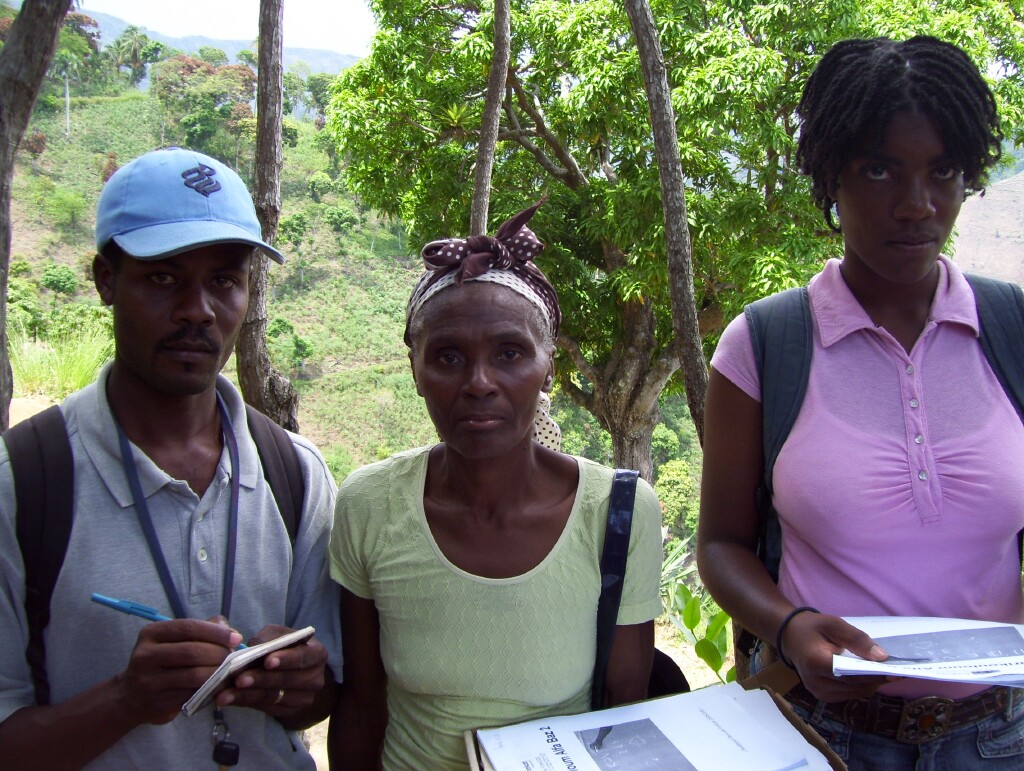
Author Archives: Steven Werlin

About Steven Werlin

I moved to Haiti in January 2005. I’ve been writing regular essays since then about the various projects that my colleagues and I work on and about our lives in Haiti.

Challenges, Challenges

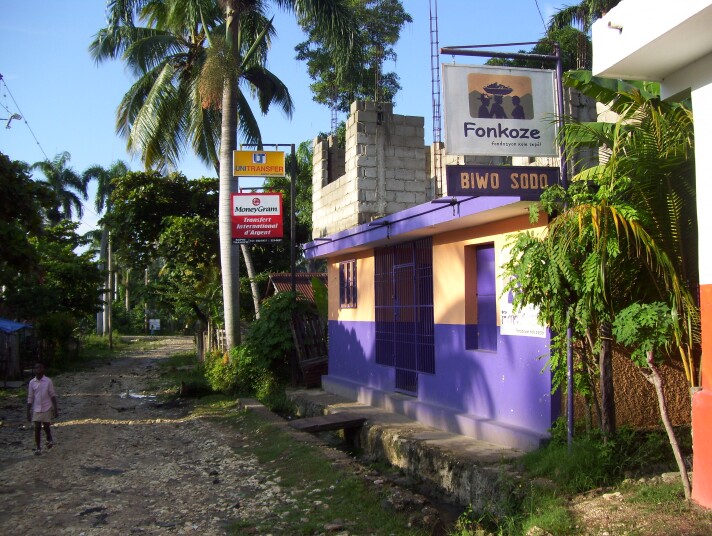
Helping poor women gain access to the financial services they need to change their own lives can be challenging work. A recent visit to the Fonkoze branch in Sodo highlighted some of the obstacles that have to be faced.

Here is the front of the Sodo branch:

The most important action at a branch, whether in Sodo or in any of Fonkoze’s 32 branches, doesn’t happen at the branch office, but in credit centers that can be quite a distance from the branch.

A credit center is a collection of 25, 30, or 40 women. Often even more. They might meet in a local church or in a school, but they might just meet under a large tree. The women are organized into groups of five who take their loans and make their repayments together. The centers meet twice-a-month, once for reimbursement or disbursement of credit, and once for discussions. They also host Fonkoze’s education programs. Fonkoze might offer two or even three different educational programs simultaneously in a credit center, depending of that center’s needs.

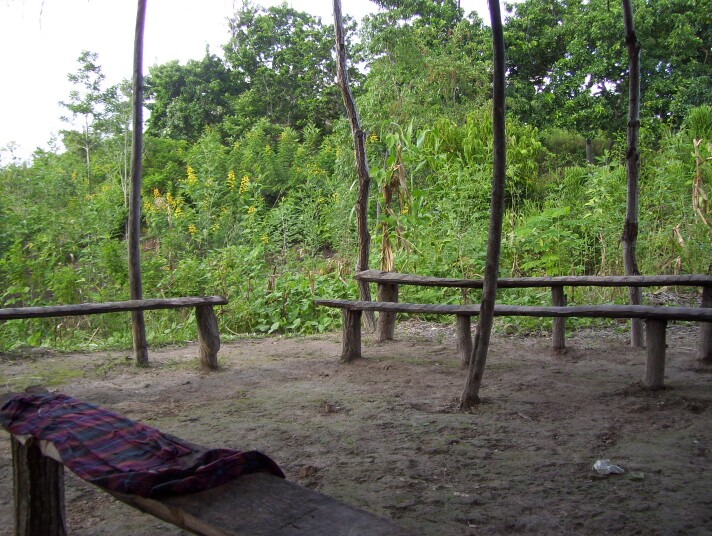
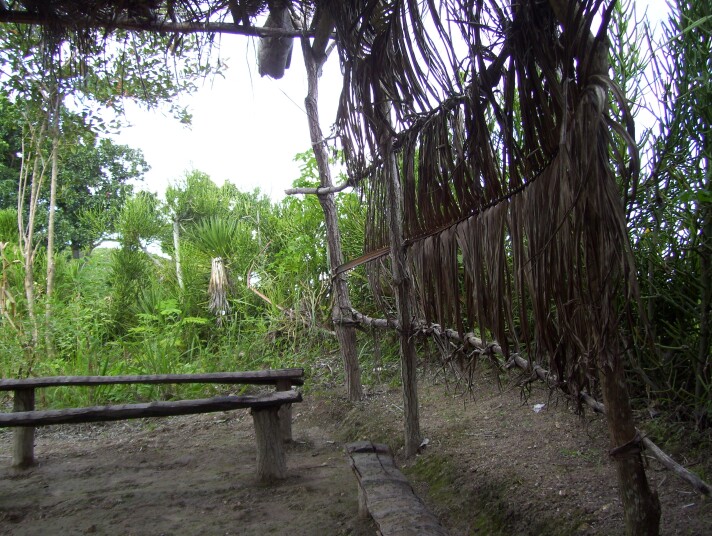
Here are some pictures of the spot on Savann Long where one of Sodo’s larger credit centers meets. The members built the structure for themselves in one member’s front yard.

Now Haiti is roughly the same size as Maryland, so with 32 branches – 36 by the end of the year – you might think that credit centers would never be that far from a branch. In a sense you’d be right. They aren’t far. But their proximity doesn’t help you if the roads are bad enough.

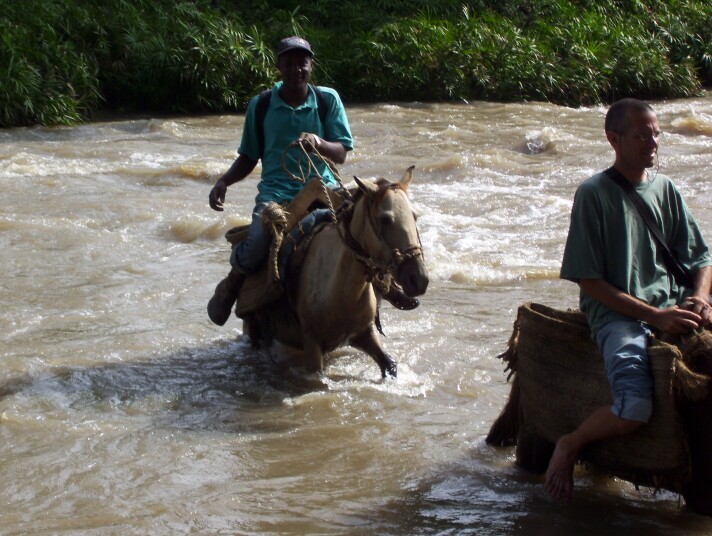
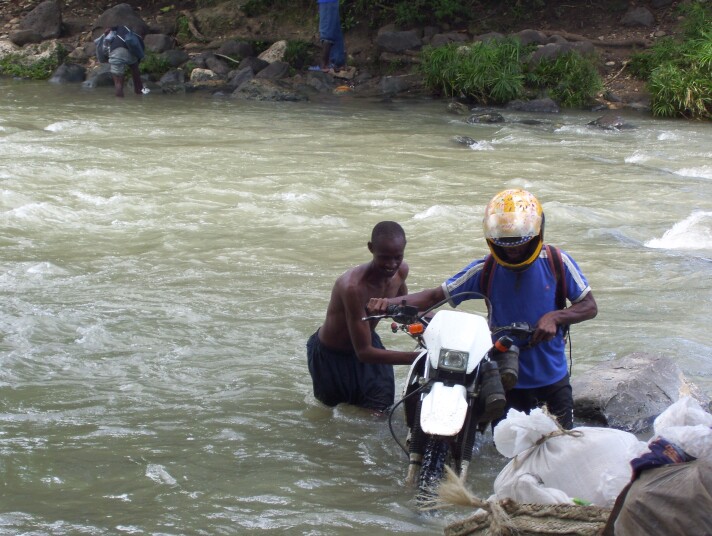
And in the Sodo area they are bad enough. On Tuesday, we had to go to the center in Savann Long on horseback, over four hours each way, and on Wednesday we went to another center in Zoranje, a long hard motorcycle trip from Sodo.

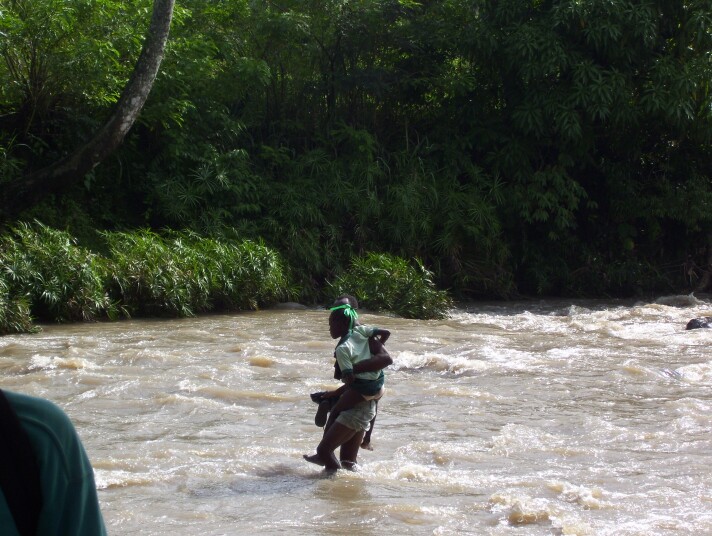
One challenge was crossing the river that separates Sodo from most of the communities it serves.

Crossing from Sodo was much easier than crossing back. On the way back, it was well past dark and raining hard. We had to gallop just to reach the river before it rose to high to cross.

The man carrying this schoolgirl is a professional river forder. He charges about three Haitian gourds (less than ten cents) per child. He gets them across without their dirtying their uniforms.

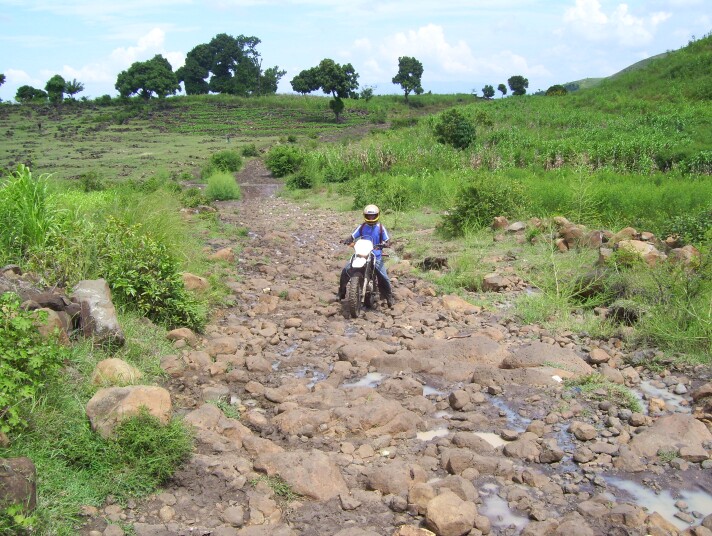
The river isn’t the only barrier. The roads just aren’t good.

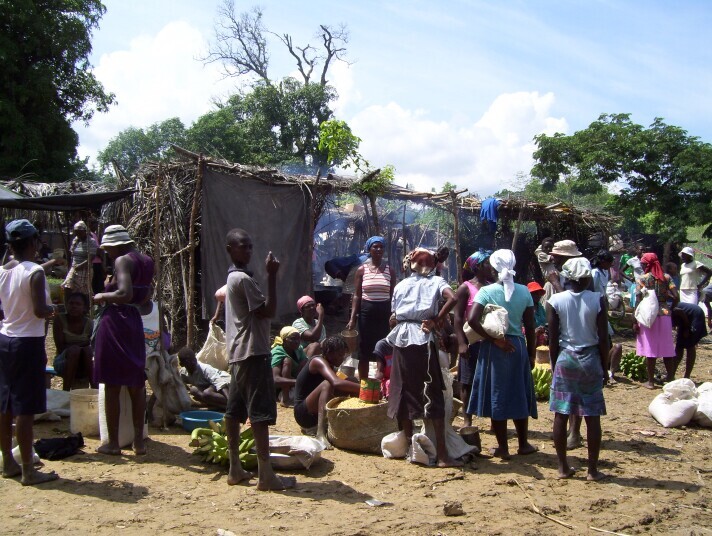
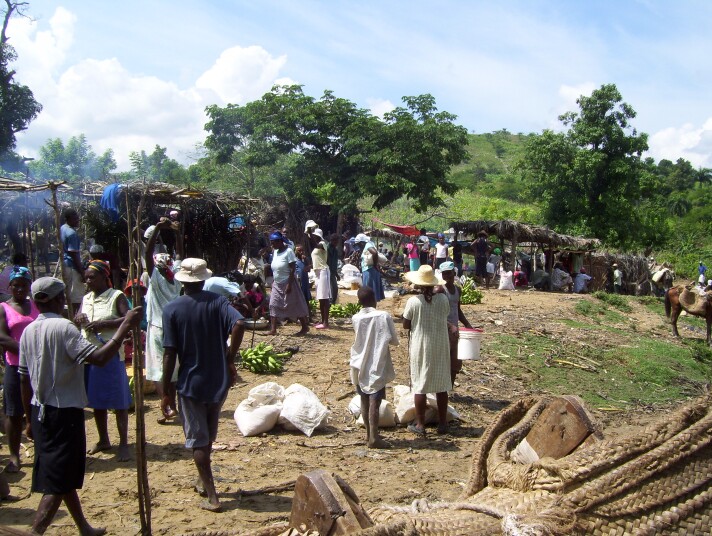
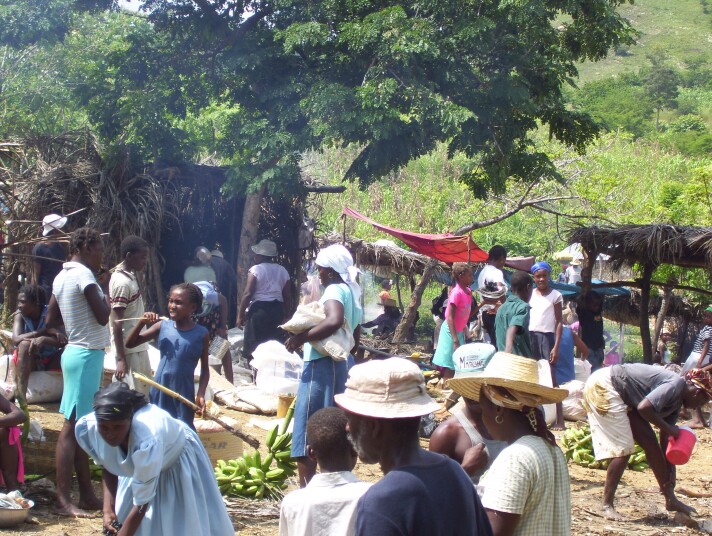
We passed a local market on the way.

Logistical aspects of Fonkoze’s work, like transportation, present only one small piece of the overall challenge. I hope to write more about other pieces soon. But for two hard days in Sodo, transportation seemed like enough of a challenge to me.

Beyond Microcredit

Fonkoze’s standard solidarity-group microcredit has been proven to be an effective tool to help poor women help themselves out of poverty. Groups of five women organize themselves to receive and reimburse their loans together. They act as guarantees for one another, eliminating the need for collateral and for someone to cosign.

Loans start at about $85 and can increase to more than $1400, and the success women have at managing increasing loan amount is only one small sign of the progress they make. Fonkoze has a battery of data that demonstrates clients’ progress out of poverty by showing how their standard of living improves: better houses, more children in school, and better nutrition are typical results.

But microcredit is not the answer for all of Haiti’s poor. Over 50% of Haitian households function on less that $1 a day, and some of these are so poor that they would not be able to absorb and make good use of a sum as large as $85. For some of these, Fonkoze has created a special program of mini-microcredit, with even smaller loans – they start at less than $30 – shorten repayment periods, and closer accompaniment from specially trained credit agents. It’s a six-month program that prepares a woman to enter standard microcredit by giving her some additional structure.

Even this program, however, can’t reach the poorest of the poor. It depends, after all, on a woman’s capacity to take $30 and invest it immediately into a business that will enable her to make repayments and generate profit. But if a woman has no business, has never had a business, then she can hardly invest money in one. If her children are consistently hungry, she cannot even be expected to invest money that comes her way. She needs to buy food.

Fonkoze is now experimenting with a program designed to help these poorest of the poor, It’s called “CLM” or Chemen Lavi Miyò, which is Creole for “the Road to a Better Life.” It features education, close supervision, some subsidies, and the transfer of income-generating assets. At the end of 18 months, participants have sustainable incomes, small bank accounts, and can move into regular microcredit without need of further subsidies. It’s based on a program that has been developed of the course of ten years of research and practical experience in the field by BRAC, one of Bangladesh’s large NGOs. Fonkoze is piloting the program with 150 participants in Haiti, spread out through three locations: Lagonav, Boukan Kare, and Twoudinò.

I spent the day yesterday on horseback, slogging through the deep, black mud of Boukan Kare, meeting program participants. It was stunning.

Anyone who’s spent even a little time in Haiti has seen poverty of a sort that we in the United States are unaccustomed to. But CLM participants endure poverty that is even harsher that what one generally sees in Haiti. They have no income-generating assets of any kind. They own no animals. They own no farming land. If they own a home, it’s one room, with a mud floor, walls of woven sticks packed with mud, and a straw roof. They might go a day, even two days, without eating. They tend to have large families, but none of their children can go to school. What little they have comes from begging. They are, of course, sick all the time.

Adeline can serve as an example. Her mother was chosen through an exhaustive, three-step selection process to be a program beneficiary. First, Fonkoze organized a meeting in her neighborhood at which community members identified the poorest households in their area. Then, Fonkoze field workers visited the homes of the families the community had identified as its poorest to complete detailed surveys of each household and create a preliminary list of recommended participants. Finally, Fonkoze’s CLM Program Manager visited each recommended household to confirm that it qualified for the program.

Adeline’s mother was selected. She had Adeline and six other children to support with a husband who wasn’t helping her. She had no income except what she could beg. She would go, as Adeline told me, for a week at a time without lighting a cooking fire.

And then she died. Adeline was the oldest surviving child. A couple of older siblings had died. Her father was ready to send her away to live in domestic servitude in Mirebalais, the nearest city. Instead, Fonkoze offered her the chance to participate in the program in her mother’s place. She would have to become the de facto head of her household at the age of only 14, but she would get to stay with her little brothers and sisters and have the means to help them to a better life.

So she received extensive training in the care of goats and chickens. Those are the two businesses she chose to enter. Then she received seven chickens and three goats. Her weekly visits from her Fonkoze Case Manager include coaching directly focused on her businesses, but also lessons in nutrition, hygiene, and health. They also include literacy training – Adeline’s never been to school – and lots and lots of encouragement. Fonkoze is helping her repair the dilapidated shack her family lives in, and is partnering with Paul Farmer’s Partners in Health to guarantee them free access to essential health care. Finally, she receives a stipend of just under $1 a day to free her from begging to support her siblings so that she has the time she needs to take care of her animals and go to school. She’s starting first grade this fall.

Adeline is excited to be part of the program. Her goats are doing well: There are four of them now, and one of them is pregnant. She’s been managing to save almost $1.50 per week of the stipend she receives. That will be important down the line as she prepares to enter microcredit. And she and her siblings now eat every day.

She still has problems. One is her father. He’s been unwilling to help her at all, even by just building a simple coop to protect her chickens. Several have died. And it must be awkward for both of them as he watches her assume responsibility for her own and his other children’s lives. And make no mistake: She is still very, very poor.

But already her life is very much better than it was. That’s what she says. The question for Fonkoze is whether that improvement will sustain itself beyond the program’s 18 months. Is CLM a short-term relief from hunger, or truly the road to a better life? If the experience in Bangladesh is any indicator, it will be very much the latter. BRAC has been able to help a high percentage of participating families there remove themselves from extreme poverty. But Haiti is Haiti. It should work here as well, but only time and experience will tell.

Liberal Education by Other Means

I was educated in a tradition that sometimes calls itself “liberal”. The word, in this instance, does not refer to the fact that my parents and grandparents were Kennedy and FDR democrats. It refers to my formal education, which was in the liberal arts. I studied some philosophy and some literature, but also some math, some political theory, some experimental science, and even some music. I insist tiresomely on prefacing each piece of my education with “some” to point to the fact that the education was not designed to make me a specialist in any particular area.

In fact, it was designed to make me free. That’s why it’s sometimes referred to as a “liberal” education: because it was designed to liberate me. The motto of St. John’s College, my //alma mater//, is “I make free men from boys by means of books and a balance.” The motto comes from a time before the school admitted women, and sounds better in Latin than in English.

When I ask myself what it was designed to liberate me from, I’m left saying something like “from the shackles of ignorance.” It’s an answer that sounds dated, perhaps, but I think it holds up pretty well to closer examination.

Most of the people I work with in Haiti seem to have more urgent problems than those shackles. Not only that, but the leisure that the sort of education I received – and am very grateful for – requires is almost entirely unknown. The sort of work we undertake here together is very far removed from the seminars I attended all those years ago. But I want to say nonetheless that it’s often liberal in the very same sense that my own education was: It makes those of us engaged in it free.

Here some examples might help.

It’s back-to-school season in Haiti, as it is in the States. The most important difference is, perhaps, that many Haitian children are sitting at home waiting for their families to organize the tuition money they’ll need to send their kids to school, or the money to buy uniforms, or for some other necessity. Some children are already in school, but others will wait until October, November, or even January to get started. About 50% won’t go at all.

Ti Kèl and Mackenson started last week at the public school in Mariaman, so we got back to work on Sunday. The two of them are my neighbors, now 16. We spend Sunday mornings whenever I’m available doing math together on the blackboard on my front patio. They’re good students, but only in sixth grade. For various reasons, they both started late. We’re a little worried, because there’s a rumor going around that public high schools will no longer accept students over 15 into the seventh grade. They’re pretty confident that they’ll be able to pass the national primary school graduation exam next June, but if they can’t get into the public high school in Pétion-Ville, it may be the end of their education. Neither is in any position to pay for seven years of secondary education at a private school.

We began reviewing some of the stuff we worked on in May and June. Arithmetic with fractions, for example. We worked on all four operations. I thought it would be a good place to start because they were starting to get good with fractions last spring when we stopped. Ti Kèl aced them on his final. I saw his corrected exam. It helped him shock his entire school by coming in fourth in his class, much higher than he ever had. Mackenson, who is generally first in their class, did almost as well. He did better than Ti Kèl on other parts of the final, and so came in first once again.

But I added a twist, and it exposed the fragility of what they knew. I gave them some problems with mixed fractions, and Mackenson in particular was put off. It turned out that he, quite literally, did not know what he was doing. He remembered, for example, that to multiply fractions he need only multiply numerators and then multiply denominators, and that to divide them he need only flip the second of two fractions upside-down and then multiply, but he wasn’t clear enough about what a fraction is to be able to convert mixed fractions into simple ones – like 3 2/7 into 23/7 – much less to add, subtract, multiply, or divide them.

He was frozen, imprisoned, by a certain lack of understanding. He was able to manage well enough when he was on familiar ground, but he lacked the flexibility, the freedom, that real understanding could give him to attack problems that are partly new.

So we spent some time just talking about what fractions are, and he seem to make progress. I’ll know more about how real that progress was in the coming weeks.

I spent part of last week in Pointe des Lataniers. It’s a small fishing village on the very western corner of Lagonav, the large island across a small bay from Port au Prince. I have friends from Lataniers, and we had decided together to organize an experimental literacy center in the town.

As in most parts of Haiti, where official literacy rates are usually given at around 50%, illiteracy is a problem in Lataniers. But, also like other parts of Haiti, Lataniers has various other problems as well: access to safe drinking water, loss of fertile land to erosion and salinization, lack of schools, and more. Our goal was to help organize a literacy center that would also become an engine for community action.

The approach the center would use would be built around REFLECT, a method I’ve written about before. REFLECT is designed to help participants organize knowledge they already possess in a manner that helps them face it, and so make use of it. (See: Learning to REFLECT)

That’s exactly what I saw on Thursday. Participants spent most of class tracing a calendar on the ground as they stood in a circle. The calendar was a listing of each of the ways they make money. For each of their income-generating activities, they went month-by-month, noting when the activity in question would bring in more money, and when it would bring in less.

They made several discoveries, but one that was especially striking. They all agreed that goats bring in much more money in December than in any other month. A very well educated Haitian was with me, and he explained that the demand is higher in December because of the New Year holiday, when lots of people like to eat goat.

But the participants countered that he was missing the real point. Goats are more expensive in December because there are none to be bought. People don’t sell them. And then they explained: They sell goats when they need money. In December, they don’t need money because that’s when they sell their peanut crop. So they don’t sell goats.

As soon as they explained this, they were ready to say that it was silly. They might not need the money right at that moment, but they would be able to make much more money by selling their goats in December anyway. They said they’d do so starting this year.

It’s important to note that every one of them already knew perfectly well before the meeting that they would get more for their goats if they sold them in December. But they had never faced that knowledge in a way that enabled them to make use of it. Talking about the fact with one another, in a conversation about the problems they have earning the money they need to get by, put their own knowledge in front of them. It liberated them from the ways they habitually look at things, and so made them freer than they had been.

Bainet to Lavale

One of Fonkoze’s most successful branches is the one in Lavale, a rural town outside of the city of Jakmèl. To say that the branch is “in Lavale” is true, but it doesn’t tell the real story. The branch serves credit customers throughout a large region in southern Haiti. Credit agents on motorcycles ride over two hours to get to centers as far away as Bainet and Côte de Fer.

These photos are from a recent visit to a credit center in the hills outside of Bainet, in a very small community called Montoban.

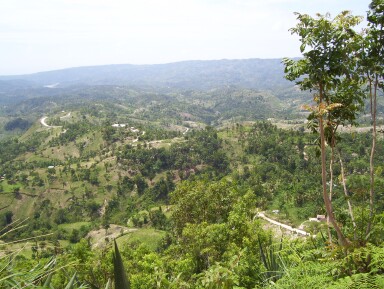
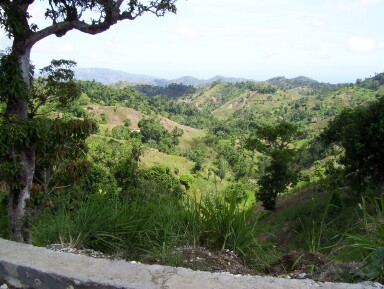
The trip to Montoban, through the mountains around Lavale and Bainet, was beautiful.

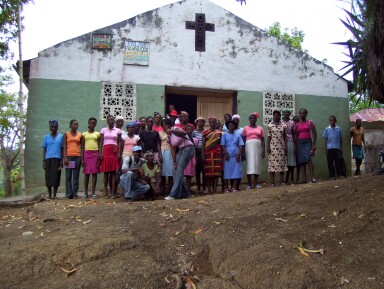
Here is the center. It meets inside a church/schoolhouse. There are roughly 85 members, each of them a businesswoman who supports her family with the enterprise her Fonkoze loans enable her to build.

Like all Fonkoze credit centers, the one in Montoban is led by a center chief, a woman elected by her fellow members to help Fonkoze’s staff coordinate center activities. My visit was not part of a scheduled meeting, and the message that we were coming was never delivered. But she heard our motorcycles and rushed down to meet us. Within five minutes, she had procured a megaphone, and was calling her women to meet. Within 15 minutes 25 women were there. By the time we left a 45 minutes later, there were over 40 women present and others were still arriving.

Here’s the Montoban center chief, flanked by the Fonkoze staff members who serve her center: her credit agent and her education coordinator. She was pretty remarkable.

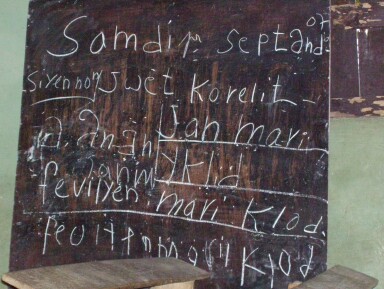
I spoke with the women about the educational programs they’re receiving right now from Fonkoze. Here’s a photo of their most recent literacy lesson up on the blackboard.

I did some interviews with participants. I spoke to Madlèn, for example.

madlèn

Here’s my write-up of what she had to say:

My name is Madlèn. I’m from Montoban, a rural area outside of Bainet. Bainet is a city on Haiti’s southern coast.

I am a businesswoman. That’s not to say that I have a shop or a store that sits in one place. My business moves. I go to Bainet to buy beans, rice, sugar, cooking oil, and the other things I sell from wholesalers. Then I bring my merchandise to the different rural markets in the area where I live.

I’ve always needed credit to make my business work, but it used to be that I borrowed from local moneylenders. They would charge 20%, 50%, or even more every month. But a couple of years ago a friend told me about Fonkoze. I joined right away, almost two years ago, and am now on my third loan. It’s for 5000 gourds [$143 U.S.]. I’m really seeing a difference in my profits since I joined Fonkoze.

When the woman we elected as chief of our credit center said there would be literacy classes, I was very excited. I never learned to read and write. I really hated having to just make a cross and leave a thumbprint when they ask me to sign my name.

So I joined the literacy class. We finished one session and are now in the middle of a second. I was so pleased when I took my last loan and signed my own name on the contract.

My children are happy to see me go to school. They’re proud that their mother is learning, and they want to help. But I like doing my homework myself. Learning to read and write is something I’m doing for myself.

I hope that I can continue learning in our credit center. I think it will help me make my business grow. Thank you Fonkoze.

Here’s her signature:
Madlènsigns_2

It is not easy for Fonkoze staff to get everywhere they serve, and Montoban was a rough ride. Here’s a short video that can give you some idea. The ride was about two hours, over mountains, across rivers, and through other difficult terrain. I’m on the back motorcycle with the credit agent. He’s shouting advice to the literacy coordinator, Manise, who’s on the front motorcycle. She’s just now learning to ride.

A Trivial But Curious Matter

Haitian dogs understand standard Creole. To convince one to leave a house it has entered, or generally to get lost, one need only say “sòti chen!” Creole for “Dog, leave!” My Lilly only appears to be an exception. She ignores what I say to her, but immediately obeys anyone else in the neighborhood. If I really want her to get lost, all I have to do is ask Valouloun, Madan Anténor’s 14-year-old girl, to speak to her.

Cats here are, as they are in the States, a little different. People don’t much bother to tell them to go away, but when they want to call them, they say “Mimi, Mimi.” In a sense, that is their name. They all are called “Mimi”. It’s also a Creole word for “cat.” Haitians sometimes use the word Creole borrowed from French, “chat,” but they just as often use “mimi” instead.

The word’s source is obvious enough. It’s just an imitation of the sound a cat makes.

Things get interesting after dogs and cats. To tell a chicken to get lost, a Haitian says “shee!” Apparently, the word means “go away” in the language of Haitian chickens. It works for other species of domestic fowl as well: ducks, turkeys, and guinea fowl.

But if I’m not talking to a bird, I can’t say “shee”. Goats, for example, respond to “sa!” Donkeys respond to “weed!” Cattle respond to “wach”. It is as though each type of animal has its own language, and Haitians speak them all.

It’s a little curious.

I can’t figure out why, say, goats and donkeys are addressed in different ways. In the case of cats, things are clear. Haitians make a sound like a cat makes. And often enough they do the same thing when calling other animals, such as when they call chickens to feed, as opposed to when they’re driving the away.

But goats do not say “sa.”

One could try to argue that that is how Haitians hear them. It might not seem plausible to someone who’s heard a goat, but, after all, we English speakers somehow think that roosters say “cock-a-doodle-doo”. Nothing could really be farther from the case. So it shouldn’t surprise us too much if Haitians hear goat noises differently from the way we hear them.

But the argument starts to crumble when one hears young Haitians yelling “mehmeh,” when they see UN peacekeepers. Haitians say that the peacekeepers steal and eat their goats, and accuse them by making goat sounds when they pass by. If nothing else, that shows that Haitians think of goats as saying “meh.”

And the same argument can’t even get started in the case of donkeys. The odd noise they make sounds nothing like “weed.”

So I’ve been wondering where these various animal words come from. Why can’t I say “sa” to a Haitian chicken or a dog? Why can’t I say “sa” to a cow?

Surely I could. And the animal I was addressing would just as surely get the message well enough if I used the right tone of voice. No one has ever suggested that the reason Lilly fails to obey me and me alone is that my Creole pronunciation is poor.

Haitians, however, don’t mix these words. Or they don’t very much. And I just can’t figure it out.

I can tend to think of my ignorance about “sa” as contrasting sharply with my good understanding of “sòti”. I might know nothing about “sa”, but I know that “sòti” comes from the French verb “sortir*”, and can trace this latter word even farther to its Latin roots. There are people who can trace the word back farther still.

But I shouldn’t kid myself. I know nothing at all about how a sound like “sòti” came to mean “leave”. Tracing the word backwards through history might push the question into the remote past, but it doesn’t suggest an answer.

Such an unanswered question is surely less important than others, like how to fund Fonkoze’s education programs or how a poor Haitian family will pull together its next meal.

It’s trivial, but that doesn’t make it any less of a question. Enough of a question, at least, for a quiet Saturday morn

Lekòl Nòmal Matènwa

Actually, there is no “Lekòl Nòmal Matènwa”. At least, not yet. A “lekòl nòmal” is a school of education, and Matènwa doesn’t have one. What it has is a successful community school, the Matènwa Community Learning Center (www.matenwa.org), which I’ve written about quite a number of times.

That school is at the center of a seven-school network of rural primary schools that have banded together to change education on their island, Lagonav. They have chosen to stand behind certain principles: active, student-centered learning, without beatings and without humiliations; education that’s appropriate to the rural region the schools and, more importantly, their students are in; and education in Creole, the language that’s native to all residents of Lagonav and the only language that students and, indeed, most teachers, speak and understand well. It’s a small start, in a way, but the network is only in its second year. Several other schools are interested in joining.

One of the most important things that the network can do for its member schools is organize faculty development seminars. Though the schools’ principals consistently name raising financial resources as their first need – Who can blame them? They are private schools located in communities of families that cannot really afford to pay – they just as consistently list teacher training as their second. The network’s ambitious goals for the kind of education it aspires to offer must remain nothing but goals unless teachers understand them well and have the skills they need to bring them about. So this past week, the Matènwa school has been hosting a summer workshop for about 25 teachers from member schools – and from some schools that are not members.

The workshop’s subject is the psychology of learning. How we chose the subject is itself a story. About two years ago, I spent a week with the Matènwa teachers studying psychology (See: HardQuestions). Even at the time, we had heard that the same Haitian university that had produced the textbook on psychology generally was producing a second on the educational psychology in particular. We knew right away that we’d want to study it. So we began asking the publisher for the book. For a while I was going to their bookstore every few weeks, expecting that it would finally be there. But over a year later, it was still pending.

Then we heard this spring that it was finally available. The university in question had opened a satellite campus in Lagonav’s one large town, and one of our colleagues had signed up for classes. There he discovered that the book was in use. He suggested that we arrange a workshop on the book because he felt that, even for him, the participatory methods we use would help him get more out of it than the lectures the university offers him. For most of the teachers we work with, who cannot go to college, a workshop would be the only chance they’d have.

When I began planning the workshop with the Matènwa teachers, we decided that a two-part approach would be best: I would spend one week meeting with them, going through the book as carefully as we could in such a short time. We’d then spend a second week with the larger group of teachers. During that second week, the Matènwa teachers would divide themselves into teams of two and three. Each team would be responsible for leading the workshop for a group of six to ten other teachers. For the Matènwa teachers, this would mean that they would not only get a second chance to study the book but also that they would gain experience as workshop leaders.

The first week we spent together was hard. We had seven chapters to get through, and five days to do it in. And we had to spend time the first day establishing a work plan, and reserve time on the last day for establishing a second work plan for the second week.

Fortunately, most of the teachers had read through the whole book by the beginning of the week, so we worked through the first chapter on Monday, and then two chapters a day for the next three days. Friday we finished Chapter Seven and had our planning meeting.

The biggest challenge we felt ourselves facing looking towards the second week was that the other teachers would not have the chance to read the book in advance. They would get the book on Monday, and would have to read its chapters during the workshop week itself. Since some of them would have long walks to join us every day, and plenty of chores to do on returning each afternoon to their rural homes, we knew that reading time would be limited. We therefore decided to build quiet reading time right into the daily schedule. We’d serve a very light breakfast at 8:00, but then wouldn’t start talking until just after 9:00. We announced that the interim was time for reading or reading the day’s assignment.

From 9:00 until noon we studied chapters in groups of eight to ten, each led by a couple of Matènwa teachers. The groups would spend the first couple of hours discussing any chapter subjects that participants had questions about. Together they would try to get the clarity they sought. After that, even these small groups would divide into small ones, with three or four members at most. These smaller groups would answer the questions that the textbook’s author put at the end of each chapter.

We had lunch at noon, and got back to work at 1:00. We spend about 15 minutes addressing whatever questions lingered after the morning’s work.

After that, we tried something we had never tried before. To explain, I need to go back and touch upon something that initially puzzled us: We wanted to cover seven chapters, but we knew that we couldn’t ask participants to read more than one chapter each day. Since we wanted to reserve Friday for a different activity, we had four days, or time for four chapters at most. The Matènwa teachers chose Chapters One-Three, which are general treatments of the subject, and chapter seven, an introduction to Piaget. That left Chapters Four and Five, each on a different aspect of behaviorism, and Chapter Six, on //Gestalt// theory.

We decided that on Monday, Tuesday, and Wednesday afternoon, we would have a short lecture and discussion. One of the Matènwa teachers would present a fifteen-twenty minute talk, and then open the floor for questions.

This was very new ground for them all. In the first place, the habits they have been cultivating at Matènwa have been running precisely contrary to the traditional lecture format. Everything we’ve been working on has been discussion-based. And the Matènwa teachers aren’t much inclined to the lecture mode, especially in front of colleagues. They don’t usually view themselves as experts. So while they speak well and comfortably about their experiences at the school, presenting a more academic topic would be entirely new.

But these presentations went well. The teachers didn’t over-reach. They were brief enough that they were able to stay clearly focused, but long enough that their listeners were able to start ask meaningful questions.

Thursday afternoon was a general review of the four days’ work. We drew a tree on a blackboard and filled the tree with fruit. Each piece of fruits had a topic we had covered written on it. If everyone felt they understood the topic, the fruit was ripe and we harvested it with an eraser. If anyone had questions, we left the fruit on the tree until the questions were addressed.

Friday is an Open Space meeting. We used that very flexible format to invite teachers to talk about how they will be able to apply the week’s learning in the classes that they teach. The teachers themselves proposed a list of topics that they fitted into a previously blank agenda for the morning that we had drawn on a board. There would be two sessions, and six-eight topics were proposed for each. Once the agenda was filled, the teachers scattered, going to participate in whatever discussion of whatever topic interested them most.

At the end of Friday’s meeting, Abner Sauveur, Principal of the Matènwa school, summed things up beautifully. “When you told us that we ourselves would lead a workshop on psychology for the other teachers,” he said, “I was pretty skeptical. It was wonderful to discover what we were able to do.”

So there is, as yet, no School of Education in Matènwa. But there’s lots of teacher education going on there nonetheless.

Sixteen Dollars

A source of minor confusion for someone who’s in Haiti for the first time is the dollar. Prices are usually given in dollars, Haitian dollars. This is confusing because no such currency exists.

Haiti’s currency is the gourd. Right now, a buck buys about 35 of them. When I started coming to Haiti in the 90s, they were worth twice as much. A couple of years ago, they were worth 20% less. The value they have recently gained against the dollar both reflects and argues for cautious optimism, I suppose.

When Haitians speak of dollars, what they usually mean is five gourds. American dollars are called “dola US” or “dola vèt”. The latter expression means “green dollars.” Talk of Haitian dollars has its roots, I’m told, in a time under the Duvalier dictatorships when the exchange rate was held at five gourds.

So when Haril told me on Tuesday night that he had made sixteen dollars the Sunday before last, I knew he meant 80 gourds, or about $2.30. He had washed four motorcycles using the rainwater he collects in a basin next to my apartment in Belekou. He takes the water in a battered five-gallon bucket, and then splashes it onto a motorcycle every which way, scrubbing as he does. He used to get more business, but pressurized-water car and motorcycle washes are close by, on the main road, and they are, if not necessarily better, certainly faster.

It’s been a hard summer for Haril. I wrote of his dental problem. I also wrote of the fact that he got caught between his parents as their relationship deteriorated. His mother left their household some weeks ago. His father finally moved out of the neighborhood with Haril’s four younger siblings. Haril was left behind. He moved in with a couple of other young, parent-less men who share a room that opens onto one of the narrow corridors behind where I live. It’s a small, dark, hot, and airless space, but for now it’s home.

So Haril’s now fending for himself. He has a small business selling prepaid telephone cards. Someone helped him buy a first set of 25, and now every time he turns them over he earns 20 Haitians dollars, or about $2.85. He gives that money to an older neighbor whom he trusts to hold it for him. She keeps him from spending it. This is important because he’s counting on that money to buy the things he’ll need for school in the fall. He also assumes that he could need to help one or more of his siblings with school expenses, too. He’s especially concerned about the youngest two, a girl named Lovely and a little boy they call Pipi, because they’re really much too young to help themselves.

But if he’s to keep from eating his phone card money, he needs another way to live. So he tries hard to find motorcycles to wash, especially on the weekends. The Belekou intersection where we live is a major motorcycle taxi station, and the drivers seem to like him, so he can usually get a job or two. When he told me that he had made sixteen dollars by washing four motorcycles, I was pleased for him, but not surprised. What surprised me was hearing him explain how he had been able to make it through the week, Monday through Friday, on that money, $2.30.

He explained. Every morning he bought coffee and a little bit of bread for breakfast. It cost one Haitian dollar a day, less than fifteen cents. At lunch, he would go to lower Belekou, where there is a community restaurant, something like a soup kitchen, run by a Roman Catholic priest. There he can get a plate of beans and rice for another dollar. In the evening he buys a roll spread with peanut butter from a street vendor for the same price. It’s not much, but it’s three small meals each day for only fifteen gourds, or 43 cents.

And he does a little better than that because the older boys he now lives with are really kind. They like Haril, and they understand his situation. Guynold is in his mid-twenties, and he’s unemployed right now, but he had a job for a while in a factory. There, he earned 70 gourds a day, working six days a week. He’s now living mainly off savings, but if Haril’s at the corner when Guynold comes out in the morning, he’s more than likely to buy Haril breakfast: ten gourds of beans and rice or fifteen of spaghetti. They then share five gourds worth of juice. Daniel isn’t much older than Haril, but he’s been supporting himself by fixing flat tires for some time. He shares what he has with Haril as well. I’m not sure what Jonas lives on, but I’ve seen him share it, too.

So Haril is scraping by, thanks in part to friends who have taken the place of family, and he can probably continue to do so for the next weeks. As long as nothing goes wrong. Any unexpected expense will use up the money he’s saving for school, and even that won’t go very far.

When school starts in September, things will be quite different. Whether he can go to school, do his homework, and earn the money he needs to support himself and help his siblings is hard to guess. I want to say “no”, but it’s the same “no” I would have offered to someone asking me whether he could live on fifteen gourds a day.

Development and Dentistry

Like a lot of people, I think I’m reasonably smart about some things and a little stupid about others.

One of the things I’ve consistently proven stupid about is dentists. Though I have very fond memories of the man who was our family dentist when I was child, I can’t think of going to a dentist without feeling myself starting to panic. That wouldn’t be so bad. We don’t control our emotional responses to things.

But it becomes stupidity when one allows the panic to be the decision maker. In spring 2004, I spent what seemed like weeks without sleeping with a toothache, rather than risk sitting in a dentist’s chair, until I finally had to go and have it yanked. While sitting in the chair, through what turned out to be an entirely painless procedure, I got so frightened that I stopped breathing. The dentist had to remind me to inhale. I remember his words: “Now Steve, I’m going have to ask you to take a breath or two.”

I hadn’t gone to a dentist for any kind of routine examination in longer than I remember – it had been over ten years at least – until Tuesday. I was visiting my parents, and we used the visit to arrange a check-up. It turned out to be a two-day affair. I had cavities to be filled. The dentist also spoke of possible future root canals and of wisdom teeth that she may eventually want to remove. But, all in all, the damage from those years of negligence was pretty minimal. I certainly deserved much worse.

One of the people that I had to be thinking about as I sat in her chair was Haril. He’s an eighteen-year-old friend of mine from Cité Soleil, a member of the group I work with there. A few weeks ago, I had begun to be concerned as I noticed his normally cheerful, lively disposition turn sleepy and sullen. I know that things have been very stressful for him at home – he’s caught in the crossfire between parents that are unable to get along – and I know that life in Cité Soleil starts out hard enough without extra problems. I had seen Haril change like this once before, and it turned out that he had an urgent problem, so I decided to ask him what was up.

It turned out that he had a toothache. It was his first. He didn’t know anything about going to a dentist, and didn’t think he had the money to do so. He was spending pocket change buying aspirin from street vendors, but it wasn’t getting him through the night. He wasn’t getting any sleep.

It also turned out that the problem was easy enough to resolve: I gave some money to a motorcycle driver who works at the station in from of my apartment. He’s a big, fatherly fellow they call “Pastè”. He knew of a dentist he trusted, and was willing to sacrifice his morning. He would take Haril, wait with him, pay the dentist, and bring him home. Though there might be a long line, the time in the chair would certainly be short. Haril would get a shot of Novocain, and then the tooth would come out.

I went back to Cité Soleil that same afternoon, and Haril was sore. Within a day or so, however, the problem was gone. The procedure cost fifty Haitian dollars. That’s 250 gourds or about $7.15. By Haitian standards, it was quite expensive. In the countryside, the usual price is more like thirty to fifty gourds, a hundred gourds at most.

My two days with my parents’ dentist, however, cost more than $7.15, more than a hundred times that. Even in 2004, when I simply had a tooth pulled, it cost more than $300. It always elicits shudders in Haiti when I reveal that price.

Haril’s use of dentistry seems pretty typical for Haiti. He had never been to a dentist in his eighteen years because he had never had a problem. I should admit that my own use was no different from his until this past week. Though I had been to the dentist often enough in my youth, I don’t know that I had been to one for a routine check up in Haril’s lifetime. I can’t remember. The problem that sends a Haitian to a dentist – whether to a formally trained one or to an informal practitioner – is a severe toothache. The solution to a toothache is to have the offending tooth pulled. Cosmetic dentistry and routine preventative maintenance visits to a dentist are rare in Haiti, almost unheard of, though Haitians devotedly brush their teeth with cheap Chinese toothbrushes and toothpastes every day.

All this may be changing in Haiti, especially in the capital and in other areas where the presence of development organizations and of Haitians who’ve spent time abroad can contribute to rising expectations. But very many Haitians have never been to a dentist at all, and it’s not so surprising that Haril, facing dental pain for the first time, was a little at a loss as to what to do. He didn’t know where to go, or how much it would cost, or where he would get the money he would need.

Things are so different back home. They are, at least, if I define “home” as the socio-economic environment within the US that I grew up in. One visits the dentist twice a year, one gets braces to correct any misshapenness, and bad teeth are filled or otherwise repaired before the damage goes too far. My own long negligence makes me, I think, the exception, not the rule, and nothing about my dental history relates to my not knowing what to do or where to turn. And it doesn’t relate to finances. Though I haven’t had dental insurance, I could always have set my financial priorities in ways that would have made preventative attention affordable. Simple stupidity: That’s all it has been.

I won’t presume to say what relationship to dentistry Haitians should have. It’s not so different from other medicine: should they aim for the situation we have in the States, where there are excellent services, well integrated into the habits people develop from childhood, which are expensive as hell? It’s easy to say that the miserable nights Haril spent sleeplessly are a sign that something is wrong. But how much investment would be necessary to transform Haiti from a place where dentists principally pull damaged or ailing teeth to a place where they can help keep teeth healthy? How would one make more preventive dentistry available? And how would one nurture a culture in which Haitians – unlike me – are inclined to make good use of it?

Haiti is a place that needs to change in all sorts of ways. In this one respect, it probably resembles the United States more closely than Americans often admit to themselves. The rotted teeth and toothless mouths one sees, the toothaches that interfere with Haitians’ lives, are all emblematic of that need. But they are only problems. They do not really point towards the solutions Haitians need.

Yoyo Piman

Yoyo Piman is dead. He was shot on Tuesday by UN forces attempting to arrest him. The guys I know in Belekou shared the news on Thursday.

When I got up to Kaglo Saturday afternoon, I heard the same news from Breny, Mèt Anténor’s eleven-year-old nephew. Yoyo Piman was well known in Haiti. Though perhaps “notorious” would be a better word. He was the second-in-command of the gang that ruled Belekou until the UN overran all of Cité Soleil in February of this year.

He went into hiding, but didn’t go far. He stayed in Belekou, in a small, one-room shack in the midst of one of the neighborhood’s many narrow, unpaved corridors. On Tuesday, someone told the UN forces where they would find him, and they moved in Tuesday night. He tried to flee, and was shot. The guys I know were especially struck by how he died: running barefoot, half-naked, in the middle of the night, through the putrid Cité Soleil mud after four months of hiding in the cramped darkness. A miserable way to end.

I want to be very careful how I write about Yoyo. The most certain fact is that he died accused, but not convicted. When Breny spoke to me about it, he expressed excitement at the death of a terrible criminal. He also enjoyed making fun of Yoyo’s name, which was really a nickname. “Piman” means “pepper”. I don’t know how he came to be called Yoyo Piman. His real name was Junior.

But Breny is a child, and one who lives far away from the reality of Cité Soleil. The guys from Belekou lived their whole lives around Yoyo Piman, and never spoke or speak of him in anything but positive terms. He was someone they knew they could count on: for advice, protection, and a few dollars now and then when they were in need. I’m told that during December he would walk the streets in his neighborhood loaded down with cash. No one in the area would go without a gift to celebrate the coming New Year.

I met him in December, I think. I don’t remember exactly when. I had just rented my room in his neighborhood, and he came for a visit. We had a long and interesting chat. Before even I had begun working in Cité Soleil, the young men who wanted me to come had spoken with Yoyo and Amaral, the real boss. They asked the two to give their blessing to my visits. The guys wanted to do what they could to ensure I could come and go safely. Amaral said I was welcome. But when the collaboration with the guys started to deepen, we wanted to talk with them directly to make sure they were really on board.

The guys chose to ask Yoyo to come by to speak with me. They were never comfortable with Amaral. They neither said nor say anything bad about him. They never really speak of him at all. As much as I can tell, it’s partly in the old “If you can’t say something nice . . .” sense. Except that there’s a difference: Amaral wielded enormous power in the neighborhood. It might have been dangerous to speak ill of him.

So one day, Yoyo came by, and we talked for almost an hour: about the English class Héguel and I were teaching, about the progress of the group, about my impressions of Cité Soleil. He was glad I was working with young people he grew up with. At the time, some of his men were attending the class, and he was glad of that too, though as the battle began to heat up in January, they gradually dropped out. He seemed to feel a leader’s responsibility for them. He assured me I’d have no trouble with him or his people. He had discussed the matter with Amaral, and could speak for them both.

He also spoke of the struggle that he and his gang were embroiled in. Amaral and he felt trapped in an armed struggle with the UN. Amaral’s brother-in-law, Evans, who was the head of the gang in Boston, the neighborhood bordering Belekou on its northern edge, believed, Yoyo said, “in a military solution.” The Belekou did not feel as though it was in a position to separate itself off from the other gangs in Cité Soleil. When the UN finally moved in with all the force at its disposal, blood flowed in Boston, where Evans insisted that his people fight it out. Amaral and Yoyo, on the other hand, had their people lay down their arms. It’s not known how many died in Boston, but in Belekou the UN moved in without opposition and, therefore, without violence.

And Yoyo talked about his life. He had been wanted by the police for several years, so though he could circulate freely within Cité Soleil – the Haitian police still do not enter the neighborhood – he was unable to leave.

Except once. One evening after dark, a longing to see Champs de Mars, the renovated public park in the middle of Port au Prince, overcame him. He hopped on his little motor scooter and gave himself a downtown tour. He said he enjoyed the outing, but could not feel safe outside of his home turf, so he never repeated the experiment.

I try not to kid myself about him. The money he freely gave to neighbors – to all who asked for it and to some who didn’t – did not grow on a tree and it didn’t fall from the skies. I don’t know what business he was in; I doubt he was selling popsicles. But I have to say I liked him and was grateful for his openness to letting me work with the guys. My neighbors in Belekou, who knew him all much better than I, evidently liked him too.

His death provides an obvious moment for looking at how things stand in the Cité. After several months of what can only be called warfare between the gangs and the UN, with guns going off almost constantly, the neighborhood has now been quiet since February. There is a new sense of security, even if it’s rooted in the presence of the tanks that pass by my gate almost hourly throughout the day and night. The tanks and the heavily armed men they carry.

But I recently read a journalist’s interview with a man who lives in the area. The man said that he was pleased with the new security situation. “But,” he added, “You can’t eat security.” Security is not enough. Without the economic opportunities that allow someone to eat and to feed their family, the peace that tanks currently enforce can’t last.

I think that the man’s view of Cité Soleil can be generalized to apply to all of Haiti. A lot of progress is being made these days. There’s a lot of complaining, too. There’s so much work to be done, that the accomplishments to date can be hard to notice. But the local currency is stable, after years of losing value against the dollar. It’s even gained some of its old value. Some roads have been built or repaired. The capital is cleaner because of squads that have been hired to sweep and clear the streets of trash.

And finally there’s the security situation. Streets in Port au Prince that were utterly empty after dark just a year or so ago are now bustling well into the evening: with pedestrians, cars, and street vendors. Adding a couple of hours of street life every day in a country where the vast majority of all economic activity is in the informal sector has to help.

But the progress seems fragile. Prices are starting to rise again as the price of gas goes up all over the world. And there’s still very little work here. As long as the economy fails to provide opportunities for most Haitians to earn their livelihoods, as long as most Haitians live in poverty, political instability is only the next disaster away.

And economic development will not be easy. To paraphrase something Fonkoze’s leadership likes to say in another context: You can’t simply furnish someone with resources and expect them to move forward. You have to accompany them. People need to learn how to plan, how to organize themselves, how to keep track of their own work. Creating economic activity in Haiti will take money, but also lots of labor-intensive, attention-intensive effort.

The complexity of the challenge is before me all the time. I recently watched as a major non-for-profit took the first steps in their plan to create a business for 20 residents of Belekou. Before they had even selected participants, their coordinator in the field had run off with money he collected by charging hundreds of people a substantial fee for submitting their résumés. As far as I can tell, the plan has been postponed. Meanwhile, a woman I know was unable to send her boy to take the national sixth-grade graduation exam because she didn’t have the money to pay the owner of the boy’s school what she owes him. She owes less than half of what she paid the not-for-profit’s coordinator.

My own work with the guys in Belekou has been increasingly focused on our attempt to establish an income-generating activity. A first plan, to build and sell cheap solar chargers for telephones, seems to have run aground. The guys’ new plan is to open a very small bakery. It seems like a good idea. We’ve found someone willing to lend them the capital they need to get started. The local demand is evident. The very-small scale that they want to start with should be manageable.

“Should be” and “seems like” are not, however, the same as done. It will be a challenge for the guys to organize themselves, to share both the work and the rewards in ways that seem equitable to all. It will be hard for them to keep the earnings in the business, working for them, in a world that’s full of things they want to buy. They are hungry, both for consumer goods and, some of them at least sometimes, for food. Surely there are other challenges that I don’t foresee. And if violence returns, it could easily swallow up whatever progress they have made.

But we have to be optimistic, even if even we can tend to fear what lies ahead. There’s simply no other option. Some of the guys have parents that support them, but not all of them do. And even those who have parents are unlikely to get all the help that a young person needs. Many of them had to drop of school before finishing primary school. A few got somewhat farther, and a few still attend. None have any reasonable prospects of getting a good job. Self-employment is probably their only reasonable hope. For people as poor as they are, there is no real alternative to success.

More about Texts

I wanted to say something more about the ways the texts we are creating for topic-focused Wonn Refleksyon activities are working. What I wrote most recently (What Conversations are About) seemed to be too unclear. A second opportunity for reflection came this week, as I traveled to Belladere, on the Dominican border, to work with Fonkoze credit agents there.

I’ve been to the Belladere area a couple of times now, both before the new Fonkoze branch there opened and since. (See : Almost Belade.) It’s a lovely part of the country: green and mountainous, a primary coffee-growing region. Trade between Belladere and Elias Pina combines with poor roads between Belladere and Lascahobas, the nearest larger Haitian city, to make Belladere a little bit isolated from the rest of Haiti. There’s very little phone service there, no electricity, and no cybercafe.

I spent two days and visited four credit centers, but the conversation we held in the first of those centers, a relatively new one in a place called Do Batis, or Baptiste’s Back, has a lot to say about what we are achieving and what, perhaps, we can achieve. The center is almost two hours by motorcycle up a deteriorating mountain road from Belladere. Delva, the credit agent responsible for recruiting and serving clients in the area makes the trip several times a week. When his business involves loan disbursing loans or collecting repayments, he must make the trip with a substantial amount of cash. A center might have 30 members of more. A single reimbursement for an entire center might require him to return to his office with over $1000 dollars in cash. A disbursement would involve several times that. He travels unarmed through a region with no law enforcement presence to speak of.

The topic of the first story in the collection we are creating is, therefore, credit center security. 100% of a center’s security depends on the prudence and discretion of the members it serves and of the Fonkoze staff members who visit it. It is thus important to make security a topic of reflection.

The story I wrote is easy to summarize: a credit center member named Mariz is frustrated because she has to come to meetings. She complains to a friend, and he agrees to go in her place. The center’s members accept him without questioning his presence, as does the Fonkoze credit agent. After attending several of the meetings for Mariz, he comes to understand how the center works and he arranges for the credit agent to be robbed after collecting a reimbursement.

After listening to the story, credit center members are asked to meet in small groups. One is asked to talk about Mariz’s responsibility, others are asked to talk about the centers’ officers and their responsibility, and one is asked to consider the credit agent’s responsibility. After about ten minutes of small group reflection, the groups come together to report their thoughts to one another. After that, there is a short general conversation about related issues.

In Do Batis, the conversation went much as one might have expected it might. Attendance at the meeting was small – only ten women – but those who were there got right to the point about their security. They spoke both about Mariz was wrong to send someone to the meeting in her place and how the center’s officials, its members, and its credit agent were all wrong to accept her replacement when he arrived. With respect to the content-based objectives, the meeting got off the ground quickly, and the conversation raised the issues we hoped it would raise.

But the conversation really became interesting when I asked the women whether they had security experiences they wanted to share. One older women, who had been quiet so far, took the floor right away. She explained that a man had attempted to rob her just about a week before the meeting. She lives in an isolated house with only a young boy. The man broke into the house late one night, and tied her up. The boy fled. The man demanded the money she had made for selling a substantial amount of coffee that day.

She immediately realized that he had been following her. He saw that she had left that morning with a large load of coffee beans, and knew she had returned having sold them. What he did not know is that she stopped on her way home and left her cash in the hands of a small savings cooperative she participates in. She had no cash on hand, so she offered the thief the large stock of dried beans she had prepared for sale that week. He wasn’t interested. By this time, the boy had contacted her son-in-law, and his had arrived raising a racket. The thief fled.

She spoke to the center about how worrisome it is that the man had been keeping track of her that way, and how important it was to make sure she had only minimal cash on hand. After hearing this story another woman, I’ll call her Janoz, spoke up. She reported that her older sister had just recently heard through a neighbor that Janoz had been spoken about by a group of young men. The young men referred to Janoz as a important businesswoman. They had, apparently, been noticing her progress. This, Janoz said, could not bode well. She would need to take more care to conceal her efforts.

Another women soon spoke up, explaining how she never sells all the merchandise she leaves her house with. She doesn’t want anyone to think she might have a large amount of cash on her. In addition, she’s given up traveling to the market in one nearby town where she doesn’t trust the residents.

At this point, the conversation was among the center’s members. They were sharing their experiences and offering one another advice. Their credit agent and I had nothing to say. Though I cannot know whether the women in the center in Do Batis, or in other Fonkoze centers where we establish our work, will improve the way they speak with one another – the Fonkoze version of Wonn Refleksyon lacks our usual emphasis on group evaluation and the texts it uses may be too closely related to members’ lives – it is a promising approach if it can create opportunity of conversations like the one in Do Batis. Such conversations will serve the credit centers well.