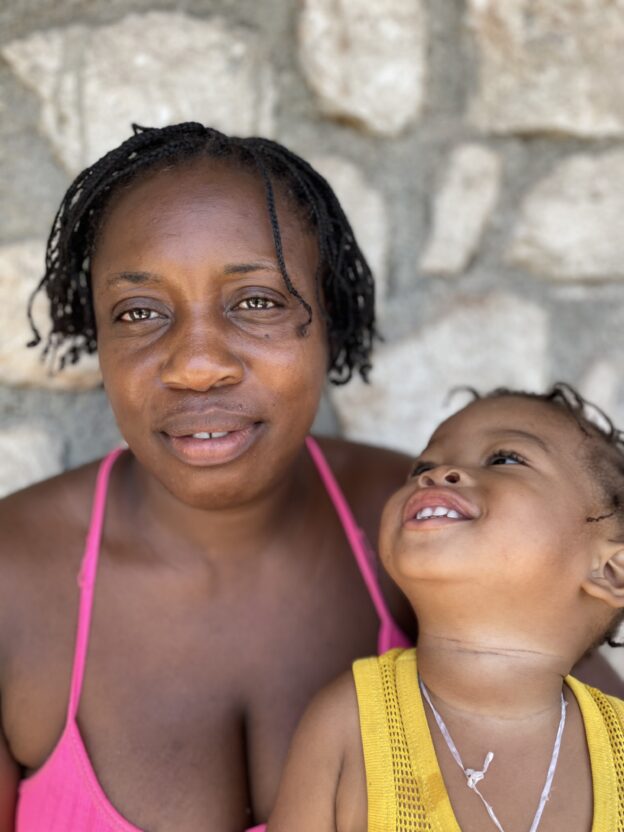
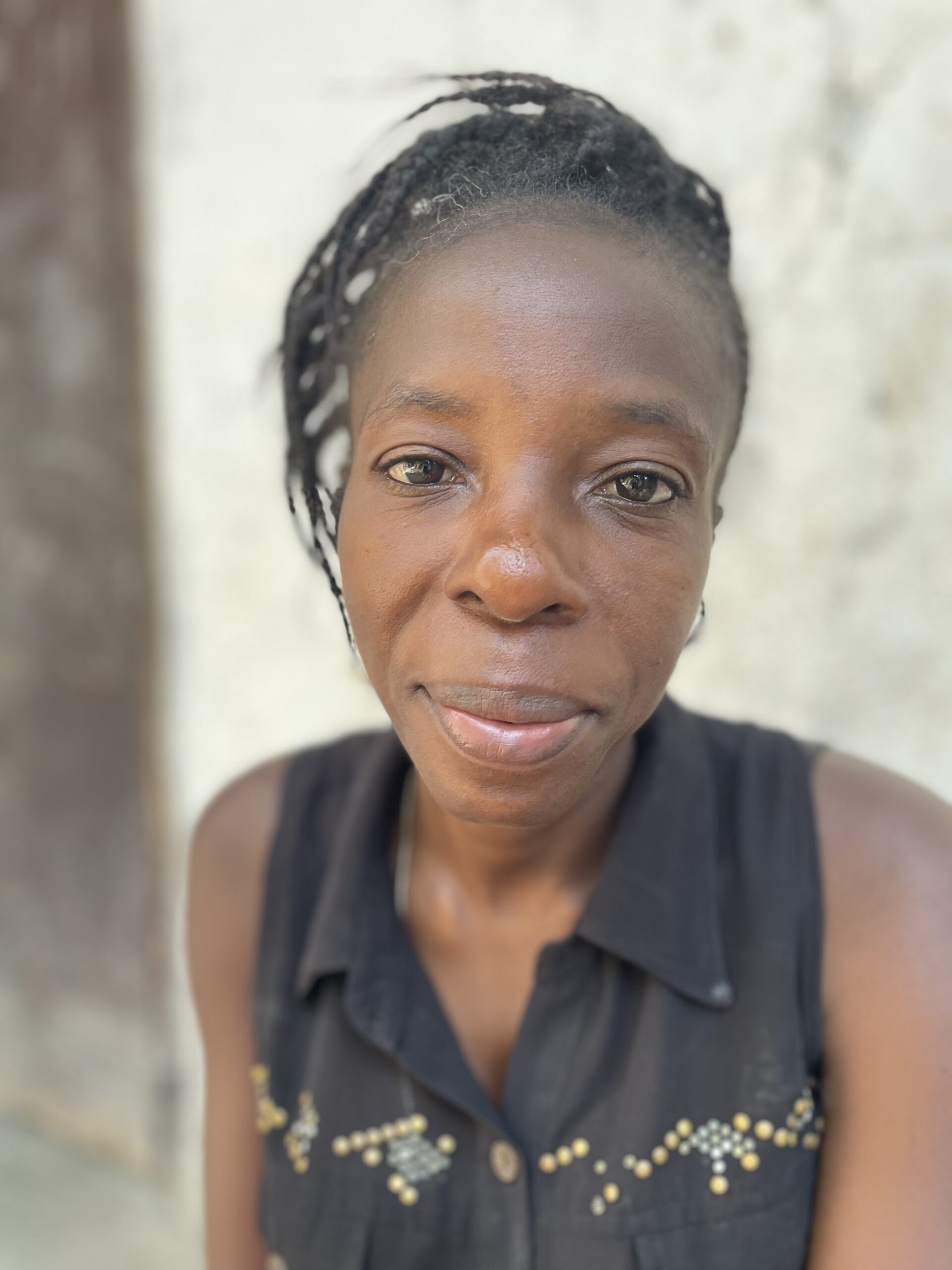
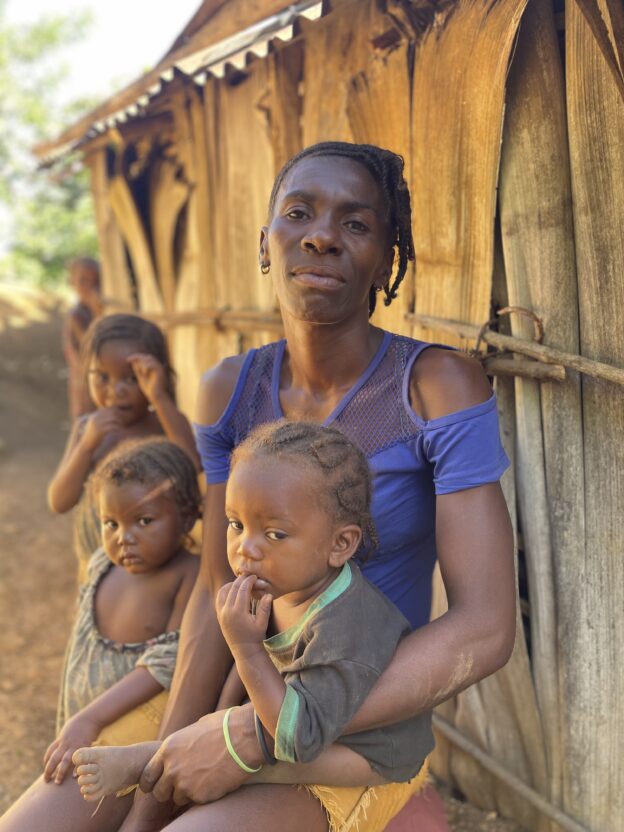
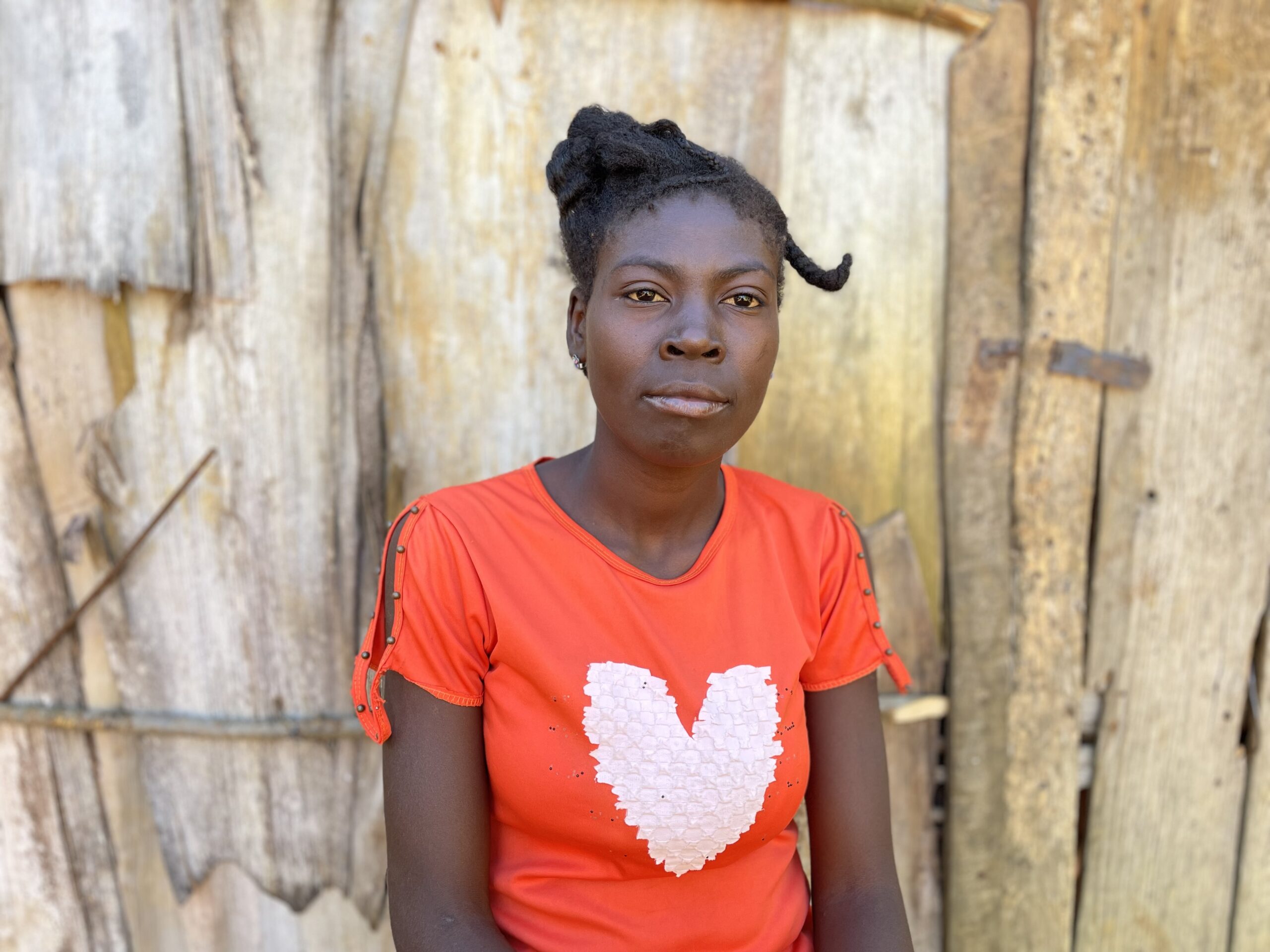
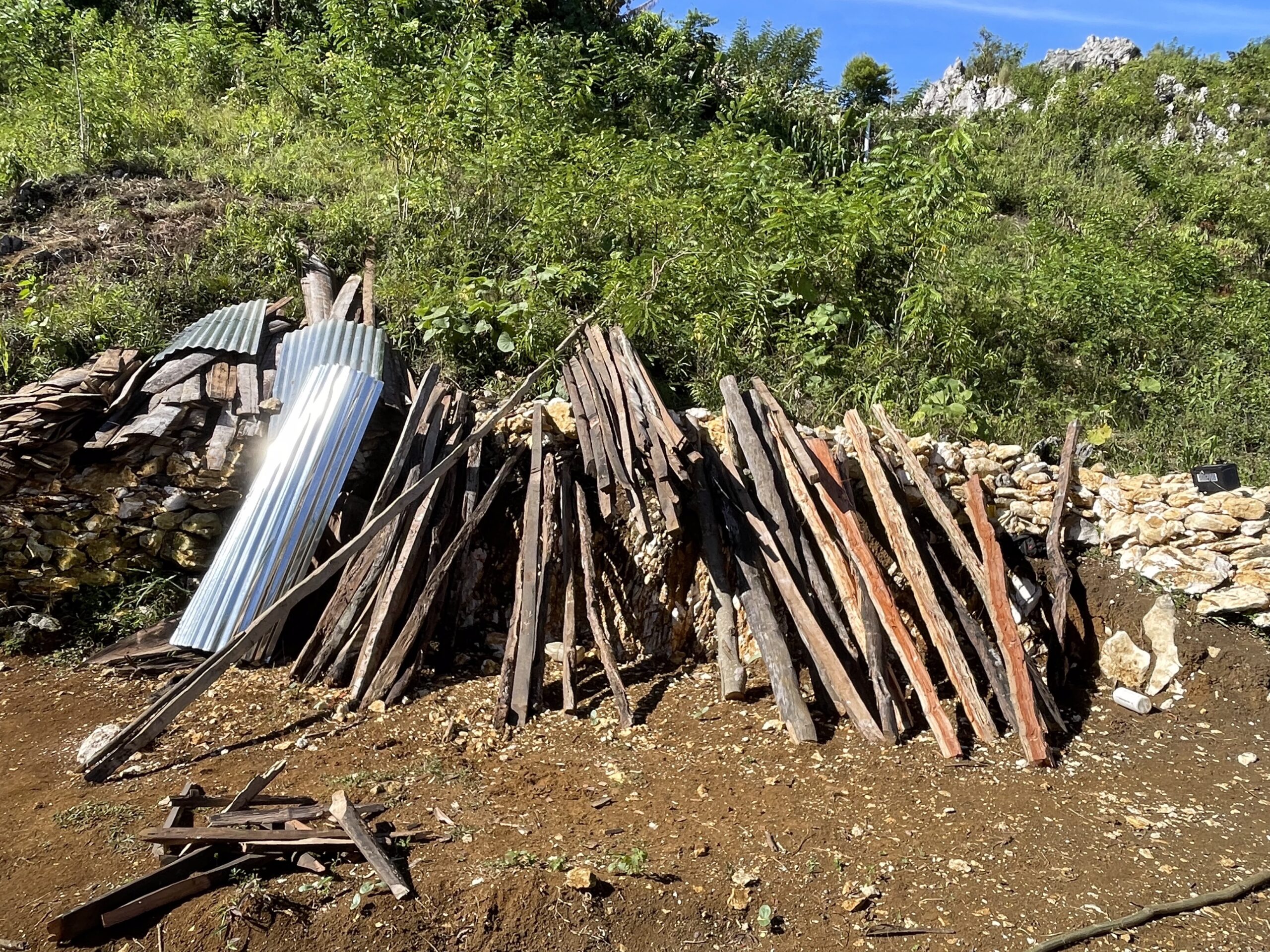
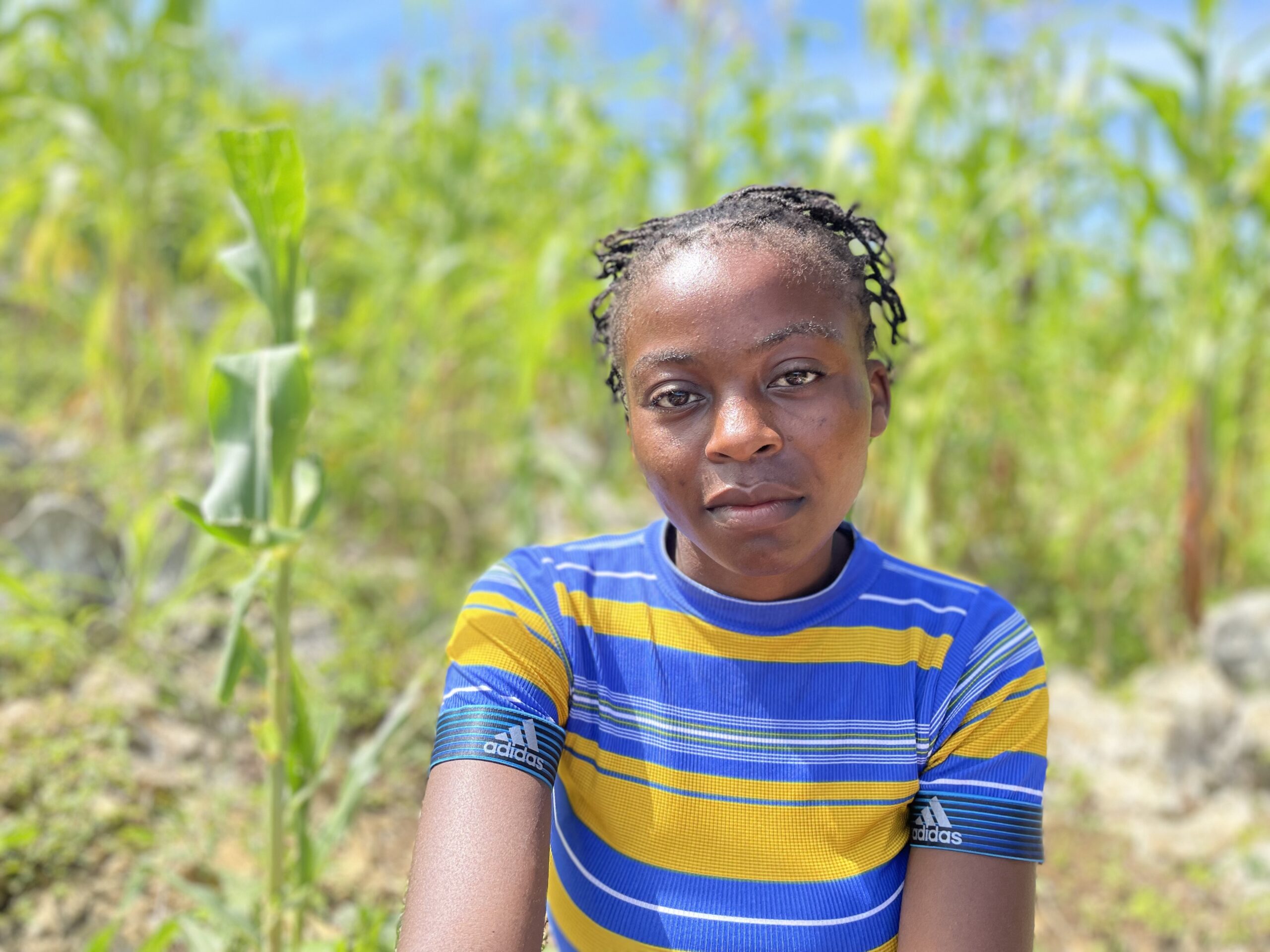
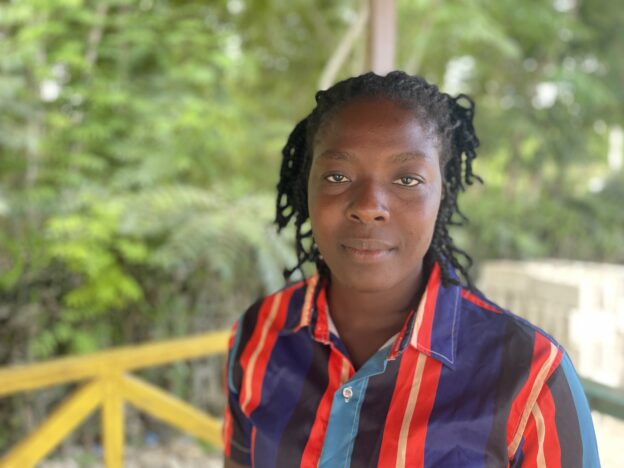
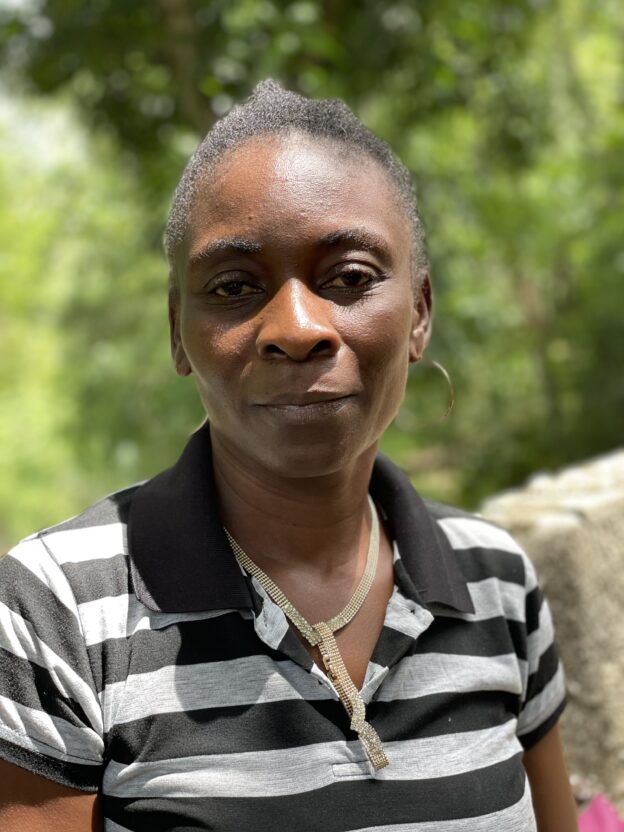
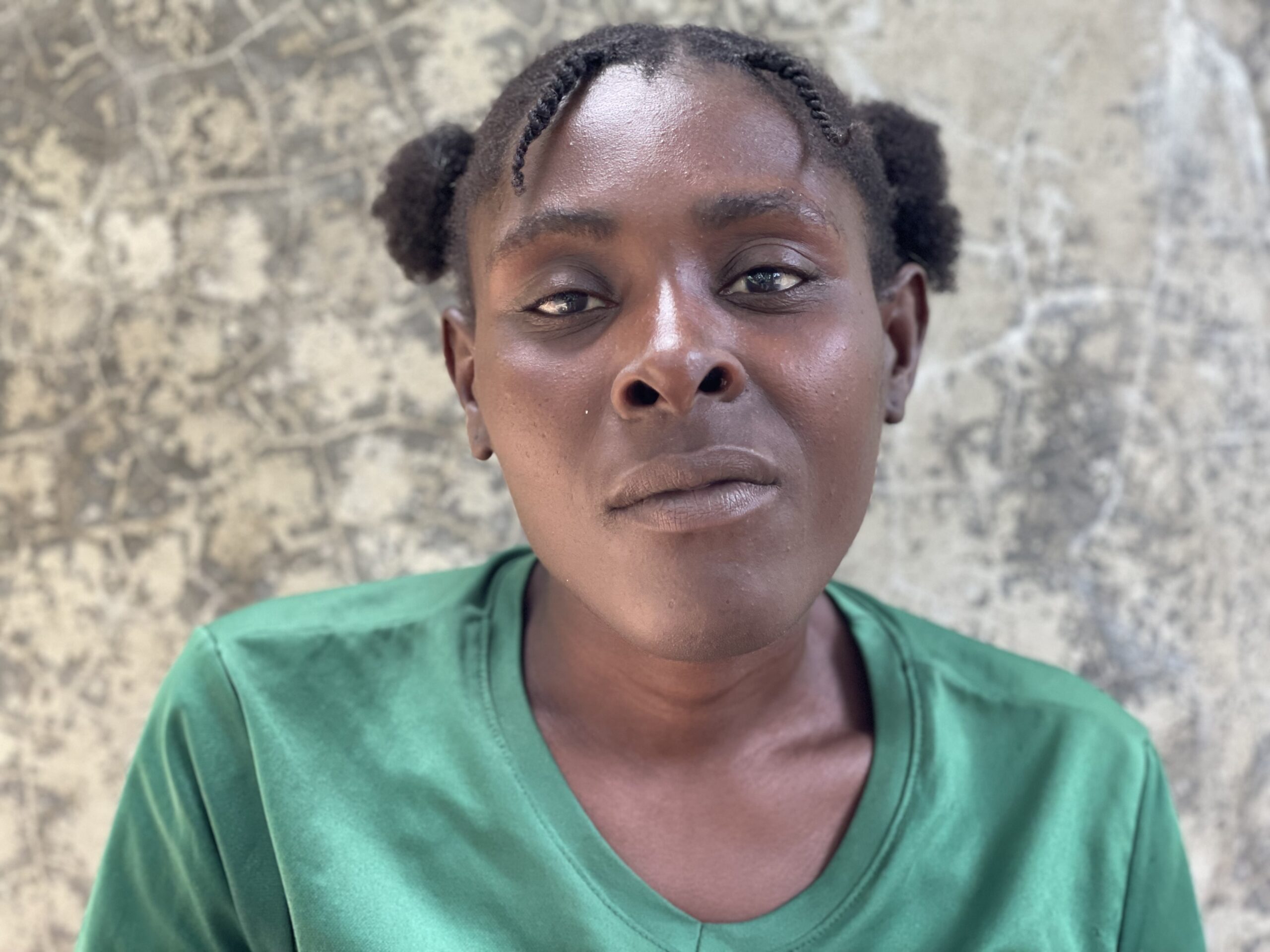
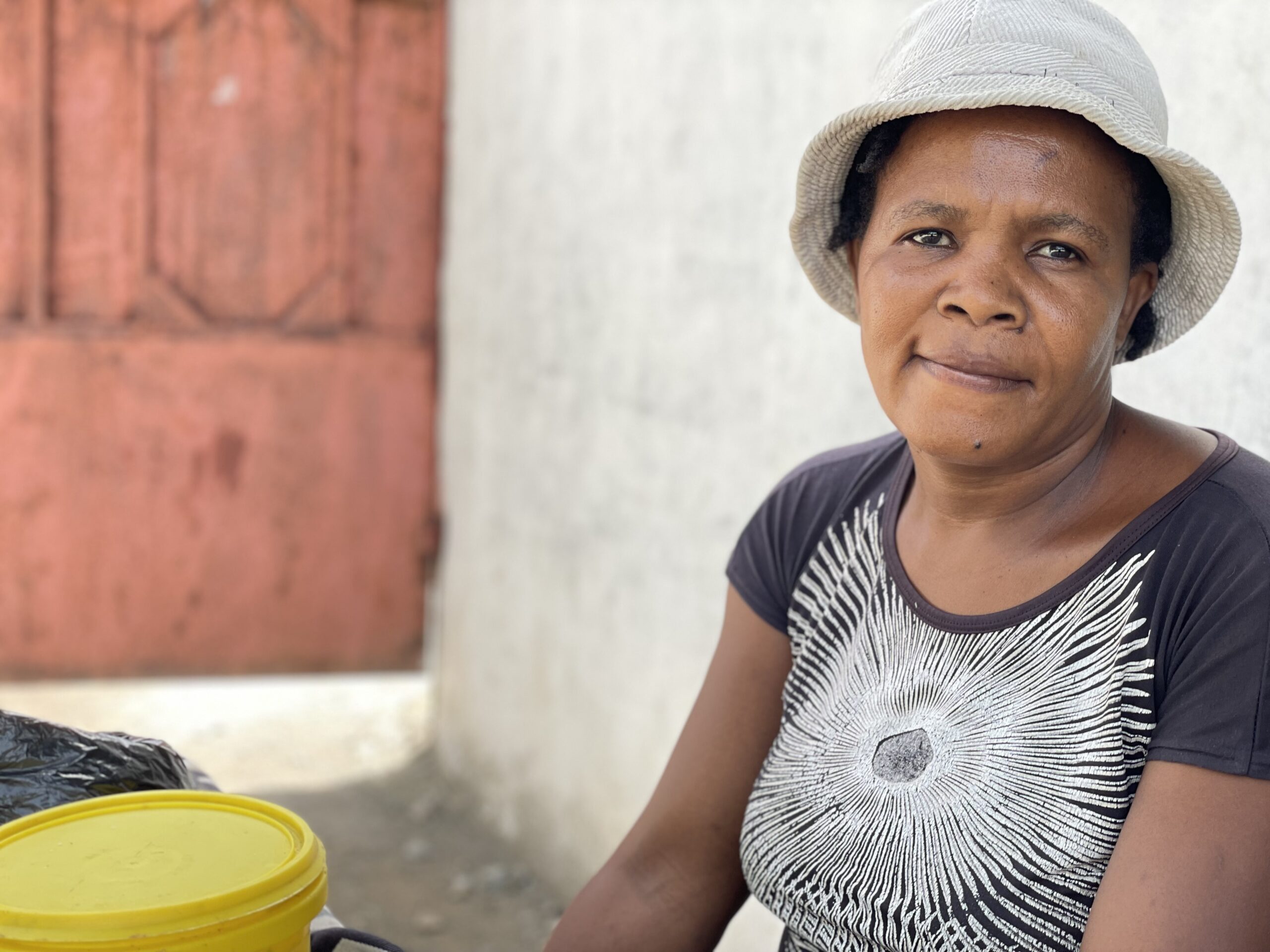
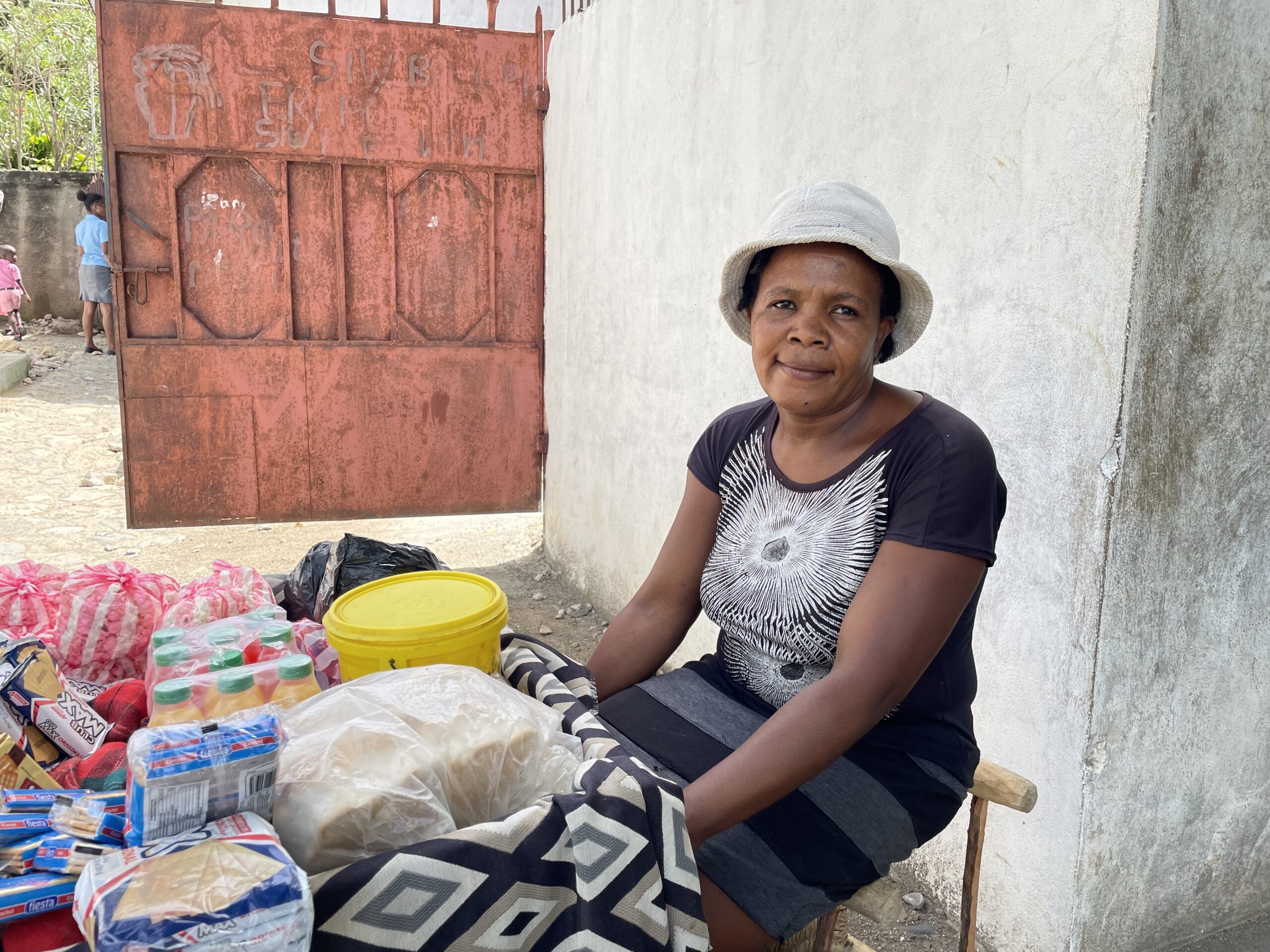
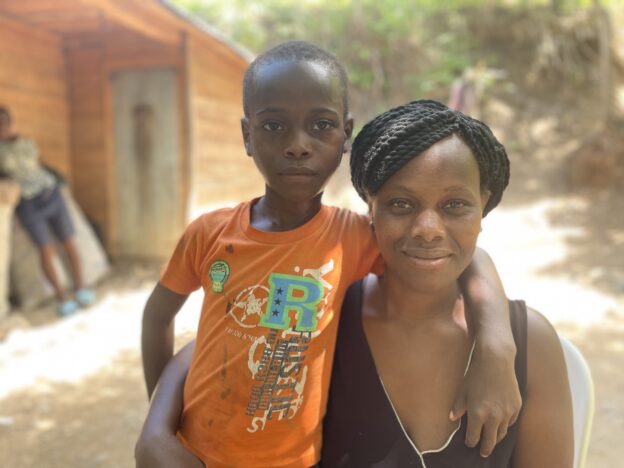
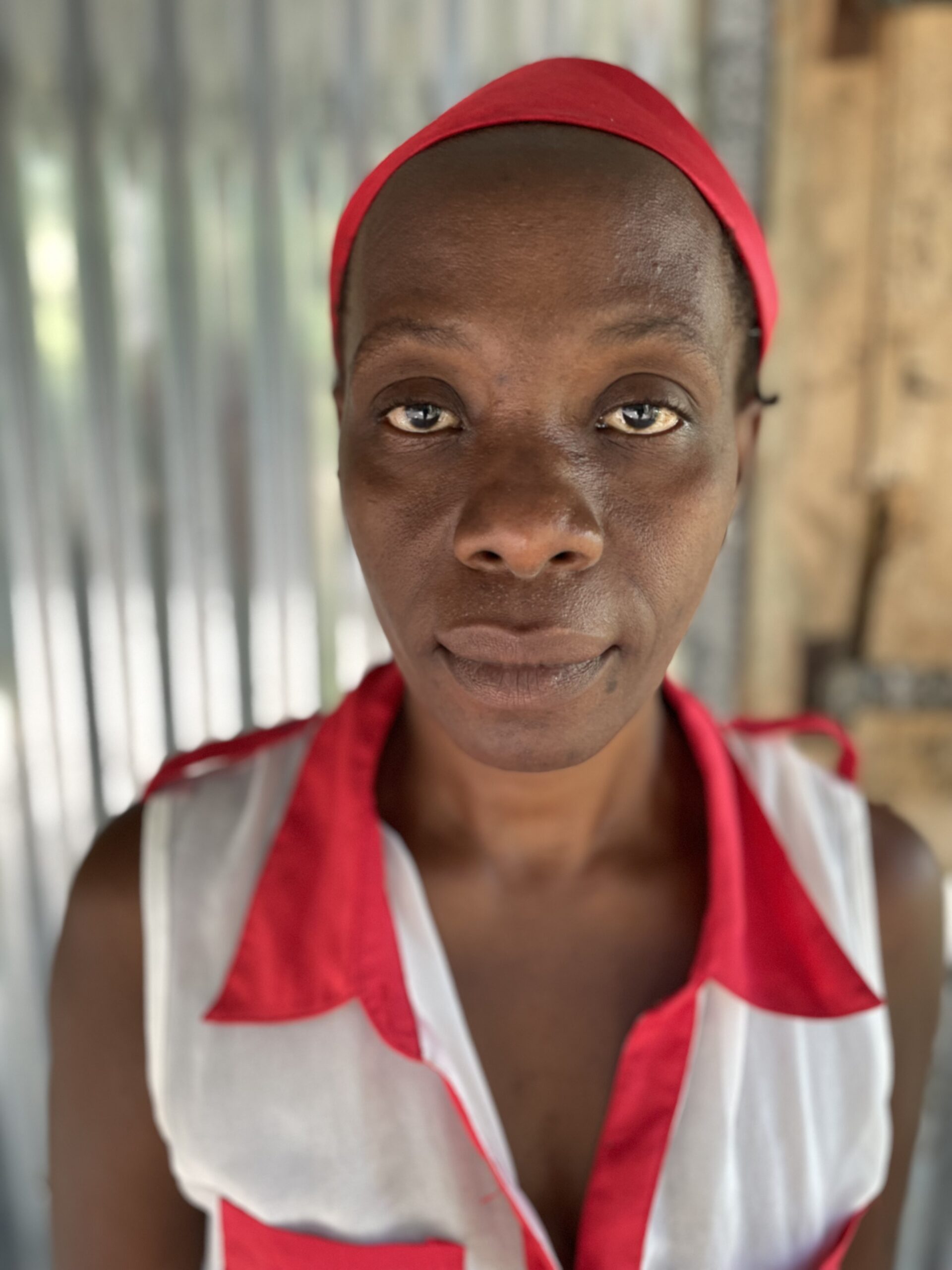
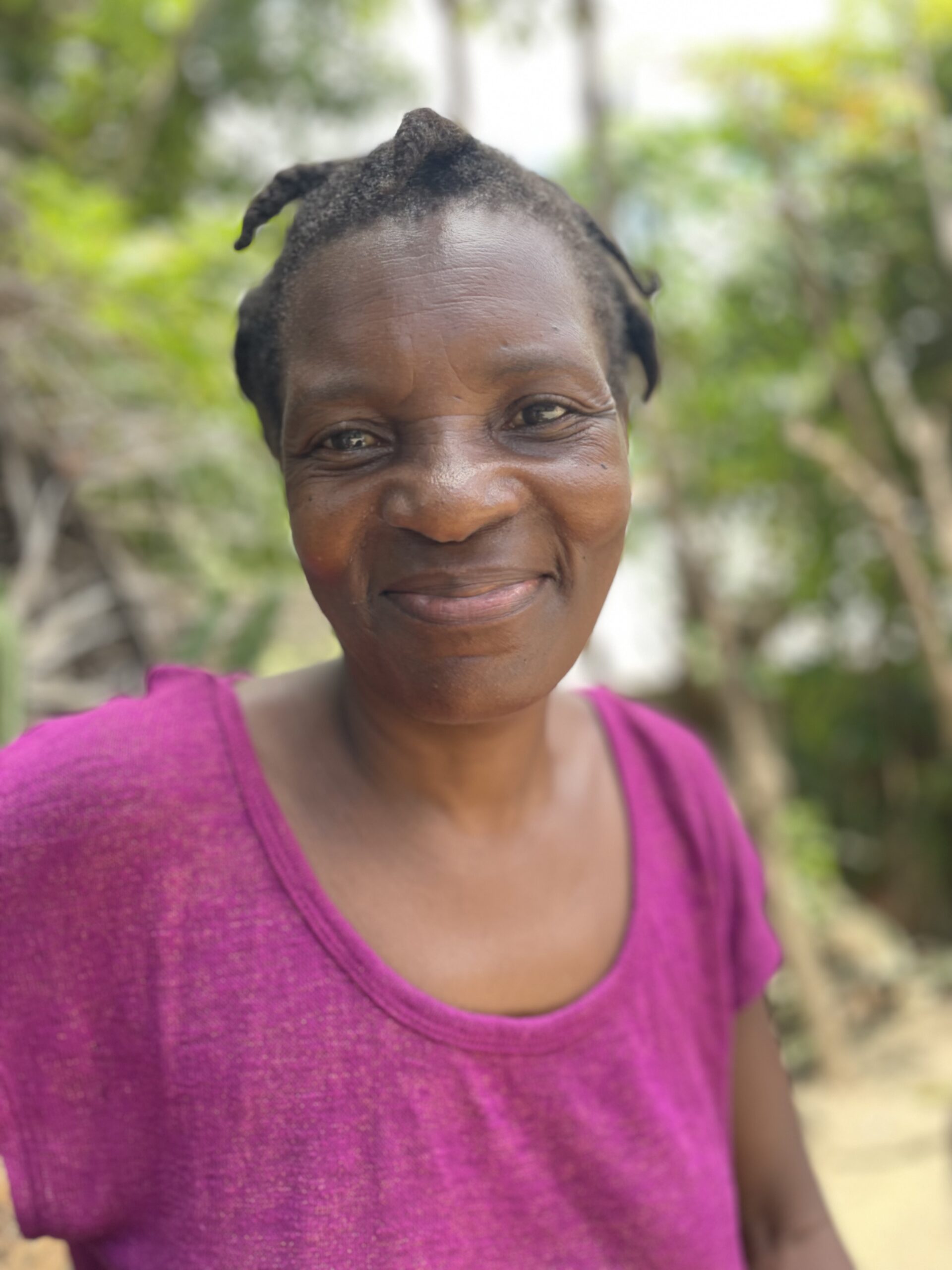
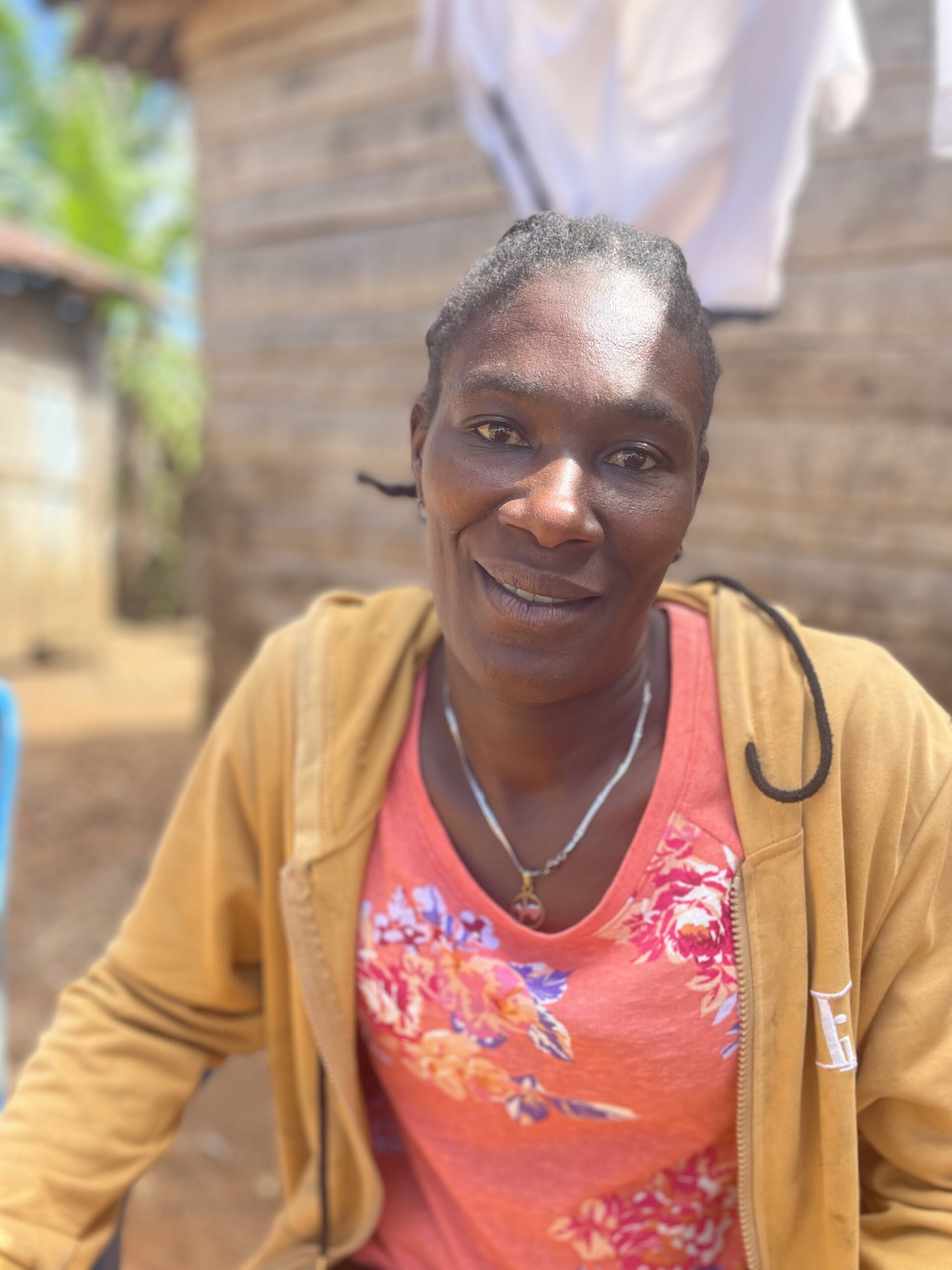
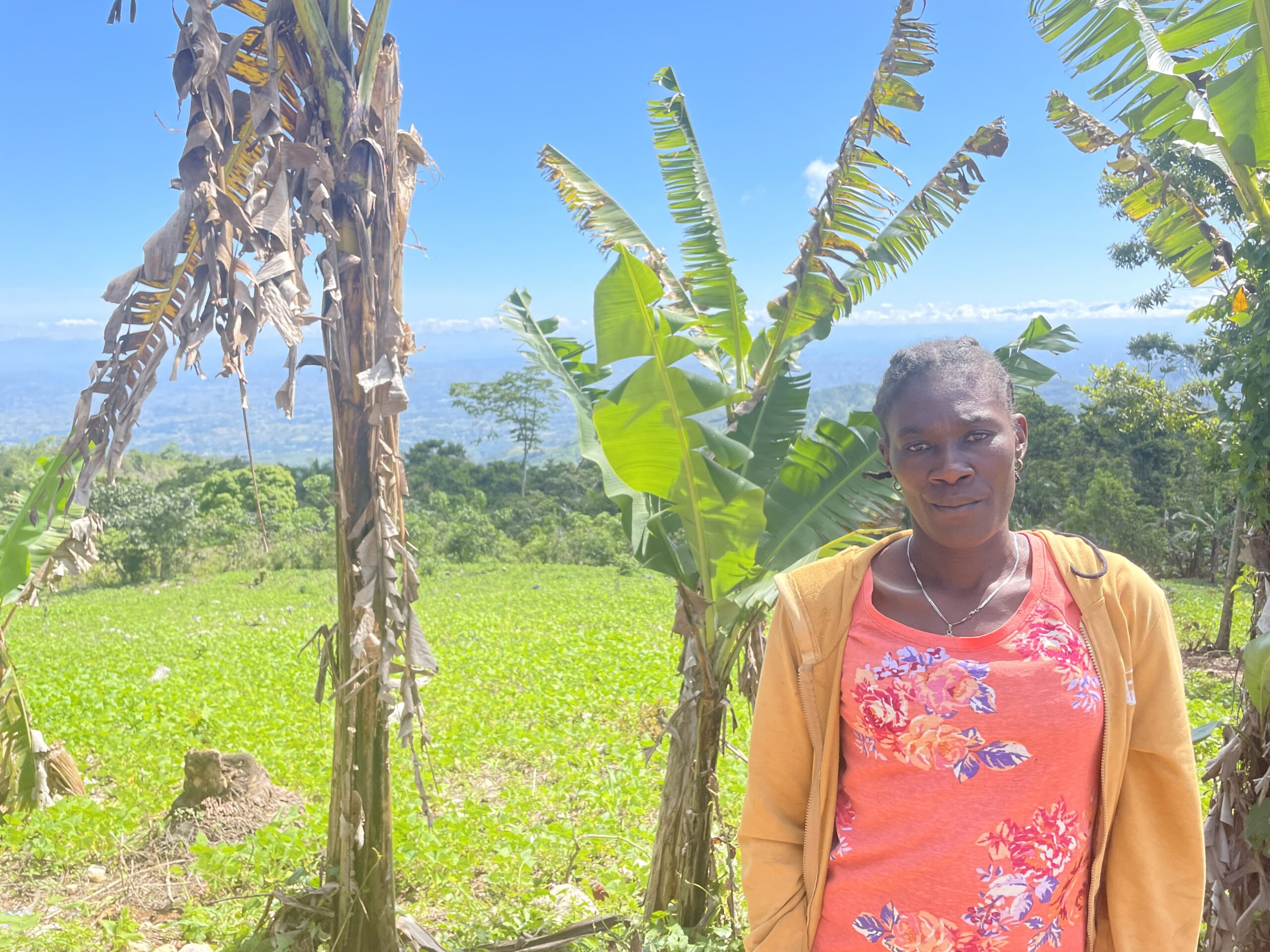
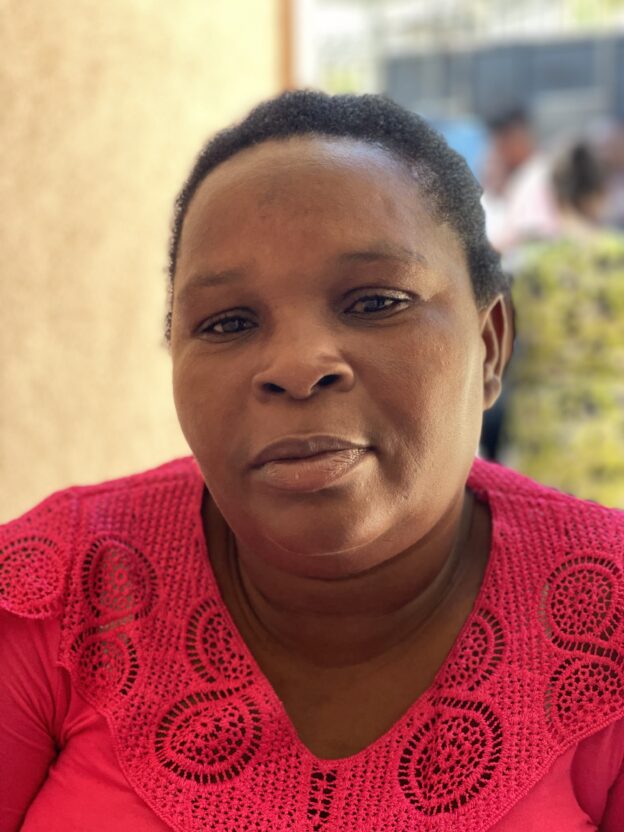
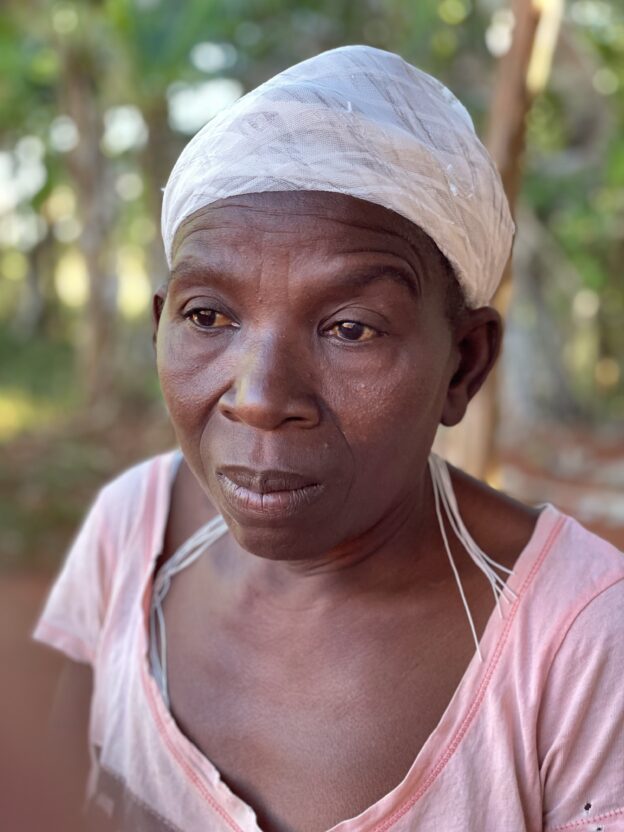
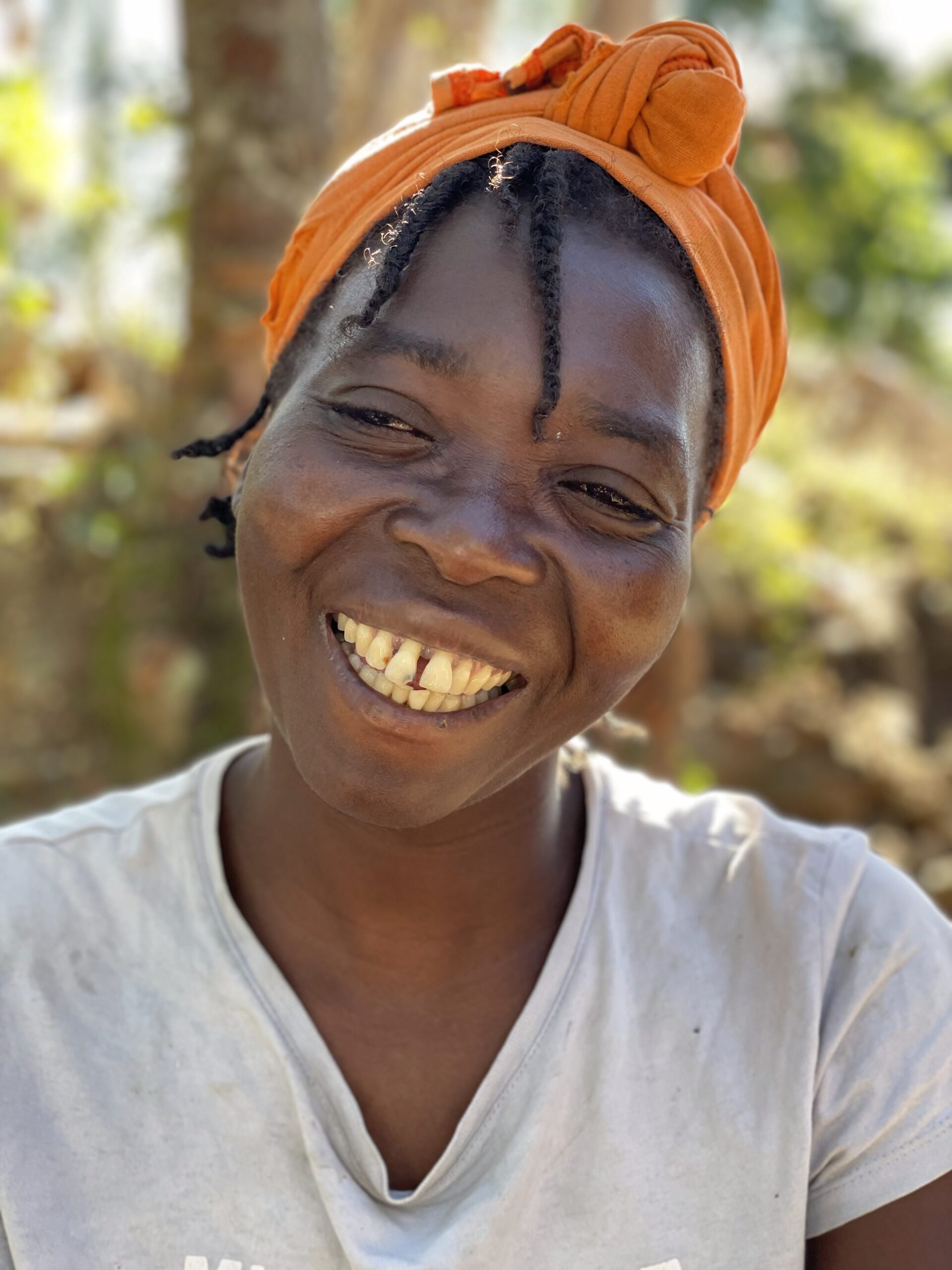
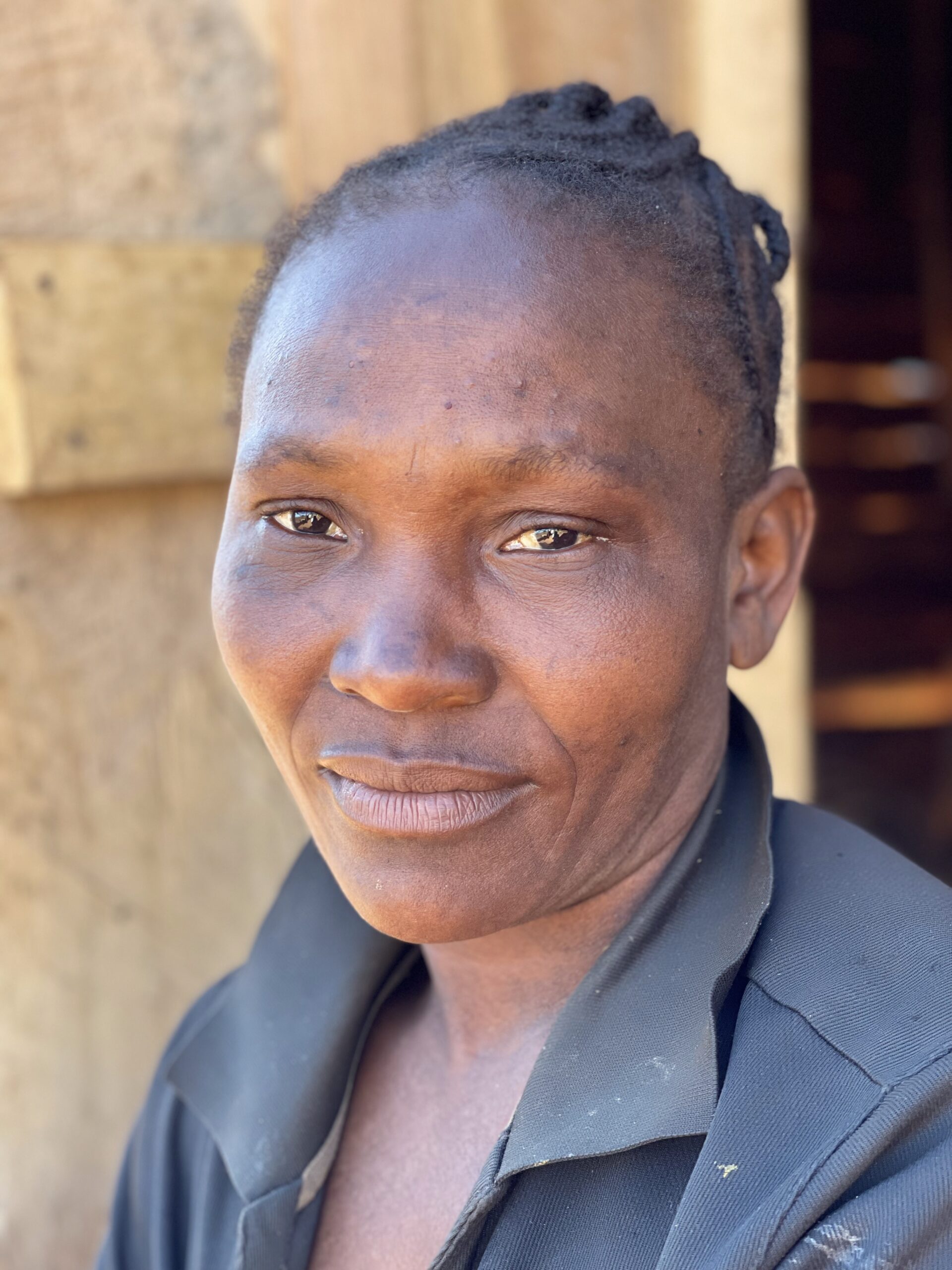
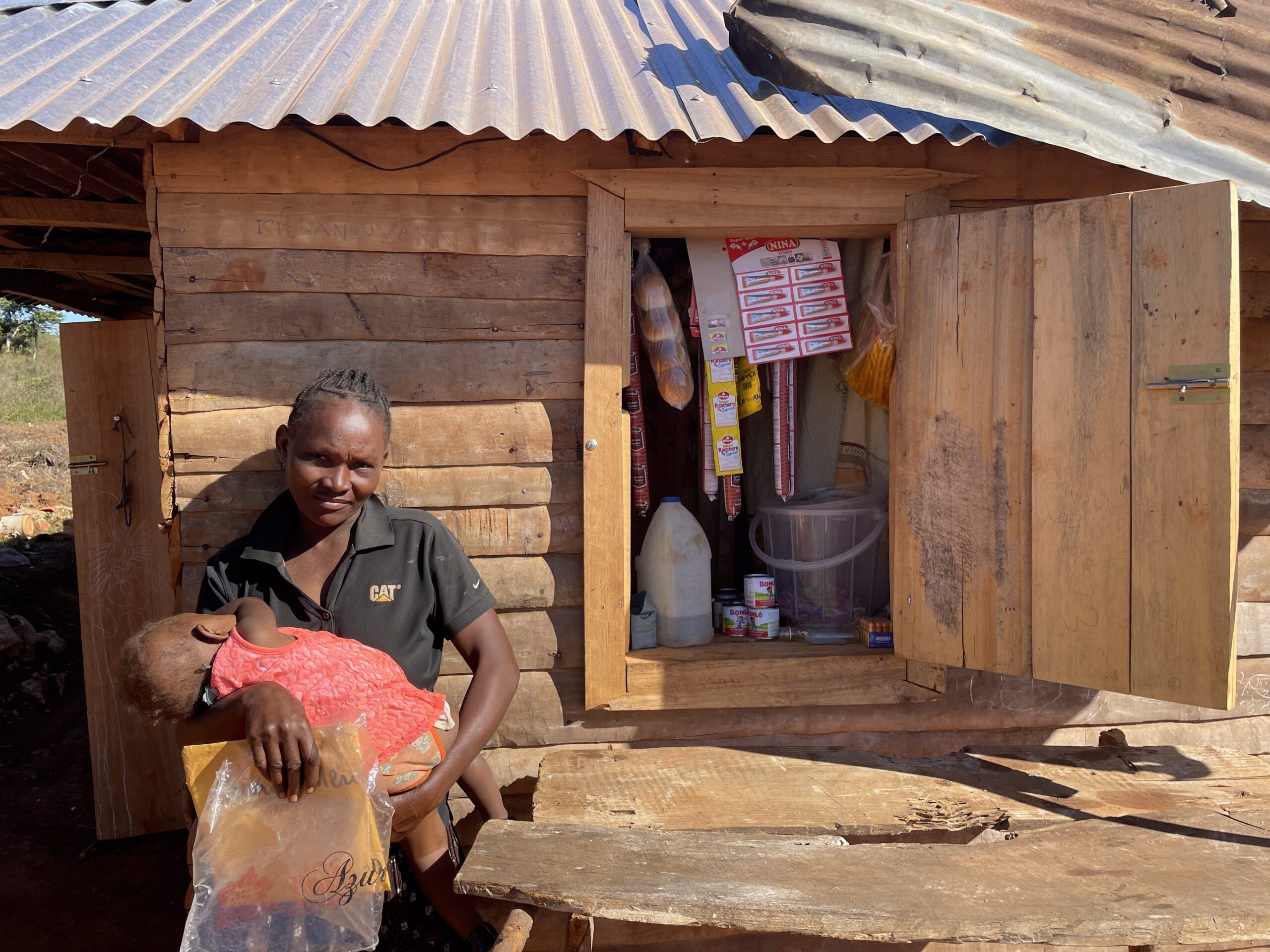
Franceline lives in Zetrèn, a community just off the main road that winds from downtown Bonbadopolis back north through the commune’s second rural section. She lives there in a room with her four children and one grandson.
Up until a couple of years ago, her husband lived with them too. They all shared shack down the hill, behind her current place. Her husband earned the income that the family depended on, cutting trees for charcoal makers or doing day labor for local farmers in their fields. It wasn’t much, but it meant that the family had something to eat and that the children could go to school.
Even then, it was hard for Franceline. She didn’t earn income herself. “You just sit around waiting for someone to put something into your hand.” But her husband died, and then Franceline had to fend for the kids and for herself.
Without capital to invest or any experience at business, she ended up just doing laundry for neighbors. They generally paid her in food, rather than cash, so she no longer had a way to pay the children’s school fees, and she had no way to set anything aside to create a better way to earn. Her children were often hungry. “It was so hard when they would cry.”
Franceline joined the CLM program, but she felt from the start that raising animals, which most members take on as their first CLM-financed business, would be challenging. “I didn’t want to start with a lot of goats because I don’t have anyone to help me look after them.”
Despite her reservations, she decided to buy a single billy goat with 7,500 gourds of the investment funds that the program provided. Buying a male is very unusual for CLM members. Almost all choose females, banking on their producing offspring. Franceline, however, had thought it through. “The females they were selling at the time were from Bòdmè. They are used to being kept tied up.”
Bòdmè is another neighborhood of Bonbadopolis, along the sea shore. Folks who keep goats in that part of the commune don’t keep them tied. They let them wander to find their own food, and what they find along the shore is different from what goats eat around Zetrèn. Franceline decided that, rather than taking a risk with a poorly adapted female, she’d raise a billygoat until it was valuable enough for her to sell it for enough to buy a better female. She does want a female eventually, because she thinks that having a small number of goats is the best way for her to make sure that she has money every year to send her kids to school.
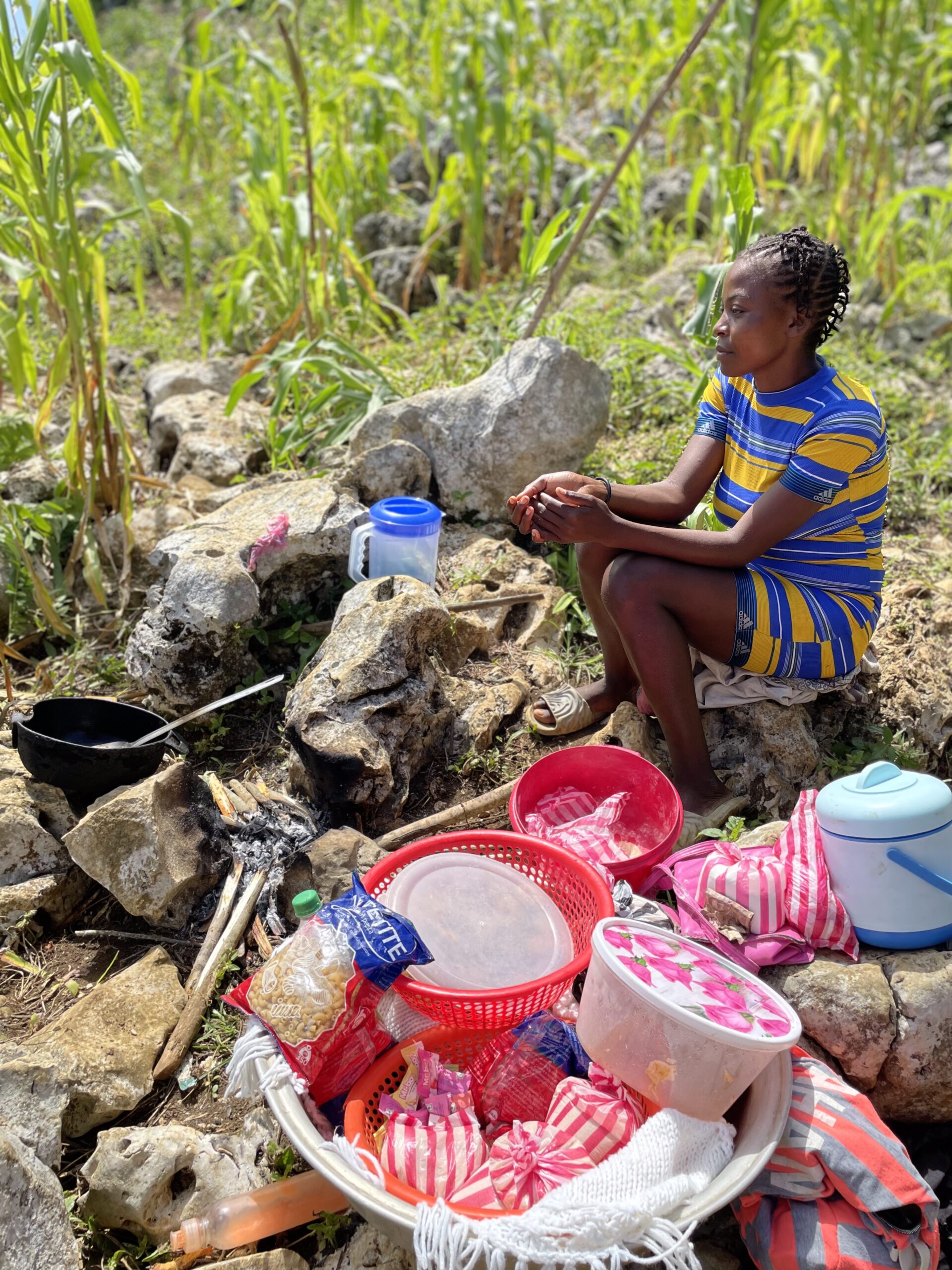
The first payment of her investment fund was 15,000 gourds, so buying the goat used just half of it. She used the rest to start a business. She bought snacks — cookies, crackers, etc. — and began to sell them in front of a large school nearby. She managed her profits carefully. “If I have 100 gourds, I try to eat just 25.” Though she immediately admits the spending just 25% of her profit is an exaggeration, she sticks to her point. “I keep saving something to add to the business.”
With her house falling apart, she wasn’t sure where she was going to live, even with the support that the program promised her. But her grandmother’s house was empty, and she had a talk with her aunt. The house could never become hers. Her grandmother had several children. But her aunt agreed that she could use the materials that CLM would provide to repair one of the house’s larger rooms. That’s where she and the kids live now. She’s thinks of building her own house on her father’s land, where she and her husband had their shack, as a project, but it doesn’t seem close just yet.
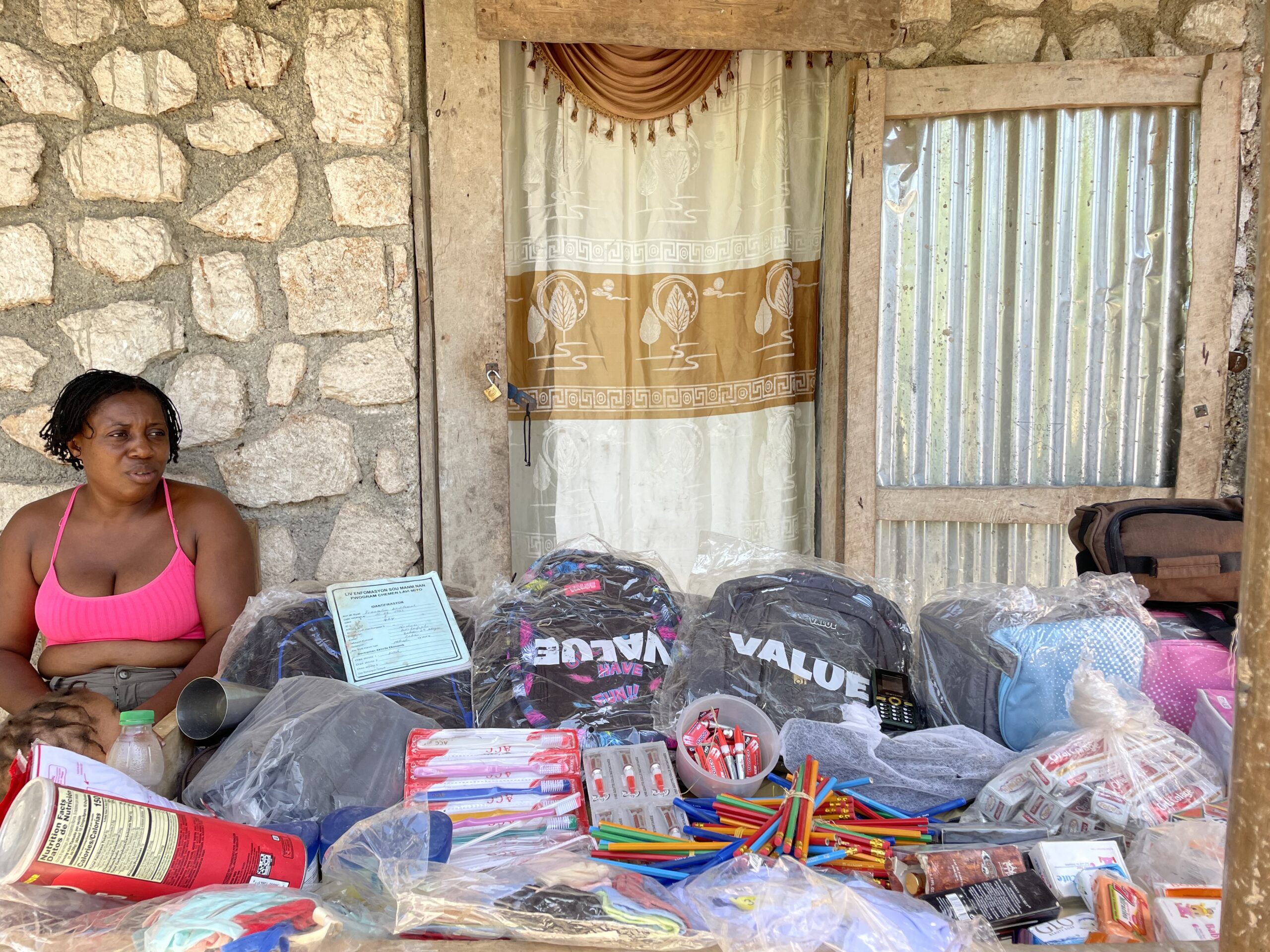
When it was time for her to receive the rest of her investment capital, she knew that she wanted to grow her business. Since she was selling right in front of a school, she stocked up on school supplies: pens, pencils, notebooks, etc. Sales are down right now, because summer vacation is not over yet. But when her savings group ended its 12-month cycle, she took the payout and bought some larger items, like school bags. She is already displaying them in front of her home. She’ll move them to the front of the school, with the rest of her business, soon. Eventually, she would like to be able to sell a full range of groceries.
Rose Andre is a CLM member from Hat, an agricultural area between the main road to the Dominican Republic and the Artibonite River, east of downtown Laskawobas. She has four children with three different men, and she lives in a small house with one of the kids. She used to do day labor in the fields along the nearby Artibonit River. Or she would do a day of laundry for someone. She did not have her own business.
She joined a savings and loan association that called for 1,000-gourd contributions each month, which she made with her laundry money. She took out a 15,000-gourd loan, and she went to the border to buy merchandise so she could go into business. She bought household plastics, like washtubs. She used the income to join a sòl, another type of savings club common in Haiti. She bought a goat. But the business stopped working well for her, so she switched to buying and selling onions.
She bought her onions at the border, but she got caught in heavy rain. The onions were soaked. It was nearly a total loss. She was left with just 4,500 gourds, which she paid to the savings and loan association as a partial reimbursement, then she went back to doing day labor.
When she joined CLM, she started saving up her weekly stipend, first to repay the money she owed to the savings and loan association, then to buy support posts for the home that she built with the program’s assistance.
Now she is in the savings and loan association that Fonkoze established for her and the other members of her cohort. She’s used credit from the association to buy extra roofing, the palm wood for walls, and the lumber she needed for her doors. She borrowed 25,000 gourds in all.
She bought goats with most of the investment fund that the program provided. She now has five of them and an adult turkey with five rapidly growing poults. She had already bought a chicken with the stipend she received during the six initial days of training, and that single hen is now eight chickens.
But she also invested in small commerce. She initially went back to onions and tomatoes. She bought 6,500 gourds’ worth. But she quickly shifted back to plastic housewares. She goes to the market at the border to purchase merchandise, and she sells at large markets near her. She sells in downtown Laskawobas, the market in Kwa Fè, farther east down the main road., and the one in Kolonbyè, to the south in Savanèt commune. She was selling in Mache Kana, a large market in eastern Mibalè, but the gangs took over the area, so she stopped going. This week she plans to explore a large rural market in Waysek, northeast of where she lives, as an alternative to Macha Kana.
The business has been thriving. She now buys merchandise for 25,000 gourds per week, almost four times what she started with. And it has been growing even as she repaid her VSLA loans. The current situation in the region has made things more challenging, however. Increases in her transportation costs have cut the profit that she makes by a half.
Despite the difficulties, she wants to push her commerce to continue to grow and to eventually buy a cow. She also wants to pour a concrete foundation for her new home and to live a better life. When she thinks of how things were, she thinks about how she used to work very hard just to maintain her misery. She doesn’t do those jobs anymore. She no longer does day labor in the fields nor other peoples’ laundry.
In a year or two, she hopes to have a much larger business. One worth 50,000 gourds at least. She plans to use regular credit from her new savings and loan association to help her make her business grow.
Rose André has a few months to go before she graduates, but she’s already thinking about what she would say to a woman just starting the program. “Take good care of your business assets, because they are what helps you move forward and keep all that they teach you at the training workshops in mind.”
Marilia is a CLM member who lives in Gwo Moulen, in a neighborhood called Lagon. She has four children with two different men, but neither of the men does anything for his kids.
She used to borrow money from Fonkoze to run a business to feed her family and send the children to school. That’s why one of the children made it all the way to eleventh grade. The others did not get as far.
Marilia’s second husband abused her. Every time she asked him for money to take care of the children or pay for their school, he would hit her. And he was with other women at the same time.
Marilia decided to leave him. She had been selling oranges and chayote in Laskawobas. She had had a bad day. Sales were poor. She had to find someone to give her a little money so that she could buy food to bring it home for her kids. When she told her husband, he started beating her with a stick. She was afraid for her life. If it wasn’t for neighbors who helped her get away from him, he might have beaten her to death.
She left the second man that very day, but she felt she needed help taking care of her children, so she took up with a third man. She hoped that this time would be different. This third man had no other women, but he had grown children, and his children treated her badly because they said she had no children with their father. They wanted to kick her out of the home she shared with their dad, and only local leaders kept them from doing so.
She was okay with the way the man himself treated her, but he always repeated that everything he had was for his children. It got to the point that her own children started to leave. One went to the Dominican Republic to work. Another started her own family earlier than she should have. One of her children won’t even look at her because she could not send them to school.
When she joined CLM, she got to work. She took the stipend the program gave her for food, but she did not buy food. She used it to go back into business because hers had fallen apart. With income from the new business, she started buying poultry to raise in her yard. When she received the money to invest, she added to it by taking a loan from her savings association, and she bought a donkey, which she needed for her business to grow, and a single goat.
She continued to work, and she was able to buy a pig. She’s now been in the program for 12 months. She has her donkey and four goats, and now her pig is pregnant, almost ready to give birth. She has two ducks and several chickens.
She now has found someone in the nearby community of Lospen willing to rent her a small piece of land “sou pri dacha.” That means that her rent payments will count towards eventual purchase of the land. But the seller encountered financial problems, and Marilia needs to speed up her purchase. She wants to buy the land to build a small house on it. She worries that if her husband were to die, his children would drive her out of her current home. She hopes to sell her pig to pay for the land. She’ll add the money she receives at the end of her savings club’s 12-month cycle. She can buy the land for 125,000 gourds.
Her pig is pregnant, though. She thinks that if she waits for it to have its litter, she can sell both it and some piglets, too. The seller has given her until December to pay. Even if she lives in a house now with her partner, she says that her body is there, but her spirit is already out the door. Her goal is to move into a small house built on her own piece of land.
Guerline is not from Hat. She’s from Kas, an important rural market across the river to the north. She was a single mother of three. The children’s father left her to work in the Dominican Republic. Another man, Lonie, came to Kas to see a friend and he saw Guerline as well. The two have been together on land that belongs to his family ever since, and Guerline now has an additional child with him.
She and Lonie got by before the CLM program on his fishing. He worked the nearby river and the cluster of lagoons formed by the hydroelectric dam. She brought his catch for sale to market. It didn’t give them much, but it kept them and the children mostly fed. They did, however, have to live in a room of his parents’ house.
Much of that has changed since Guerline joined the program. She bought two goats with funds that the program provided. Both have reproduced. She now has four, and one is pregnant again. She also invested in a small business selling kleren, or Haitian rum, and cigarettes. “It makes me enough to buy shares every week in my VSLA.”
She and Lonie were also able to finish their new home. She hopes that when their VSLA’s one-year cycle ends, she will be able to use the payout, together with money from the sale of a goat or two, to buy a small heifer. “A cow gives you something you can turn to if something bad happens.” She also thinks about raising cows so that she can eventually sell them to buy land. “The cow isn’t the real point, the land is.”
But Guerline has problems, too, and the biggest one is Lonie. “When he drinks, he is terrible,” she says. She first decided that she had to move her three older children out of the house. “I didn’t want him around them.” Each child now lives with a different relative. She stays in touch with them, and makes sure they are in school, but they are no longer with her.
Her older children’s father recently called from the Dominican Republic. He was worried about his kids because he heard that Laskawobas was under attack from the gang that overran neighboring Mibalè. Guerline patiently explained that the neighborhood where they live has not yet been threatened. But when she got off the phone, Lonie was furious. He said that the other man had no right to call her and that she had no business talking to him. She tried explaining that she was just letting him know that his children were safe. Even Lonie’s parents took Guerline’s side, but Lonie would not cool down, eventually slapping her with the flat blade of his machete.
Guerline’s not timid. She picked up a rock and hit him with it. But the fight gave her a lot to think about. She says she told him that, if he doesn’t stop drinking, she will disassemble their house and leave him, taking the house and their child with her.
Rosemarie lives in Kalib, a neighborhood of Gwo Moulen. She has been struggling to support four children. She says her life was hard until she found the opportunity that CLM offered her.
Before the program, the household had a mule. Her partner had purchased it with money he earned as a day laborer in the fields in the Dominican Republic. She had always planned to use the mule to start a business bringing produce to market, but that never happened because she never had the capital she needed to start.
With part of the investment fund that the program provided she bought two goats, a pig, and two turkeys, and used the rest of the money to begin a business selling bread and sugar, which rural Haitians need to enjoy the bread and coffee they enjoy first thing in the morning, and pig feed.
As a member of her savings and loan association, or VSLA, she was able to borrow an additional 10,000 gourds to invest in the business. With that additional money and the profit that she kept investing, she kept adding different products to the business, like rice and other basic groceries. The business was eventually worth about 55,000 gourds, or nearly $425. And it was growing even as Rosemarie used its profits to buy a second pig, send two of her children to school, and purchase the beans she’d plant as her spring crop.
But because of the gang violence that overwhelmed Mibalè and then threatened Laskawobas, her business fell apart. She was afraid to go to market to sell her merchandise. She used up her stock just feeding her family. She got to the point that she wasn’t sure how she’d repay the balance she still owed on the loan from her VSLA. She had to take the last reimbursement directly from her savings.
But Rosemarie did not get discouraged. She talked with her case manager, and they worked out a plan. Rosemarie decided to sell one of her goats to get a new business started. It was her turn to get the payout from her sòl, a group savings club in which members make a fixed weekly contribution and each week one member gets the whole pot. So, she added the sòl money to the revenue from the sale of the goat, and she invested in cooking charcoal.
The new business is going well. Rosemarie says, “I won’t ever stop struggling forward. I have learned that when you fall, you shouldn’t just stay down. You should make the effort to get back on your feet.”
Rose-Manie lives in Bezwen, an area above Kalabat, a small market in eastern Gwomòn that is the location of a parish church. She has one child, a three-year-old boy, whom she is raising without help from his father. The two of them live with her parents and her younger siblings.
She was able to start a small commerce even before she joined CLM. After weaning her baby, she left him in her mother’s care and moved to Gonayiv, the large city south of Gwomòn, to work as a maid. “I cooked and cleaned and did laundry.” She made 7,500 gourds per month, and she refused to spend any of it. So when she returned home after three months, she had 22,500 gourds she could invest. That is about $175. She arrived home during mango season, so she quickly added to her capital by buying and selling mangoes. When she shifted to selling groceries, she had almost $200. She sold rice, cooking oil, and the range of basics that Haitian cooks depend upon.
But Rose-Manie got sick, and her business capital slowly disappeared. For one thing, she continued to have to spend to feed herself and her boy even when she was too sick to work. For another, the medical expenses themselves were considerable. By the time she joined the program, she and her boy were largely depending on her folks.
But things have started to change since she joined the program. She bought a goat with 9,000 gourds of the first 15,000 gourds of her investment fund. She is trying to buy a smaller goat with the remaining 6,000, but she hasn’t found one that she likes yet. She hopes that if she takes good care of the goats, she can accumulate them until she has enough to sell them to buy a cow.
She expects to receive the remaining funds for investment soon, and plans to invest it to start her old business once again. She is optimistic. “Jodi a w ka gen yon bak sirèt. Demen se tout yon boutik.” A bak is a small wooden table that merchants use when they are selling just sirèt, or candy, and maybe some packaged cookies and crackers. It is a standard example of an especially small business. Rose-Manie is saying that one day you have nothing but a small table of snacks, and the next you can have your own shop.
Enide lives above Kalabat as well. Her neighborhood is Filyon. She has five children. A few years ago, when she saw that she could no longer send them all to school, she gave two of the older ones some money, and she sent them to live with a friend in Pòdpè, the major coastal city north of Gwomòn.
She and the two young women thought that the two would run their own commerce in the city and send themselves to school. The plan worked, except that her daughters found that they could not stay with the family who initially hosted them, and Enide had to borrow money to help them rent a room.
She borrowed the money from a village savings and loan association that had been functioning in the area even before CLM got there. She managed to repay what she owed, but then the association fell apart. “People borrowed money, but then they didn’t pay it back.”
The father of her younger children is around the area, but he doesn’t really help Enide with their kids. He’s married to someone else. “I’m their mother and their father. I sleep with them and get up with them every day.”
But she finds it hard to get ahead. She says, “Yon sèl dwèt pa manje kalalou.” That means that you can’t eat okra with just one finger. Okra is famously slippery. The phrase is a common Haitian proverb used to explain the need for teamwork. Everything Enide does, she has to do alone, and that makes life difficult.
She is excited about the goats she was able to buy with the first payment of her CLM investment fund. She bought two. “If I take care of them, and they reproduce, I won’t have to worry how I will send my youngest to school.” Her youngest is a son named Woodkervens, and he is just six, so he has a lot of years of school ahead of him. If she gets the number of her goats up over the next year or so, it won’t be a problem for her to sell one now and again for school fees and related expenses.
She is waiting impatiently for the rest of her transfer. She wants to invest it in her commerce. Her business model is simple. There are two large markets higher up into the mountains, farther to the east, Twa Pòto and Dandi. She buys produce there, and brings it down to Gwomòn for sale. It is a straightforward model. Produce is cheaper in such markets than it is downtown.
Up to now, she has been managing with credit. She goes to neighbors, borrows 5,000 gourds or so, and repays it the next day, when she gets back from selling in Gwomòn. They don’t charge her interest. “If I borrow from a woman, I might give her some of whatever I bought with the money. If I borrow from a man, I just say ‘thanks.’ If they see you always pay, you can usually find a loan.” But without any of her own funds, her business cannot grow. She plans to keep borrowing after she gets the money from CLM, but she’ll be adding to her own funds rather than depending on borrowed money alone.
Jolette lives in another neighborhood of Kalabat. She has a twenty-year-old son finishing high school in downtown Gwomòn and a baby with her in Kalabat. Until recently, she lived with her mother, but her mother kicked her out when she became pregnant with her second child, and she moved in with the girl’s father, Ancelot. She had had her son with another man, but he was married.
She had struggled to build the room of her mother’s house that she lived in. She sold cosmetics or groceries. Her business changed from time to time. But the expense of sending her son to school eventually ate up her capital. The shack she moved into with her girl’s father was falling apart even before she got there.
When she first joined the program, she struggled to eat even once a day. “If I ate on Sunday, I wouldn’t have anything on Monday.” The weekly stipend helped a lot. And it helped her support her son in school, too. “If I ate 50 gourds of food, I would save 50 gourds to send to my son.”
She used the first payment of her investment fund to buy a sow and a goat. “The pig will have piglets, and I will be able to sell them. My boy will be ready for college this coming year, and it will cost a lot.”
All through the conversation, Jolette keeps returning to her son’s needs. She barely seems to think about other things. “Everything I do is for my children.”
Imanie lives in Woudobay, on the ridge between Laskawobas and Savanèt, just outside the larger mountaintop community of Gran Platon. Like many of her neighbors, she uses the market in Kolonbyè, a town in Savanèt, just as she uses the larger regional market in downtown Laskawobas.
She is originally from the Savanèt side of the ridge, and she was living around Fon Desanm with her first husband and their five children when the CLM team was working there about ten years ago. At the time, the family did not qualify for CLM. When that husband passed away, however, things took a turn for the worse for her. She eventually moved to Woudobay to live with her current partner, Osnel, with whom she has three additional children.
At first they lived well enough together, but she started to dislike the way that he treated those of her children who are not his. “I think his family put ideas into his head.” The three oldest decided to leave home, and they now live with their late father’s family. Three of the five who are still with her are school age, and she managed to send them this year, though she still owes the school money.
Before she joined the program, Imanie had a very small business. “I carried a washbasin [of products] on my head, selling whenever there was an event.” She sold tobacco, cigarettes, and local rum at events like wakes, cockfights, and parties. It is a business that requires a lot of hiking in a very rural area like the one where she lives. She would try to sell at home to save herself the effort, but that doesn’t work. “When you sell at home, people always want credit, so I would rather go to events.” The business does not take much capital. Imanie would borrow from friends to keep it going, and if she couldn’t do that, she’d turn to loan sharks.
Since she joined the program, however, she has started to turn her life in another direction. She found a neighbor willing to rent her a small plot of land “sou pri dacha.” That means that the rent she pays will count towards an eventual purchase. She made a 5,000-gourd payment towards the first year’s 17,500-gourd rent. She knows that she’ll have to pay 35,000 gourds for the first two years, but she’s not sure what the final purchase price will be. She’s already installed her CLM-supported latrine on the new plot. She wants to leave Osnel and move into her own home. She even thinks that her older children will want to return to join her.
Imanie has begun taking care of the goats that she bought with CLM funds. She has two mature females and a healthy kid. She does not yet have a clear idea what she wants to do with livestock. She simply explains that she wants to keep them “for graduation.”
She has begun saving in her VSLA, though she still depends mainly on her CLM stipend to do so. She hopes that, by the end of the year’s cycle, she’ll have enough between her savings and her livestock to buy a donkey. Having a pack animal would make a big difference for her. She could buy loads of produce at the rural markets that farmers use and bring them for sale to downtown Laskaswobas, where produce is more expensive.
Anaphterline lives on the other side of a small mountaintop hill from Imanie with her husband Louiess and their two kids. She grew up nearby, just below Gwo Moulen, the next large-ish community to the east, and moved to Gran Platon when she moved in with Louiess.
Louiess has been the family’s main earner up to now. He works as a day laborer in local fields. The couple also has a small garden of their own, where they plant beans, pigeon peas, corn, millet, and what Anaphterline calls “lòt detay,” or other minor items, by which she means mainly plantains and meliton, or chayote, a squash-like vegetable common in Haiti. But it was not enough to keep them fed. “We sometimes went a day without food.”
Not that they had been helpless. Even before they joined CLM, they had purchased a house to set up on their land. They paid 25,000 gourds, and it involved selling multiple bean crops. Anaphterline adds that “the seller was really patient with us.”
But even after buying the house, they could not use it. It had to be disassembled where it stood on the seller’s land and then moved to where they live. “We bought the house, but we didn’t have the money to make food for the people who would help us move it.” Thanks to their CLM stipend, they finally had enough cash. It took four Sundays of work from four to eight movers, but the parts now sit, waiting to be assembled, where they live. “Louiess torn down our old house and put it back up in the corner of the yard so that we’d be able to put up the new house in the best spot.”
Their new house, disassembled and now on their land.
Anaphterline bought two goats with the first transfer of cash that the program provided. She had some money left over and plans to use it to buy a turkey. She expects to get the second transfer of the balance of her investment fund soon, and she will use it to start a small grocery business. “Louiess said he would build me a shack on the path that people use to hike to market, and I will run my business from that shack.”
Their goat shed and their not-yet-enclosed latrine.
She hopes that, between her livestock and her commerce, she’ll be able to earn enough to buy a cow. “If you have a cow, you can buy land. When they see you have a cow, they know you can pay, so people who want to sell land will offer it to you.”
Dinah lives closer to the center of Gran Platon than the other two women. She lives with two small children in her mother’s house. The children’s father lives nearby, but he plays no role in their lives. She has an older brother working in the D.R. who sends their mother money as often as he can. Those transfers have been the household’s main source of income.
One priority for Dinah since she joined the program has been to get herself and her children into their own house, and she has gotten to work. She paid laborers to clean a flat spot on her family’s land for her to build a home on. She hopes to start building soon. She has already installed her new latrine there.
Dinah’s prepared land with her new latrine.
In the meantime, she has started her own grocery business on the main path using the stipend she received from the program. She sells a few basics and some fried snacks. She likes selling along the path because it means that she sees people as they come and go.
She also bought two goats with money from the program. Like Anaphterline, she hopes that the goats can someday enable her to buy a cow.
Wilnise lives in Klènot, a small community on one of the main roads that leads west out of downtown Bonbadopolis. She and her husband, Brenlove, live with three kids. They had just one when they joined CLM less than a year and a half ago, but her sister left the area, leaving her two children with Wilnise. She thinks that they are her children now, and she reports that Brenlove has really embraced them too.
They live in a house that belongs to her father-in-law, and he’s been supportive. But they have always wanted to build their own home. They started the work long ago, using whatever they could bring in, but they have never had the resources to finish the job.
Even before the couple joined the CLM program, they were part of a savings and loan association. They were able to make their weekly contribution because Wilnise carefully managed the money Brenlove was paid as a day laborer in their neighbors’ fields, struggling to save something of the earnings to make their deposit each week.
Eventually, they borrowed 5,000 gourds from the association. That’s a little less than $40. They used the money to buy a tree for charcoal. Brenlove chopped down the tree and cut it into pieces, burned the pieces underground to make the charcoal, and loaded the charcoal into sacks. Wilnise then sold the charcoal.
When she joined the program, Wilnise asked the team to buy her goats, and she received two. The team bought them for her with 15,000 of the 30,000 gourds that it designed for Wilnise to invest in a business. The goats have had kids. Just just one of the kids survived. But Wilnise bought two additional goats with money she earned through her new businesses, so now they have five.
She took another 15,000 gourds of investment funds, and used it to start a business. Her business involves a lot of back and forth, but it is working well. She buys charcoal from producers along the road between her home and the port down the road. She then loads her charcoal onto small freighters and sends it for sale in Gonayiv. She doesn’t want to travel by boat herself, so she meets it in Gonayiv, sells it there, and then uses money from the sale to buy produce in Gonayiv that she can sell at the market in Bonbadopolis.
Her business is succeeding, even growing, but she feels she needs to make a change. “The road is so risky. If the truck breaks down, your vegetables will spoil.” The next time she travels to Gonayiv, she plans to buy cosmetics, rather than produce. “Cosmetics don’t spoil.”
Wilnise has big plans as her means increase. Her first goal is to finish the home that she and Brenlove began to build already.
But that house is not on their own land. The land belongs to her father-in-law. “When you’re an adult, you want to live in a home of your own.” She hopes that as her goats reproduce, she be able to trade them in for more valuable livestock, but then eventually that she and Brenlove will be able to buy their own land.
When Jean Belson was a young boy, he was afraid to let anyone see him. “When people came to my step-father’s house, I would hide under the bed.”
Jean Belson was born with significant disabilities. His undersized legs fold under him. He cannot stand up. He grew up walking on his two knees, steadying himself with his hands. His hands, too, are misshapen, but he can use them perfectly well. He lives in a house that belongs to his stepfather. His mother passed away, but her former partner has always been good to him.
Early friendship with Cius, the man who eventually became his CLM case manager, is what initially brought Jean Belson out of his shell. They were neighbors from Jean Belson’s youngest days, and Cius took to him. When Cius went to a community gathering, he would bring Jean Belson along. People who saw him would be moved to give him small gifts of money. “People would make a small gesture, and I was careful not to waste what they gave me.”
As he grew older, he became something of an entertainer at public events. Cius brought him to the first CLM graduation in their town. By then, Cius worked for the program. Jean Belson collected 1,750 gourds after his short performance, he managed the money carefully, and was able to buy a gallon of kleren, the local rum, and a couple of packs of cigarettes. That was the initial merchandise that he used to start a business.
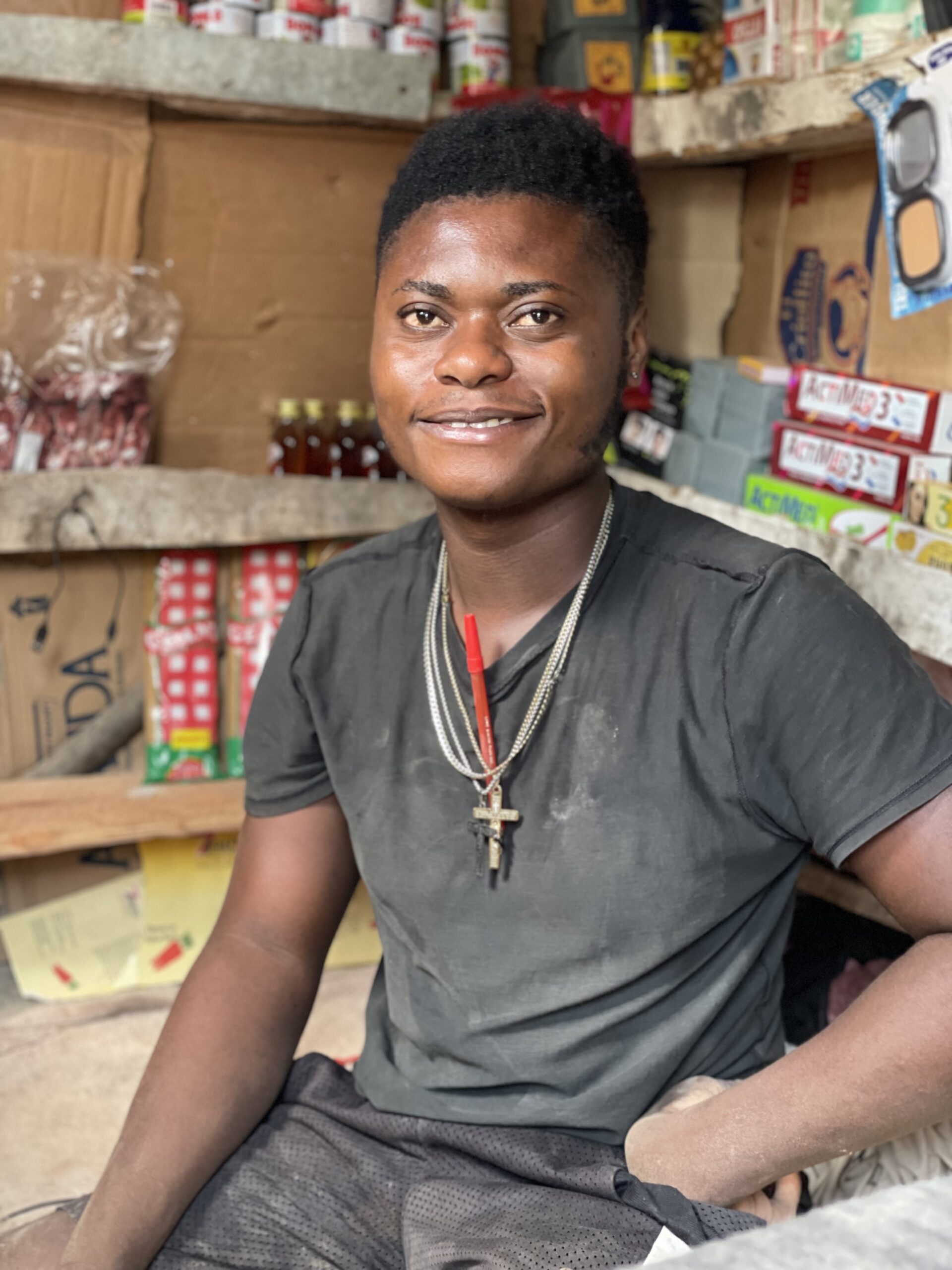
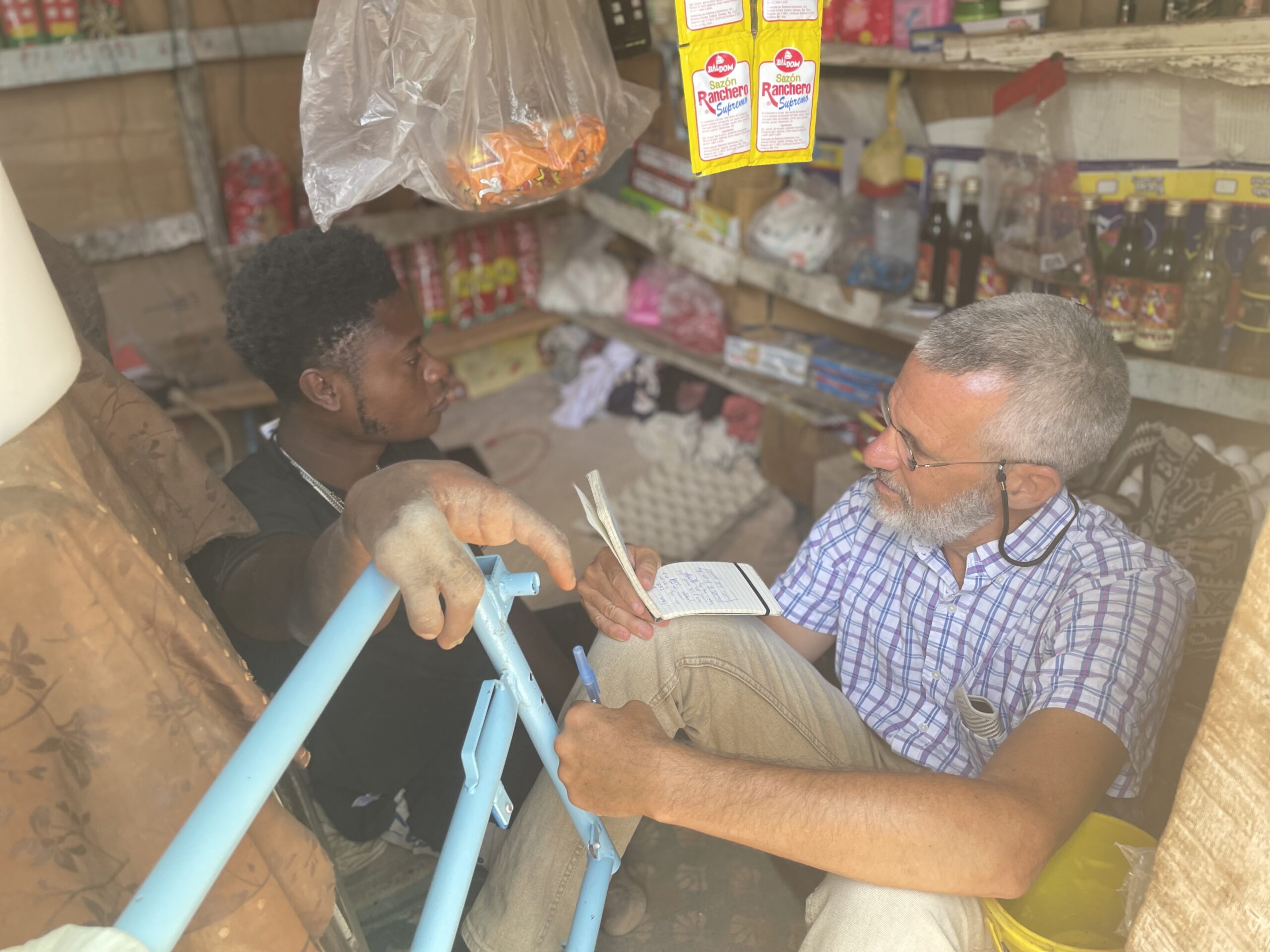
Having joined the CLM program, he’s been able to make that business grow. He’s continually adding new products. He had a booth built by the side of the road, and he’s turned it into a convenience store. It can be busy. He eventually had to take the side piece of an old wheelchair to serve as a barrier in the store’s doorway. He needed a way to keep customers from creeping in to help themselves.
But he is not willing to depend on the store entirely. He keeps a pile of rocks and a hammer next to the shop, and during down time he takes up the hammer to turn the rocks into gravel for construction. It is a reliable second source of income, if only small, occasional lump sums.
His ambition is simple. he has long been grateful for his stepfather’s love. His stepfather is happy to have him use the program’s help to put a decent roof on the shack his been living in on the older man’s land. But even so, he wants his own place to live. He’d like to buy his own land to put his home on.
Kalabat is the site of a parish church and a weekly open market in eastern Gwomòn. It is a challenging ride on a motorcycle from Gwomòn’s downtown area. The road follows a river, crossing back and forth in more than two dozen places. The riverbed is covered with rocks of various sizes, and the muddy water makes the rocks invisible, creating an unpredictable ride.
Gertrude lives in Abela, a small community above Kalabat. She shares a home with her husband and five of their seven kids. One of them is actually her late sister’s child. The girl has been living with her aunt since her mother became seriously ill.
Gertrude used to support the family with income from her small commerce. She was something like a grocer, selling basics like rice, oil, and sugar to her neighbors. She earned enough to keep the family fed and to send the children to school. Her husband added what he could be farming, but he earned very little. But when her sister grew ill, Gertrude spent what she had to try to save her. It only took a few months of trips back and forth to the hospital to burn through the capital in her business. Funeral costs ate up whatever medical expenses hadn’t burned through.This year, the children could not go to school. The family has not had food to eat every day.
She says she looks forward to the program. She has used most of her cash stipend so far to buy food for her family, but she also bought a chicken.
She has asked the team to give her money to re-start her grocery business, but also goats to raise. She wants to raise goats because they can help her send her children to school. If they reproduce, she explains, you can sell one now and again to pay fees. But goats are also insurance. She points out that if she had owned livestock, she could have spent money on her sister’s health without eating up her business.
She hasn’t worked out clear goals for her time in the program yet, but she isn’t worried. “Once you have possessions, you’ll see what to do with them.”
Figenie and her husband have seven children, but just six live with them at home right now. The oldest went off to live with a cousin in Pòtoprens just a couple of weeks ago. “My cousin told me they’d send my child to school.” Figenie has never been able to send any of the children to school herself. They do not even have birth certificates, nor does she have one herself.
She and her husband have supported the family by working in their neighbors’ fields. They “vann jounen.” That means that they sell their labor by the day. They can earn a couple hundred gourds on days when there is work, but that is not a lot for a family of nine. Occasionally, she has been able to buy a gallon of rum on credit, which she then sells by the shot. She might buy tobacco, too, to sell with the rum. But those who sometimes lend her money are reluctant to do it during planting season, when they need all the money they can muster. So she, her husband, and the children must get by on day labor.
She joined the program, and she started to look at what she could do if she had money. The first payment of her weekly stipend was four weeks’ worth, 2,400 gourds, or a little less than $20. She put away 1,000 gourds to use to buy shares in the savings and loan association that the CLM team has set up for her and her fellow members, but she also bought a couple of measures of pigeon peas that she has planted on her own small plot.
She’s asked the team to buy her a pig and some goats that she can start to raise, but she does not have a clear idea what she will do with them. She says clearly enough, “I don’t have a plan yet.”
Mulène is from Kalabat itself, but she only moved back there recently. She had been living as a widow with her daughter in Kwadeboukè, Pòtoprens’s northernmost suburb until about a year ago. She supported herself and her daughter selling groceries. But gang activity drove her out of the room she rented there. She lost everything. She fled back to Kalabat, where she moved in with her mother and her younger sister. She says that they have been living mostly off of neighbors’ charity.
But she has gotten off to a quick start in the program. She took the four weeks’ worth of stipend that she received, and immediately went into business. She bought a range of snacks — cookies, crackers, popcorn — and began selling them off of a small table that she sets up in the schoolyard near her home. Business is good. The schoolchildren buy her inexpensive snacks.
She thought about using the stipend for household expenses, but it didn’t seem right to her. “If someone gives you something, you can’t just wreck it. You can’t just eat it up.”
She’s already thinking ahead. The school year is almost over, so she will need to make a change in her business soon. She hopes to start selling her snacks in the market, but she wants to go back into the grocery business as well. She will be able to do that, she says, as soon as the CLM team transfers to her the funds for income-generating activities that it plans for her. She wants to raise goats as well, but in the light of her experience as a grocer, raising goats still seems a little like an afterthought.
The CLM program is just getting started for Rositha, a 31-year-old single mother of six from the hill above Kalabat in the Rivyè Mansèl section eastern Gwomòn. The father of her first three children abandoned them and her, but then she found another man and had three more kids with him.
He helped her take care of the kids she already had, and the couple was struggling along. The man farmed, and she had a small business selling corn in downtown Gwomòn. Sometimes she’d buy plantains near her home and hike downtown with them, carrying them on her head, for sale there. She and her children lived then, as they live now, in one room of a home that belongs to her brother. Other family members live in the home’s other two rooms. Her partner lived nearby, with his parents.
But the man grew sick. She spent all the capital in her business trying to help him back to health, but he eventually passed away. She was left on her own with her kids. Family members took the two oldest to lighten her burden. They are now in school, but they aren’t with her. She’s been struggling along with the other four, living mainly on charity from family members.
When the CLM staff started working in her neighborhood, she did not think much of it. When they visited her a couple of times, asking questions, she was happy to respond. She didn’t know what it was about, but she says, “I thought I might make something out of it.”
She enjoyed the six days of training that launched her into the program, and she looks forward to the chance to apply what she learned. She hopes to be able to use the investment that the program will make in her livelihood both to return to small commerce and to begin raising goats. She thinks that commerce is important because it can give you the money you need to manage your family and also allow you to save something. And she wants to raise goats because they give you something you can sell if you run into a sudden need.
She does not yet have a real vision of what she wants to accomplish in the 18 months she will spend in the program. For now, she says only that she hopes when she graduates to be able to hold onto what she has come to possess.
Germène lives in her mother’s house with three of her kids. One daughter spend the school year in downtown Gwomòn with family that sends her to school, but she comes home for vacation. The children’s father is not around. “He’s not here because life is hard. He goes around looking for work. He is in Okap now. The children like to talk with him on the phone when they can.”
She is supported, as is a younger sister who is also now a CLM member, by their mother and stepfather. Their stepfather farms. She too has land she could farm, but she doesn’t have the resources she’d need to plant.
She didn’t see anything odd about the questions the CLM asked her during their selection visits. “I didn’t know why they were asking all those questions. Now I know.”
She’s been frustrated by her struggle. “You get up in the morning, but you don’t do anything. you have children you don’t send to school. It’s like you’re no good to them.” She hopes that CLM will give her a way to acquire things that she has not been able to have.
Like Rositha, she’s is interested in small commerce and goats, and for some of the same reasons. Goats are easy to care for, and they give you a way to get your hands on money if you have a problem you need to solve. Small commerce gives you a regular income. You can take care of your family and deposit money in a savings club.
During her six days of training, she received a daily stipend. All the new members did. This small stipend, worth less than $2 per day, was originally conceived to cover transportation costs, but over the years members have almost always decided to walk to training so that they can use the stipend in other ways. Germène used hers to begin making contributions to a savings club. The members of the club take turns receiving the whole pot after each regular contribution. Germene’s turn hasn’t come yet, and she initially hoped to be able to use her turn to set herself up in a small business, but the one child she sent to school this year was sent home for non-payment of fees. So, she now thinks that the money will have to go to the school.
Edouarin and her husband Vercius have a large family. One of their younger daughters helps Edouarin count how many live together in their home. They have eleven children, though just six still live with them. The two oldest now live in their own homes. Another three, Vercius says, are “out in search of a living.” They have five grandchildren with them as well. So, they are 13 all together.
Edouarin says that the house they live in belongs to her brother-in-law. Their own house was in a miserable state, and the brother-in-law was living in Gonayiv, the large city to the south of Gwomòn, so he said that they could just use his.
The couple survives by Vercius’s farming. Some of the land is theirs, but mostly he works as a sharecropper, giving up half the yield to the land owner in exchange for the right to work it.
Edouarin wants to start raising livestock with the program. She’s hoping to have both goats and pigs. They offer what she calls a “garanti.” She explains that the garanti is the young that the animals will have. For her, it is a profit she can count on.
But she also wants to get into small commerce, and she explains that she wants to contribute money to the household. She does not want to count on her husband’s farming for everything. “If he pays for the rice, I can buy the oil and the salt.” And she adds, “I’ll will feel differently about myself when I have my own [economic] activity.”
She doesn’t yet have much in the way of specific goals for CLM, but she know what is important to her. “I do not ever want the children to have to sit at home again. I want them to always be able to go to school.”
Merjina Jean lives in Gwo Moulen, but she isn’t from the area. She’s from Flande, a busy y-shaped intersection that connects the road to Mibalè with the roads to Laskawobas, Beladè and the Dominican border in one direction and with the road to Savanèt in the other. She was living with her mother there when she had a child with a young man from Mibalè. Her mother threw her out of the house. The father’s mother ask her to give her the child to raise, but Merjina couldn’t bear to part with it. “He was the only child I had.”
She drifted for a short time, then she met the father of her second child, her daughter. He was from Gwo Moulen, and he brought her there to live with him. She would stay at home with her two small children, and he would travel back and forth to the Dominican Republic, working odd jobs there, and then coming home with what money he could.
One day, while he was in the D.R., the man’s mother came to tell Merjina that the man wanted her out of the house. The house was on his family’s land, so Merjina felt she had no choice. She had to leave, but she had no place to go. A neighbor finally invited her to move with her two children into a small shack on his land. By then she was part of the CLM program. She was selected while still living with her daughter’s dad.
When it came time to invest in assets to develop, she decided that she wanted livestock. The CLM program used to acquire the assets a member wanted and then transfer them to the member, but the program has been evolving, and it now transfers funds for investment in cash. Members make an investment plan in consultation with their case managers. They discuss the total amount that the program can offer to them, and they work out what different investments they will make. When they are ready to make those purchases, the case manager gives them the cash and follows up to see what they end up buying. Merjina took the money the program made available, and she bought two goats and a pig.
But it appears as though the purchases were not good ones. Her pig withered and then died not long afterwards. She now suspects that it was sick when she bought it, that the seller somehow concealed the pig’s condition. She still has her two goats, but neither has reproduced yet. She probably needs to sell them to buy others. She cannot afford just to hold onto them. The program had a lot of reasons for switching from in-kind transfers to cash ones, but Merjina’s experience shows that it has work to do as far as helping members buy well.
In the meantime, Merjina is now dating another man. She and her new partner are now planning to use Fonkoze’s contribution to home repair to fix a home that belongs to him. Then Merjina plans to move in with her two children.
She’s is pleased to have a partner again, and he seems happy to be able to help Merjina. He thinks, for example, that he can help her buy better goats when she decides to replace the ones she bought herself. And they are already farming together on land that belongs to him. She is not from the area, so she doesn’t have any farmland of her own. A single good bean crop could go a long way towards improving Merjina’s finances.
But there is one problem they will need to work through. Her partner wants them to have a child together as soon as possible. For him, it is a way to cement their relationship. Merjina wants to wait. “I have two children, and I can’t do anything for them yet.” A three-way conversation about this, and the need to make it a subject of serious and honest discussion between the two of them, takes up a large portion of the time their case manager spends with them on the day of our visit.
Clautilde’s life was once very different from the one she leads now. She and her husband were succeeding. Their farming had enabled them to buy land, both for their home and for farming. They also bought a mule to help with chores, but to enable Clautilde to carry merchandise between their home on the ridge east of Gwo Moulen and the market in Laskawobas, too.
But her husband abandoned her and their three children. He went to live with another woman. When she joined CLM, she depended on charity from her family.
She has, however, been working hard and successfully since she became part of the program. She bought three goats with the investment money that Fonkoze made available. Only one had its first litter, but the kid did not survive. Now two of them are pregnant, so she is hopeful.
Her other areas of investment have been more successful. She used some of the funds left over after her purchase of the goats to start a small commerce, and some of them to buy chickens and ducks.
The poultry has been flourishing. She has to keep them locked up in a shed for the moment. They’d do too much damage to the bean fields, which are everywhere in her neighborhood right now.
The commerce was initially made easier because she already had a mule. She buys produce in Gwo Moulen, and brings it for sale in Laskawobas. There, she buys basic groceries: food stuffs like rice, sugar, and oil and laundry products as well. She sells this merchandise both in the market where she buys them and out of her home on the top of the hill.
She has a couple of problems she needs to manage, though. For one thing, her mule hasn’t been well. It has been refusing to climb certain parts of the trail with its load. She’s thinking that she needs to just put it out to pasture so it can regain its health and then sell it to buy another.
For another, she has more money than she would like in the hands of customers who buy on credit. “Things have been really hard, and when your neighbors ask you to sell on credit, it’s hard to say ‘No.'” That’s common enough for merchants that sell basic necessities out of their homes, but Clautilde explains that neighbors will seek her out in Laskawobas, too. They will find themselves in the market with too little money to buy what they need, and they’ll ask for her help. For now, she still has enough merchandise to keep selling, and she feels confident that the folks who owe her money will pay.
She has been making weekly deposits in her savings and loan association, called a VSLA. She has a loan in her hands right now, having borrowed 20,000 gourds — a little over $150 — to both reinforce her business and invest in planting beans. Her first repayment is scheduled for later this month. In July, when the association’s 12-month cycle finishes, she will receive 26,000 gourds of savings along with whatever interest it earned on loans.
The beans she planted are looking healthy. A good harvest will be a significant addition to her income. Between that money and the money she will receive from her VSLA, she has two large projects in mind. She wants to buy a cow, and she’d like to buy more farmland as well.
In the meantime, her ex-husband has been talking to her family, telling them that he wants to come back to her. Her family has asked her to hear him out. “I will listen to what he has to say this once.” But she does not think they’ll get back together. She does not believe he’ll leave the woman he left her for.
Standing in front of the bean field behind her home.
Yvrose almost missed out on the chance to participate in CLM. She was recommended for the program by the case manager who first went by her home to interview her. She had no wealth to speak of. She and her husband, Jean Gaby, had three chickens, but little more. At the time, Yvrose had no income at all. The family depended on the little that Jean Gaby could earn as a mason’s helper, mixing concrete with a shovel or carrying buckets full to where the skilled mason was working. He also did a little farming. The couple was living with their two younger children next to their church in a shack that had been thrown together with old building materials that no one wanted. Their pastor had it built for them when he saw that they had nowhere to live.
But when the supervisor who interviewed her for verification spoke with her, he learned some things that didn’t make sense to him, so he rejected the initial recommendation. Yvrose was sending the two children who still lived at home with her to school in downtown Laskawobas. Somehow, she and Jean Gaby were paying both the school fees and for daily rides to and from school for their kids on a motorcycle taxi. The supervisor couldn’t understand where all that money was coming from. The school fees might be owed. Jean Gaby might make small lumps of money that would, with enough sacrifice, eventually add up to cover them if they were carefully managed. But the taxi rides would have to be paid for regularly. The supervisor felt that someone who could afford those daily rides for two children couldn’t really be poor enough for CLM.
Just after a cohort of 150 families launched in the program, and the new members had received their first six days of training, it became clear, however, that one of the women who had been invited to join the program would decline to participate. That left an open slot. And Figaro, the case manager who had first visited Yvrose, remembered her.
Case managers are taught to do more than just fill out forms for the families they visit during the selection process, but to think of themselves as advocates. He talked to the supervisor who rejected her, and learned that the taxi rides had been a real sticking point. Then he looked into the rides, and he discovered that they were paid for by another member of the couple’s church. He asked another supervisor to consider Yvrose’s case once again, and she was quickly given the available slot.
Yvrose had once been able to earn something by purchasing produce from farmers who were bringing it to market. She and her family live right on the main dirt road. Lots of sellers from the hills south and east of Laskawobas walk by on their way to market. They were happy to sell to Yvrose if she gave them a reasonable price. It saved them the trouble of carrying their burden the rest of the way into town.
Jean Gaby had had a relatively good income as well. He worked on a large, profitable farm in Tomond, the next town to the north. He was paid a salary, and managing his earnings had enabled the couple to buy their land. The plot they purchased was large enough that they were able to give some of it to their church, and it is where the church building now stands.
But things changed. According to Yvrose, Jean Gaby’s supervisor at the farm tried to seduce her. When she rejected his advances, he fired her husband. The family’s steady source of income stopped short. Yvrose’s business fell apart, too. Two difficult pregnancies that ended with c-sections left her unable to lift loads. But her business buying and selling produce depended on her physical strength. Without it, she couldn’t continue.
When she joined CLM, she wanted to raise goats.”I always saw people walking around with their goats, and I wished that I had some too.” Traditionally, a member would receive two or three goats and then a second substantial asset, but Yvrose looked at things differently. “I wanted bigger goats right from the start.” So, she got two large females. She took balance of her asset transfer in a couple of chickens.
She managed her goats with care, and by the time she graduated she had four of them, not just two. Her collection of chickens grew as well, and she had also purchased a cow to add to her holdings. But though she had dreamed of owning goats, and was happy to have realized that dream, raising livestock was not a real focus of her experience in the program.
One focus of that experience was her path towards building a new home. When Figaro explained to Yvrose that she would have to have a dry, secure home to graduate, she said she wouldn’t be able to do it. Both Yvrose and Figaro remember his response well. With a smile he said something like, “What do you want me to do, kick you out of the program because you can’t build a house?” He told her to get started, that getting started was the important thing, and that if she and her husband made a plan and started work they would surely finish.
Truer words have never been spoken. Not only did Yvrose and Jean Gaby build themselves a new home, but what they built far exceeded the homes built by almost any member we’ve ever worked with. Members typically build two small rooms with a good tin roof and walls of either palm wood or rocks and clay, depending on the character of the soil around where they live. Despite her doubts, Yvrose and her husband built a three-room home with cinder blocks.
Part of their success depended on how hard Jean Gaby was willing to work to contribute to the project. The cinder blocks were produced right at the construction site. That required cement, which they had to buy, but also sand to mix with the cement. And rather than spending money to buy the sand they’d need, Jean Gaby collected it himself, lugging it bucket-by-bucket from a nearby riverbed. That reduced the cost by a lot.
But even so, they spent much more than a CLM family normally would to build or repair their home. By Yvrose’s calculation, they borrowed 45,000 gourds with a series of loans from her savings and loan association — about $350 — to buy the other materials they would need. That’s more than CLM invested in the home and much more than program members typically spend.
All that money needed to be repaid, however, and taking care of goats and chickens wouldn’t help her. So Yvrose took out another loan from her association to start her business again.
It was a struggle. She still cannot lift heavy loads. But by buying from the merchants that pass her house on the way to the market and then waiting for the wholesalers’ trucks from Pòtoprens that pass in front of her home from its other side, she was able to minimize the physical part of the job.
Her business model became harder to sustain, however, as the route between Pòtoprens and Laskawobas became less reliable. Gang roadblocks on the road to Mibalè that drivers had to pass through meant that trucks could not always get buyers from the capital to the market, much less past the market to the area where Yvrose lives. She could sell to local buyers by bringing her merchandise to the downtown market herself, but apart from the extra effort involved, it was also less profitable. “You don’t really know what you’ll sell the load for, so you don’t know whether you’ll make money, and then you still have to pay the cost of the transportation.”
Fortunately, another opportunity came along. The CLM team was recruiting a small number of members to participate in a training on “transformation.” That’s the word agronomists here use to categorize the processes that turn produce into other products: making peanut butter, roasting peanuts, making wine or jam from fruit. The possibilities are almost endless.
The CLM team decided to focus on a few products that could be made with inexpensive, easy-to-find ingredients and only minimal equipment. Participants learned how to make, package, and sell papita, or plantain chips, karapinya, a kind of praline, and kòk rape, a treat made of shredded coconut. Yvrose invested 15,000 gourds initially, and she soon had increased her investment to 25,000.
Her products sold well, but she soon ran into a new problem. “If I was making product, I couldn’t go sell it. And if I was selling it, I couldn’t make product.” So she made two big decisions. “There was a woman living nearby making kokiyòl.” These are a little like plain donuts that are halfway to being cookies. “I asked her if she wanted to get together to make one bigger business. We talked and talked, and we decided to work together.”
Then the two women hired seven employees. Three sell their products, two assist the two women in their production, and the other two prepare the produce — like coconut or peanuts — for processing. They pay each a small, monthly salary.
The other woman’s know-how has enabled the pair to add a range of products to the business, and the group is doing well. Yvrose took out a loan for 50,000 gourds, so she now has an investment of over 75,000, about $575. And her dream is to make the business continue to grow. “I want the business to get really big. I would like it to be big enough so I can hire everyone in the neighborhood who needs a job.”
Rosemène lives in Senadò with her teenage son. He is her youngest child. She was born and raised in Senadò, but she moved away when she met her first husband. They had four children together, but when he passed away, she could not see how to raise them by herself. By then, her mother was living across the border in the Dominican Republic, and the older woman asked Rosemène to send the children to her. They’ve been with their grandmother ever since.
Rosemène returned to Senadò, where she found an old family home should could inhabit. She had a child with another man, and he occasionally contributes some money to help her support the boy, but they haven’t been together as a couple for years. Most of the boy’s needs fall on Rosemène.
She’s done two principal things to support her son. She works in her neighbors’ fields when they will hire her, but that was never her preferred option. She always preferred to borrow money from friends or neighbors so she could buy sour oranges or meliton, a vegetable popular in Haiti. She would load a basket on her head, and hike more than two hours down the mountain to the market in Laskawobas. She would then sell her load, hike back home, repay her loan, and prepare for the next trip. Without a pack animal, the work was both physically demanding and limited. She could only sell as much as she could carry herself.
But she has not even been able to do even that much for a while. She developed a cavity, and it appears to have become infected to the point that she developed an abscess. Though the abscess was eventually lanced, the tooth continues to bother her. She can’t carry loads on her head at all anymore, so she and her boy have to make do with what little she can earn in the fields.
She bought a pig and two goats with the money the CLM program gave her to invest in business, but when she saw the the pig was getting sick, she sold it for meat. Selling a sick pig for meat in the Haitian countryside almost always means selling on credit, and that’s what Rosemène had to do. She had purchased it for 7,500 gourds, and she was able to sell it for 6,500, but she won’t be paid until June.
Her goats are doing better. They have been thriving under care from herself and her boy. One has given birth to its first kid, and the other is pregnant.
She has been making slow progress towards building a new home, but she may have reached an impasse. She borrowed 6,000 from her brother-in-law to buy the first load of palm wood planking she needs for the home’s walls, but when he asked her to repay him, she had to take out a loan from her VSLA. She was able to borrow the 6,000 gourds she needed, but she can not see how she will repay. It was a two-month loan, and with interest she’ll owe 3,120 this month, but she doesn’t have any ideas right now about where that money will come from. It is hard to see it coming from the little bit she can earn from field work, and she still can’t carry a load to market. And she has more building expenses waiting for her after that loan has been repaid.
If she is able to repay her loan, she has a plan for the savings she’ll receive when the cycle ends this summer. She knows the most important thing she can do for herself and her boy would be to get back into business, but she needs a pack animal to do it well. She hopes to be able to combine her savings with money from the sale of a goat to buy a donkey. She thinks she can buy one for 20-25 thousand gourds. “I know how to do business, a just need a little donkey to do it.”
Marie lives uphill from Rosemène, on an opposing offshoot of the main path through Senadò. She and her husband, Rodrigue, live with their three children. They have been working neighbors’ fields since before they joined the program, earning whatever the daily rate has been.
They have been able, for the most part, to feed the family and to send the children to school. “If you earn 500 gourds, yo might eat 300, but you try to save 200.” Paying for school, however, has involved borrowing money from the local credit union. They still owe 900 gourds of interest on the loan they took out to pay tuition.
But Rodrigue would also going down the mountain to central Laskawobas, where farmers pay lump sums of 1,500 gourds or more for a single job that lasts several days. These lump sums enabled the couple to to do most of the work towards building a home, but they never had the money to complete the work. The house has been sitting for years with doorways where the doors should be and incomplete walls.
They were able to complete work on their home quickly once they received CLM support. They bought the lumber they needed for doors, and hired a carpenter to make and mount them. They bought some additional planking, and they had the carpenter complete the open walls.
Marie is excited about the livestock she has been able to acquire. “Someone was letting me take care of their goat.” Normally, she might eventually be paid in kind from the goat’s offspring. “But now I have two goats of my own. One already had a kid, and the other is pregnant.” She also bought a pig and a turkey.
She has a plan. She wants to sell offspring from her livestock, add the money to what she has saved in her VSLA, and buy a cow. “Once your cow has a calf, you can begin selling milk.” She explains that a gallon sells for 500 gourds, and she can use that money to feed her kids, though she and Rodrigue plan to continue doing the fieldwork they have always done as their main source of income.
Ivronie lives on the main path between Senadò and the center of Gwo Moulen, but she hasn’t been there for long. She was a single widow, raising three children by herself, living in a home that did not belong to her. She would take care of the children by working in they fields that her late husband left for her and with a business bringing produce to market.
She met a man. He’s showing himself to be a good partner, willing to help her take care of the kids she already had. He had purchased a small piece of land, but neither had the money to build a home on it. He also bought a horse to help her with her commerce. When, however, she gave birth to another child, her first with her new husband, she was no longer able to go to market. “I have no one who can watch the children consistently. My husband has to be away too.”
Joining CLM changed her situation in several ways.
Using support from the program, the couple has been able to build a new home on the land they own. They installed a window on one side of the home that Ivronie can use to run a small grocery business. “It’s not a good business. Neighbors buy on credit, and it’s hard to get them to pay.” For now, however, with a baby in her arms, it is the best she can do. Her husband takes the baby on Mondays, when she goes to market to buy. She hopes that when her baby is a little older she’ll be able to do more business going back and forth to the market in Laskawobas.
As small as it is, her business is important to her because it enables her to save money in her VSLA every week. The livestock she bought with funds from the program is starting to prosper, and she hopes, like Marie, that when her VSLA cycle is over she will have enough money between her savings and what she can ear from selling off other livestock to buy a cow. Unlike Marie, she does not have a plan for her cow once she buys one, but she know she wants one.