Category Archives: Chemen Lavi Miyo

Gauthier

Several weeks ago Jill and Steve and I had the privilege of following Gauthier and one of his caseworkers to visit three CLM clients, or sisters, as Steve Werlin has suggested. The case manager, Shirley, was one of the rare females willing to perform this job, which demands the ability to maneuver a motorcycle along Haiti’s back roads (substitute creek bed for road here).

After two hours of being knocked into one another in the back of an SUV, our delegation arrived at the outpost that serves as the caseworkers’ home for much of the week. Feeling giddy over our safe arrival, I was trying not to think about the drive home, and one dicey precipice in particular, where I had wondered whether it might be useful to our driver if I screamed.

Once landed, we climbed the footpath leading up from behind the small school, and arrived at the home of the first CLM client. She came out to greet her Fonkoze team with a graceful welcome, obviously at ease with the relative invasion of Americans, I presume this was because her beloved Gauthier had brought them. She wore a t-shirt, a hand-me-down from the States, created no doubt for an American teenager, but its message seemed to sum up with perfect precision the way that Gauthier and his team view their sisters in the program. The shirt read, “as a matter of fact, the world DOES revolve around me.”

This woman was doing well in the program and showed us the work that she and the Fonkoze team had so far performed on her new home, a dwelling that was to house her family of ten.

The second client/sister was waiting for us in front of her newly completed house, two of her children sat on the front stoop, her husband helped to hang the laundry. She had a sleeping one-month-old baby in her lap. Shirley and Gauthier spoke with this pretty young mother, joked with her, asked how she was dealing with her new her goats, her new ceramic water filter. Before we left, Gauthier asked what she thought of the new tin roof on her home.

“Before, when it used to rain, the house would fill with water.” She answered. “But now, when the rains fall at night, we lie in our beds and sing.”

The third sister we visited that day had several children, one of which looked to be about nine, and who had been born with a correctable but untreated condition that affected her vision. Gauthier and his team had managed to save some of her sight by taking her to a distant hospital for surgery. This young girl stood folded in Shirley’s arms as Gauthier told us her story.
At one point during our visit this girl’s mother proudly brought out a small workbook, which revealed her own carefully rounded cursive. She was learning to write her name for the first time.

We asked if we could take a picture of her. She nodded yes, took a deep breath and froze in a half smile. The photo was snapped, and she released her tense shoulders, letting go a suppressed puff of air.

It was at this moment that I understood how brave these women must be. Imagine allowing someone, some organization to enter your life for evaluation. Imagine taking them through your home, peering into corners, sifting through your finances, relationships, gathering all of the information needed to turn your life in a sustainable direction. Bettering your lives and the lives of your children, yes, but how brave you must be to take this first step. Like tensing at the sight of a needle, you understand that it may save your life, but still, you gulp, wince, and then, whew, … begin to breathe again. You do this for your children and your children’s children. You suffer this scrutiny for those you love.

And now imagine the one who scrutinizes. Imagine the delicacy required of Gauthier and his team. Imagine one who possesses the tenderness to carefully pry open a life of chronic poverty in order to offer help, one who can intrude without being intrusive. This is a rare variety of human being, a highly infrequent specimen found occasionally in the remote back hills of Haiti’s Central plateau. This is Gauthier and his remarkable family.

I wish all of you in this room could have the opportunity to follow Gauthier up into the hills to visit his CLM sisters. I know it would give you hope, and courage, like a new tin roof. So that when the rains fall in your own lives, you too might lie in bed and sing.

Removing the Roof

One of the important pieces of the package of support that CLM offers to members is home repair. When members talk about the program, they consistently cite their new home with its good tin roof as one of the biggest changes that CLM has brought into their lives.

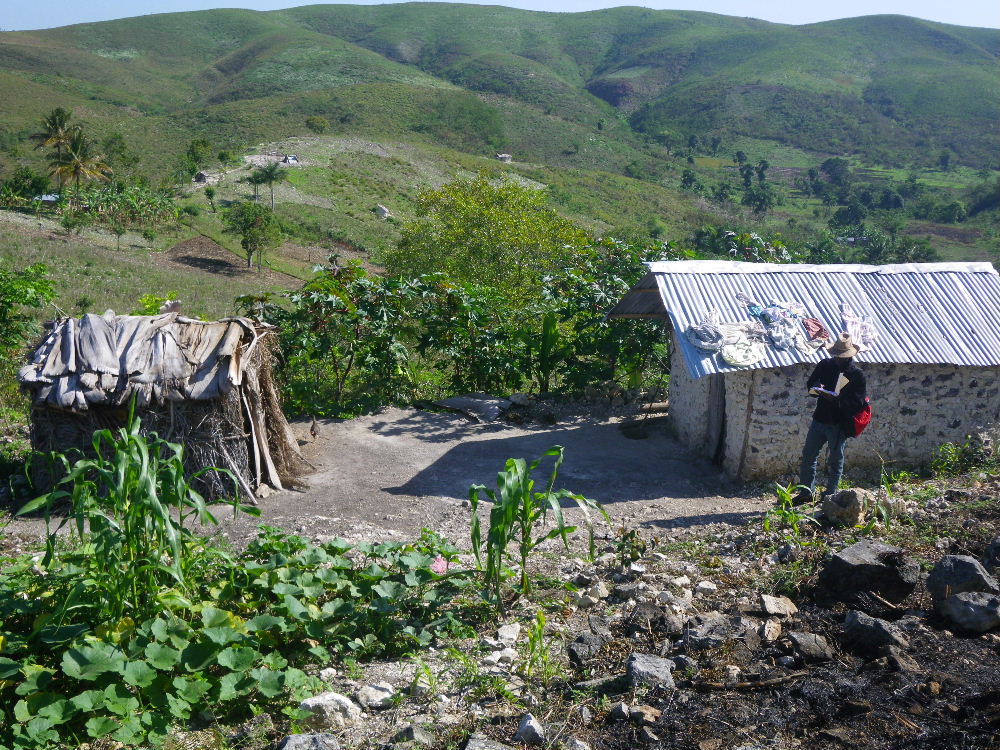
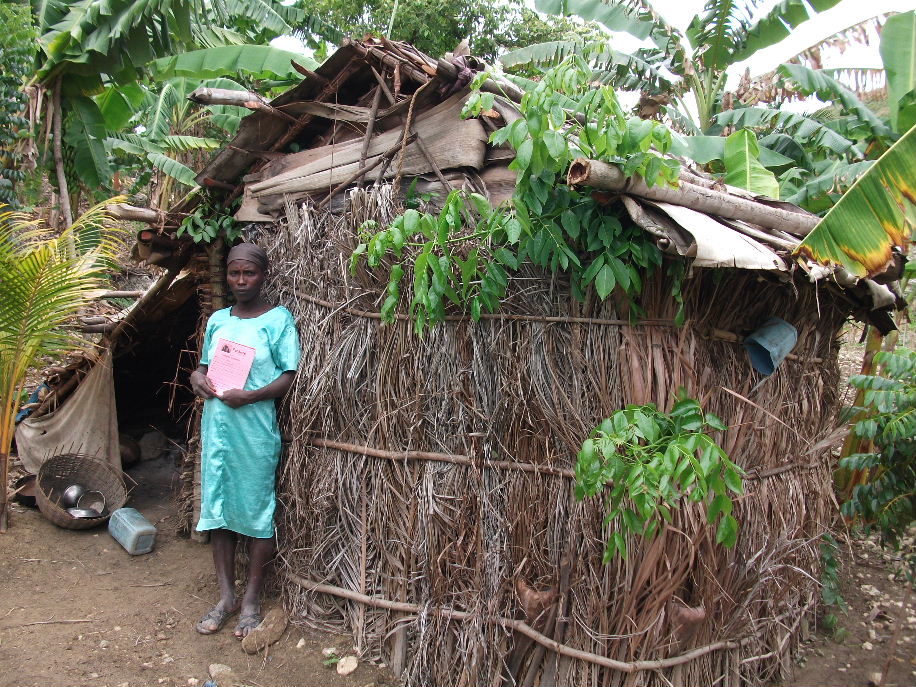
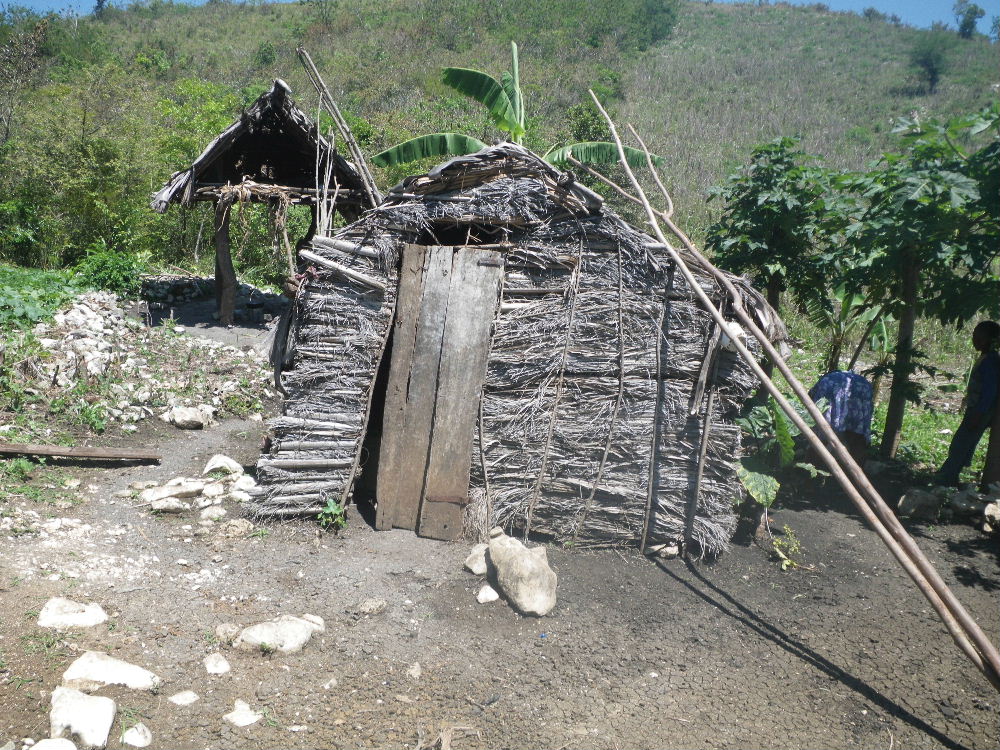
And it’s easy to understand. Most of the families we select for the program are living in terrible circumstances when we find them. Their shacks are thrown together out of the materials they can find: straw, sticks, and palm seedpods. Some of the women have the energy and the focus to make something more-or-less habitable out of the very limited resources available, but it is striking how many of them don’t. They fail to see the opportunities that even they have to make minor repairs to their houses because the small improvements in comfort or security that they could achieve are hidden by the daily search of something minimal to eat. Patching a roof or a wall, even when it would be helpful and easy, can’t seem very important to someone who has nothing to feed her kids.

All that is before women join CLM. We think of home repair as important for at least three reasons. First and most importantly, it is preventative healthcare. Families cannot stay healthy without a dry place to sleep. Second, it is economics. Members cannot engage in small commerce without a reasonably secure place to keep merchandise and cash. Finally, it is a matter of dignity. It is hard for a woman to become and to feel like a well-regarded member of her community if she lives in a shack that neighbors will always look down upon.

At the same time, we don’t look at housing as something we can just do for our members. They need to get used to doing things for themselves, and home repair is a good place to start. We give them roofing material and nails, and we pay the builders who put up the walls and raise the roof, but the members themselves have to provide the lumber they need along with the mud, rocks, or wood that they use to make the walls. It’s a big investment for our program: something like one-sixth of our total budget. And a big investment for our members: collecting the lumber and other materials can involve hard work, relatively big expenses, or both.

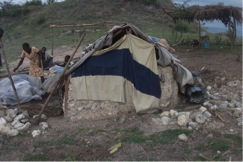
Here are some photos of homes before CLM home repair and one before-and-after shot:

All this is just a way of explaining why Monday afternoon’s activities in Bay Tourib seemed so odd. I went to two different CLM homes with a team of case managers and a carpenter who’s also a member of the local CLM support committee, and we removed the roofs from the houses and walked away with the tin.

The first case was straightforward, and we felt good about it. A CLM member had built her house on land that belonged to her partner, next to his mother’s house. He was abusive, and she had had enough. She wanted to leave him, but was worried that she wouldn’t be able to rebuild what she had with him. She was afraid to go by herself to take the assets that CLM had given her. So she talked to her case manager, and he talked to the team. He also talked to the man. The result of it all is that we went to the house as a team, with the man’s agreement, and collected her things: the tin roofing material, the roofing nails, some cement, her water filter, and a few personal items. There was a large and loud crowd, but the only sign of conflict was an argument between her and the guy’s mother over ownership of a spoon.

The second case was much more difficult. Moïse and his wife were selected for CLM because they were having a hard time just feeding their kids. A few months into the program, Moïse’s wife left him.

Normally, CLM would continue to support the woman, but we couldn’t in this case. She had abandoned Moïse and all their kids. So we decided to stick with the children, registering a daughter as the household’s nominal member. Titon, the case manager, would meet weekly with Moïse and the little girl, and they would come together to CLM trainings.

But it hasn’t worked out.

It isn’t that unusual for CLM members to be dishonest early in our experience with them. Why would they trust us? What must look like the best things we do for them — giving them assets to manage and home repair assistance — must also look too good to be true. Especially when they are surrounded by jealous neighbors, who are encouraging them to believe that we are up to no good. Distrustful members will sell a goat and then lie to us about it, claiming it was stolen or that it died. They decide to burn through their assets before we take them away again. Generally, we stick by the members as they learn that we are really looking to support them over the long haul, and things work themselves out.

Moïse’s case didn’t work out. He sold two of his daughter’s goats, lying to Titon to hide what he had done. When Titon confronted him with evidence that he’d sold the goats, he changed his story, claiming that he had sold them because he had an urgent need for cash to by clothes and supplies to send his children to school. When Titon spoke to the children in his absence, they denied that their father had given them any of the things he had pretended to buy. Titon confronted him with this additional lie. By that time, Titon had spent some time asking around, and he learned that Moïse had spent the money on another woman he was trying to attract.

Moïse agreed to buy a goat to replace at least one of the ones he had sold off, and Titon agreed to keep working with him. A couple of weeks later, Moïse showed Titon the goat he had purchased. Titon asked to see the goat’s papers. He wanted proof that the goat in fact belonged to Moïse, and when Moïse showed them to him he hoped that he had worked through the worst of the lying and that they could now move forward. He decided to hold onto the papers for a little bit just to be sure.

His hope didn’t last long. The goat, it turns out, belonged to one of Moïse’s neighbors, an older woman who had asked Moïse to look after it for her. He convinced her to lend him the goat’s papers as well, but when she asked him to return the papers and he had to explain that he couldn’t, she decided to make a lot of noise.

For Titon, it was the last straw. He felt he needed to do something to show that the agreements we make with members mean something. They sign a contract in which they promise not to sell the assets we give them without our permission. Not only had Moïse broken the promise more than once, he had lied about. Other nearby CLM members were also telling Titon, who is loved and respected by most, that Moïse had been encouraging them to do as he had done.

So we decided to suspend Moïse and his family from the program. We went to their home, removed their roof, and took their water filter. Their two remaining goats are already in the hands of a committee member, who’s holding on to them pending a final decision.

Taking the roof off a poor person’s house is very far from what our role should be. Moïse’s yard filled with neighbors as we worked, talking quietly and staring in disbelief. After we had removed the first few sheets of tin, I heard someone say, “//tout bon//?” That’s like asking whether what she was seeing was real. Would we really carry out the threat Titon had been making to remove Moïse from the program? I think we did the right thing. I don’t think Moïse left us any choice.

But I was chatting with another CLM member as we were removing the roof, and we had to agreed that it was an ugly, if an appropriate, thing to do. It’s the wet season, and as heavy rains fell late that night, I had to wonder how Moïse and his children were making out. I was dry, lying in a comfortable bed, in the residence we share with the Partners in Health medical staff.

Difficult End Games

Bwawouj is an oval valley, bordered on the north by a steep ridge that overlooks the major market in Regalis, in Ench. On the south, it is enclosed by another high ridge, this one slicing through Tit Montayn, from east to west. From our base camp in Zaboka, it takes almost two hours to get to the edge of Bwawouj — two difficult hours — and that base camp is already a four-hour hike from Viyèt, the closest our motorcycles can reach.

So, Bwawouj is one of the remoter parts of our territory. Orweeth is our case manager there, though he generally goes by a nickname, “Baba.” He’s been spending his Tuesdays in Bwawouj since January 2011. It’s a high-pressure situation because we have very little hope of helping our members there any time between visits. Baba has been struggling together with about a dozen CLM members as they’ve worked to build up their assets — mostly livestock — and learned to live better, healthier lives. Towards the end of June, the members in Bwawouj are scheduled to graduate from our program. They should be able to feed their children well, have asset bases large enough to help them weather a shock, and plans that will enable them to continue improving their lives after CLM leaves.

But the progress that CLM members make is always fragile. Their lives change dramatically during the program’s eighteen months, but the majority remain very poor. And though they can weather much more of a shock than they could have before we met them, they are still very far from anywhere that one would really like them to be. As we help these members move towards graduation, we struggle with them and the difficulties, both large and small, that continue to stand in their way.

Mirlène lives with her husband, Orélès, near the top of the ridge that looks down on Regalis. Their home is about as out-of-the-way as we get. They had two little girls, a five-year-old and a baby, just over one. A couple of weeks ago, the baby got sick. She had a fever and diarrhea, nothing very uncommon for a baby here.

Orélès reacted quickly. He ran to the midwife who had delivered the baby, convinced that his daughter was sick because he hadn’t yet paid the midwife’s bill. What the midwife said to him is worth quoting exactly. “Dlo a gaye, men kanari a la.” That means, “The water’s been spilled, but the pitcher’s still there.” It was a way to say that the baby was going to die, that Orélès should see to the mother instead. The midwife told him that he need not bother to bring the baby to a doctor. “Se pa yon maladi doktè.” That means, “It’s not a medical sickness,” and it is a way to say that the disease is related to some sort of mystical curse.

Orélès rushed back home to find the baby dead and his wife feeling sick. He and Mirlène struggled to plan a decent funeral, borrowing about $20 for a casket and almost twice as much for other funeral expenses.

By the time they had buried their daughter, Mirlène was really sick. Orélès ran with her first to a small clinic in Regalis, run by World Vision. It’s almost two hours from his home, but superior and less expensive care at a Partners in Health clinic is at least twice as far.

He bought all the medications the World Vision team prescribed, but then watched as his wife’s state continued to deteriorate. So he spoke to a friend who told him about a very skilled Vodoun practitioner in an area called Nan Chanbo, on the eastern end of Tit Montayn. It would be a long hike, but his friend assured him that the healer would be able to help Mirlène. He thought about the midwife’s claim that the sickness was not medical, and decided to bring his wife to Nan Chanbo. She’s still there, but is apparently recovering well. She should be ready to leave the healer’s home in a few days.

But now they have significant expenses to manage, expenses that could easily derail their progress forward. The $60 for the funeral is only part of the problem. The Vodoun healer assesses two separate fees. Orélès will have to pay about $30 just to take his wife home. After that, he will owe about $190 more as a final bill. That larger sum he will pay in five installments, coming once a year to the healer’s Vodoun festival in December with one-fifth of the fee as a tribute.

So even though they can carry that main fee as a long-term debt, they would need about $90 right away, and the only place they could generally look is towards their livestock. They have a substantial crop of beans that will generate some money if the harvest is good, but it won’t be ready until July. They could sell a couple of goats to get themselves out of the hole they are in, but we don’t want them to do that because their goats are the key to the asset base that we want them to develop.

Fortunately, there is a solution. We budget a small amount of money for emergency expenses. It’s a fund conceived just for cases like this: sudden expenses that risk throwing a member back into the extreme poverty she has struggled to rise out of. We have arranged to meet Orélès in a nearby market tomorrow morning, and will give him the money he needs to eliminate his immediate debts. He’ll still have to finish paying the healer, but he and Mirlène will have five years to take care of that.

In the meantime, they can continue to build up their assets. They are ready to buy a horse, which will enable Mirlène to start up a small commerce in the markets across the mountains as soon as she feels able. We cannot help her or Orélès with the grief that they feel, but we can support them so that they stay on their feet as they move forward on the path out of poverty.

Sephilia’s case is more complicated. She’s an older woman who’s raised eight children, seven of her own and an orphaned niece. All eight are married. Sephilia would not have qualified for CLM, but one of her sons was abandoned by his wife, who left their daughter behind. She became Sephilia’s ninth child.

We don’t know whether it was his wife’s abandonment or something else, but something drove Sephilia’s son crazy. He spends his days yelling and clapping and making other noise, then hiding behind a fence of straw that he’s built up next to her house. He does no work, but lives on what he can get from his mother. She always shares whatever she has with him, but it’s never enough. He is aggressive towards her, even violent. He threatens her with fists and rocks, and if you challenge him about it, he acts as though he doesn’t know what you’re talking about. She struggles to keep any food in the house at all because he will take anything that appeals to him, claiming that CLM has made her rich and that he is hungry, and then leave her and his daughter to fend for themselves.

But there is some method to his madness. He has never threatened or laid a hand on his daughter. His elderly mother has born the whole force of his violence. And he hasn’t touched the assets that his mother has begun to accumulate, though the goats and poultry would seem vulnerable to damage or theft.

Now, Sephilia is, more or less, ready to graduate. She is much less wealthy than some of her fellow members. She’s an older woman, and cannot work very hard. But she has about enough in assets to meet our minimum criterion, has farmland that she can continue to build wealth with, and a plan to grow. But the life-threat that her son represents puts all of that continuously at risk.

She’s spoken to her other children, and there is a son who would especially like her to simply move into his home. But her other children, she says, want her to stay where she is. They like the fact that they can come by anytime and get a cup of coffee or a little something to eat from their mom.

While this might sound like their selfishness, I think the truth is deeper than that. Her life in the yard in which she raised her children, where her husband’s body rests, means a lot to her. She seems to find much of her sense of worth in the little things that, as poor as she is, she can offer her kids. Though she understands that it makes sense for her to leave her home to live in a place where she’d be safe, and though she could easily bring all her livestock with her, that’s not what she wants to do. She says that her children want her to stay where she is, but she talks and acts as though it is what she herself wants. And it’s hard to blame her.

But it’s also hard to figure out how to protect her from her son. The nearest legal authority is almost two hours away on foot. She has another son and a son-in-law who live within fifteen or twenty minutes from her — there are no closer houses — but they are in their own fields all the time. We haven’t been able to get a hold of them yet. She says that her son-in-law in particular has said he’ll protect her, but that’s not working so far.

So we spent a lot of time with the crazy son while we were up there– talking, explaining, and threatening — trying to communicate how important it is for him to let his mother be. She still doesn’t have a door that she can lock on her new home, and Baba has pushed the carpenter who’s responsible for the door to get it done. But we are not sure what else we can do. We won’t be anywhere near her for almost two weeks, and we just have to hope that things will remain stable until then.
Izemène Pierre

by Gauthier Dieudonné, Director of CLM

Izemène Pierre is a forty-year-old mother of eight, who lives in Brinèt, a community right off the main road leading to the town of Saut d’Eau. She used to live in Petit Bois, a village in the neighboring commune of Lachapelle. Her husband was the sole bread winner of the house, and when he died, she was left to fend for herself and her children.

Desperate and homeless, she and her children followed a man to the annual week long festival of Saut d’Eau. A couple of days after getting there, the man disappeared. She turned to begging, and the children began doing chores for other people so they could get something to eat. At night they would huddle together on the streets to sleep, something that a lot of people do during the festivities.

Once the festival was over, they could no longer sleep in the streets. They started roaming through those streets and the roads leading into and out of the town. At the end, they began squatting on a piece of land along side of the main road.

The caretaker responsible for the land didn’t have the heart to throw them off. He allowed them to put up a shack that her oldest sons made out of twigs and mud. In December 2011, she was selected for the CLM program. She chose goats and pigs as assets. In addition, she received the rest of the items in the CLM package.

Once the owner of the land found out that a latrine was being built for Izemène and a more permanent housing being assembled, he offered to sell her a piece of land where she could establish herself and her family. Most landowners would have just thrown her out. He didn’t want to have the more permanent structures on his own land, but he was willing to make things as easy for Izemène as he could. He even gave her some time to figure out how to get the money.

But there was a problem: CLM has no funds to buy land for its members, and Izemène had nothing like the money she would need. On the other hand, if she could not buy the land, she would have to leave it.

The solution came as a surprise to us all. The CLM program often receives visitors, and we always take them to visit our members. We took a group to visit Izemène, and they were so moved by her situation, that they decided to make a contribution so that she could buy the piece of land.

Now Izemène is the proud owner of a piece of land with proper legal documents. This is the first time she has ever owned anything that valuable. Now that the raining season has started, her case manager and her regional supervisor are rushing to make sure that her house is put up to protect her and her family from the rain.


Vegetable Gardening

As the rainy season begins, we are trying to help our members plant vegetable gardens. Though almost all of them farm — whether on land they own or rent, as sharecroppers, or as day laborers — few grow vegetables. They principally grow staples: corn, millet, and beans.

We want them to look to vegetable gardening as an easy way to add both some nutrition to their diet and some income to their household. We have been emphasizing spinach, okra, carrots, and peppers: all crops that are familiar to Haitians and easy-to-grow. Our approach has been to invite members in each community to set up a model garden on one member’s land. They see and experience how to establish a garden that’s likely to succeed. Then we sell them inexpensive seeds at cost

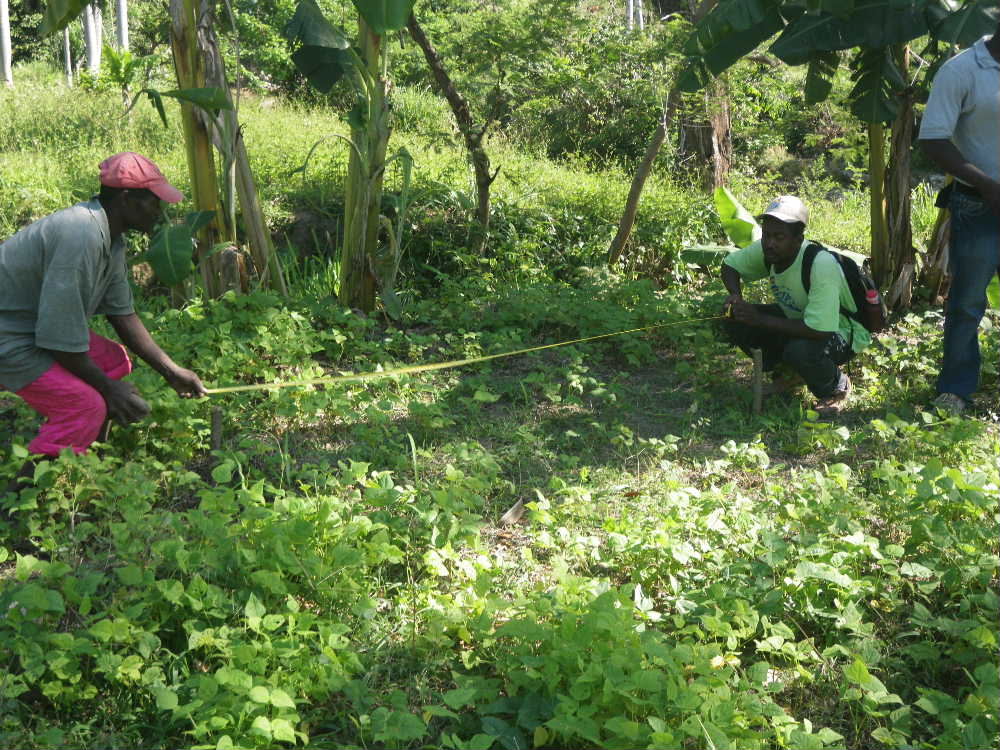
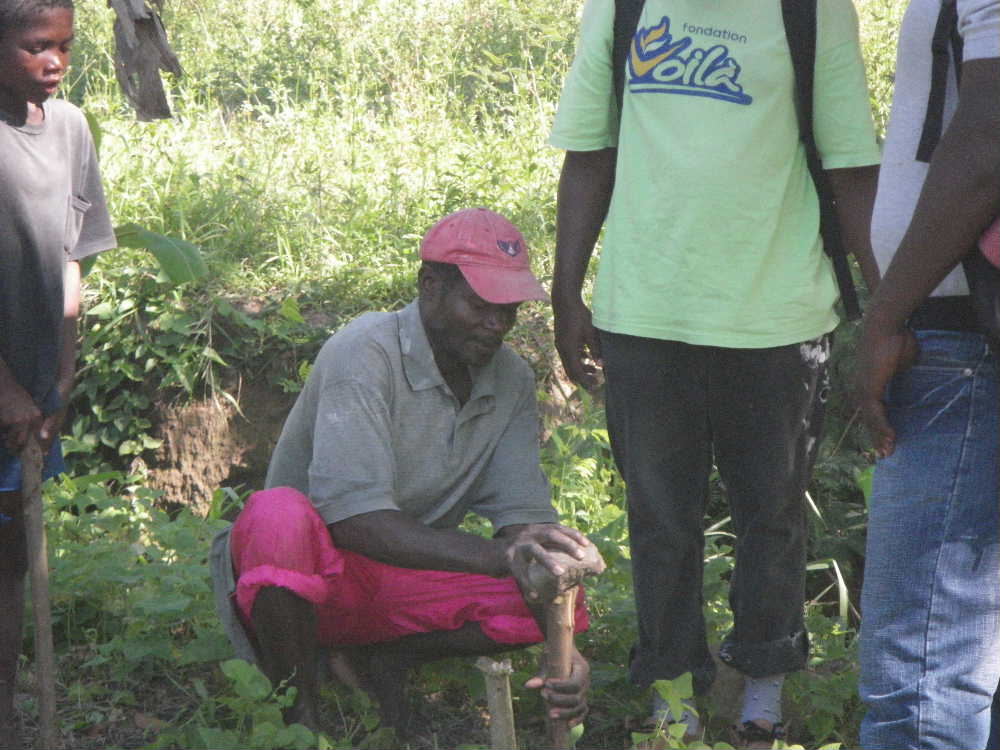
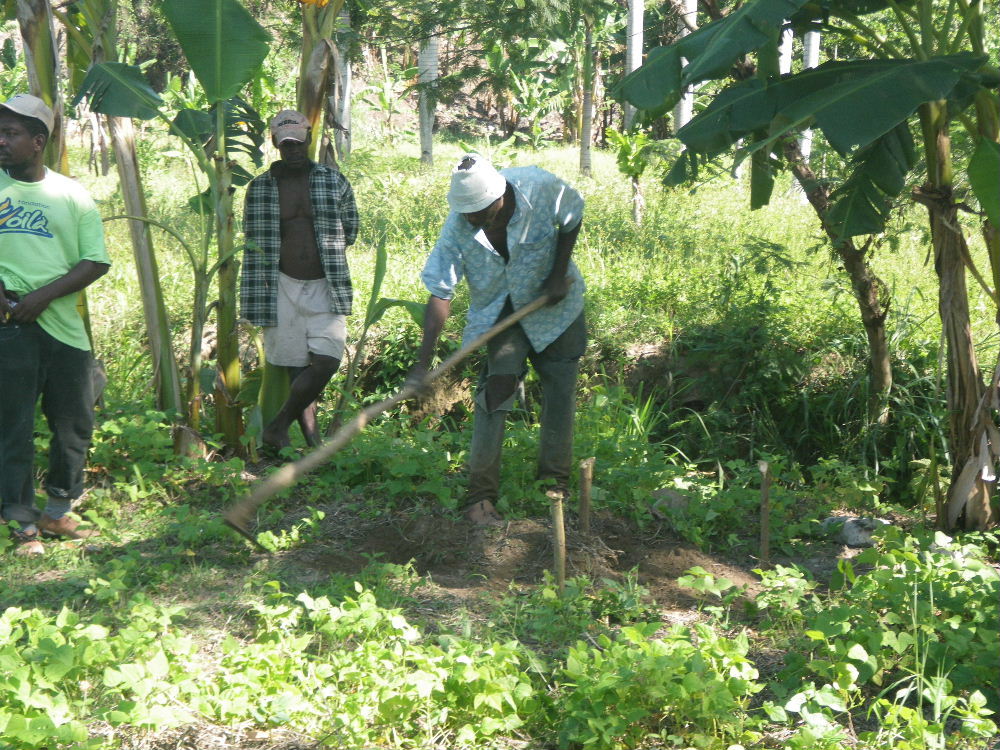
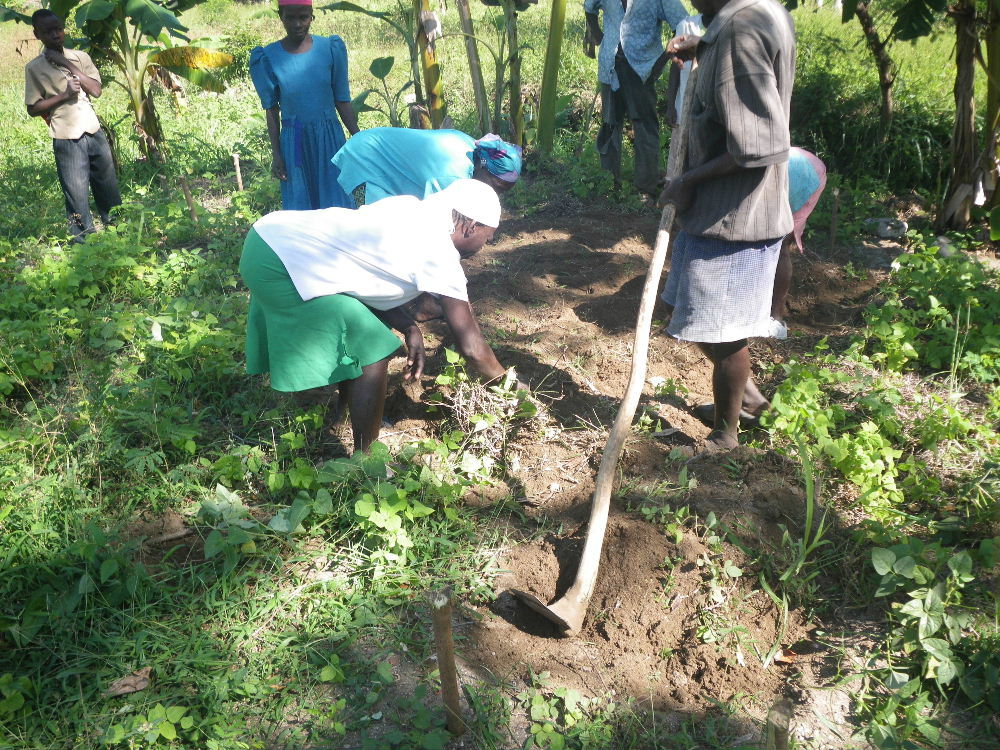
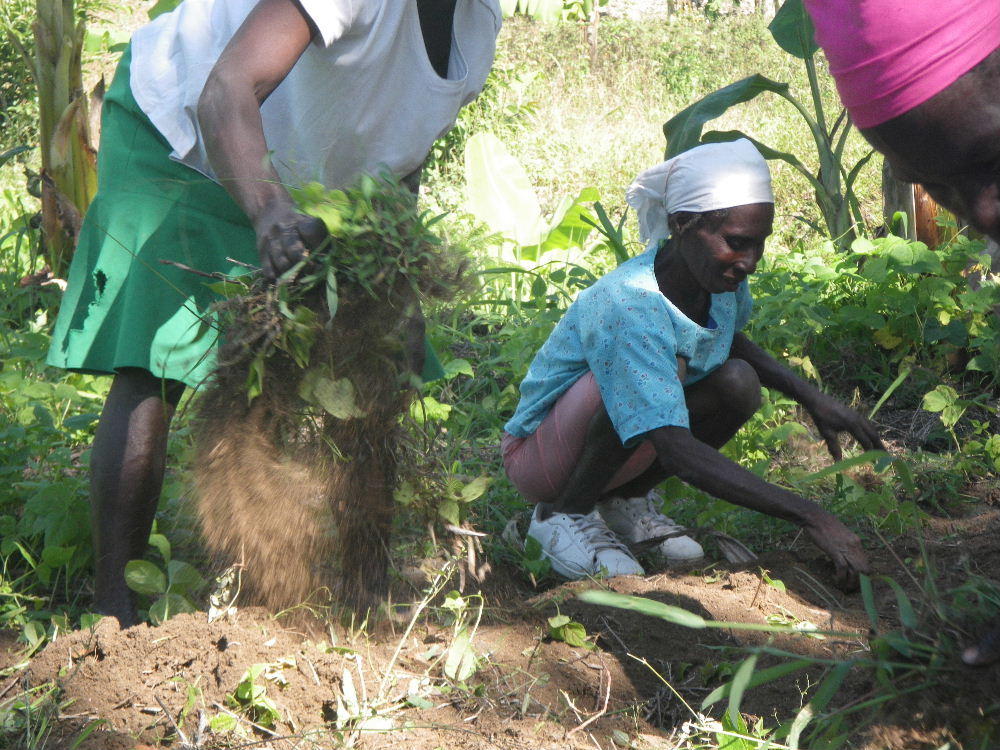
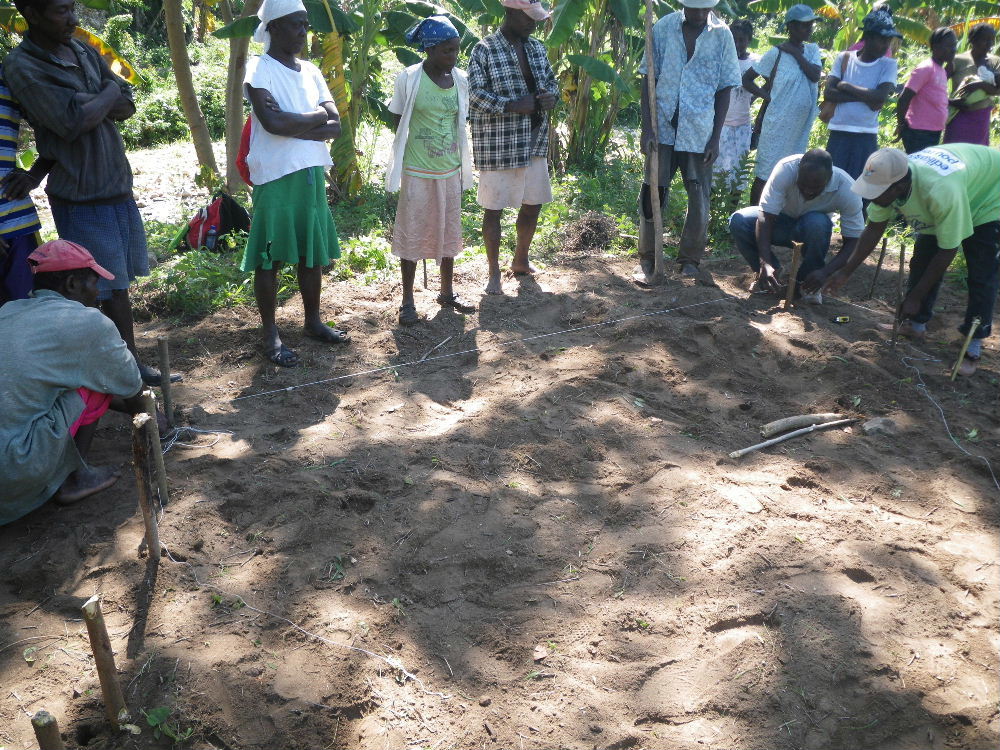
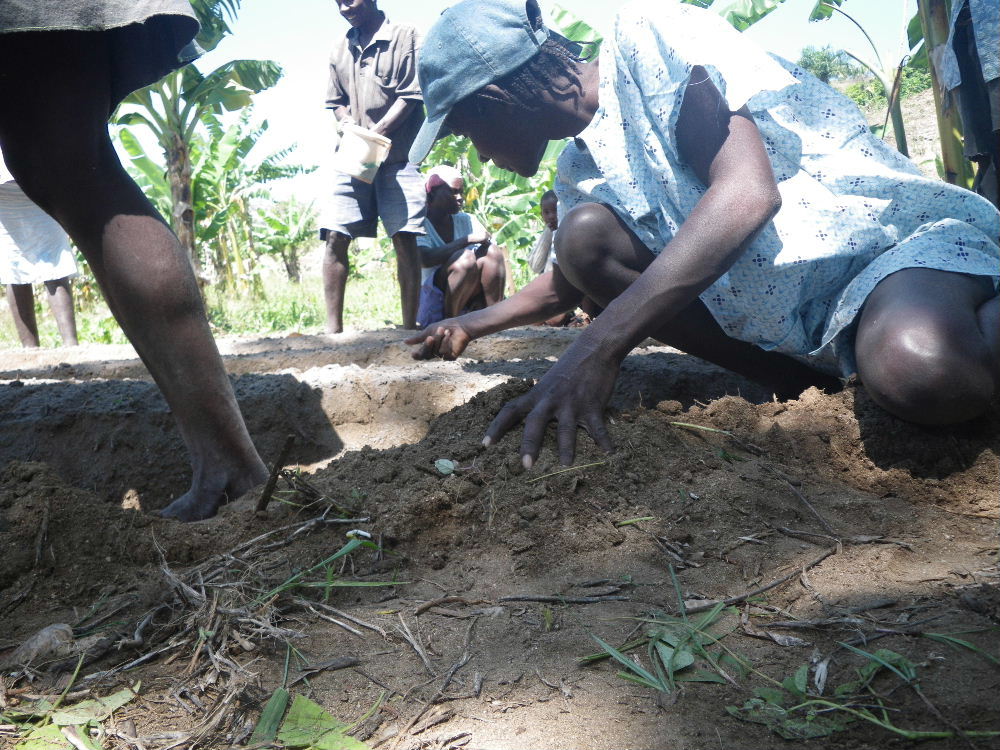
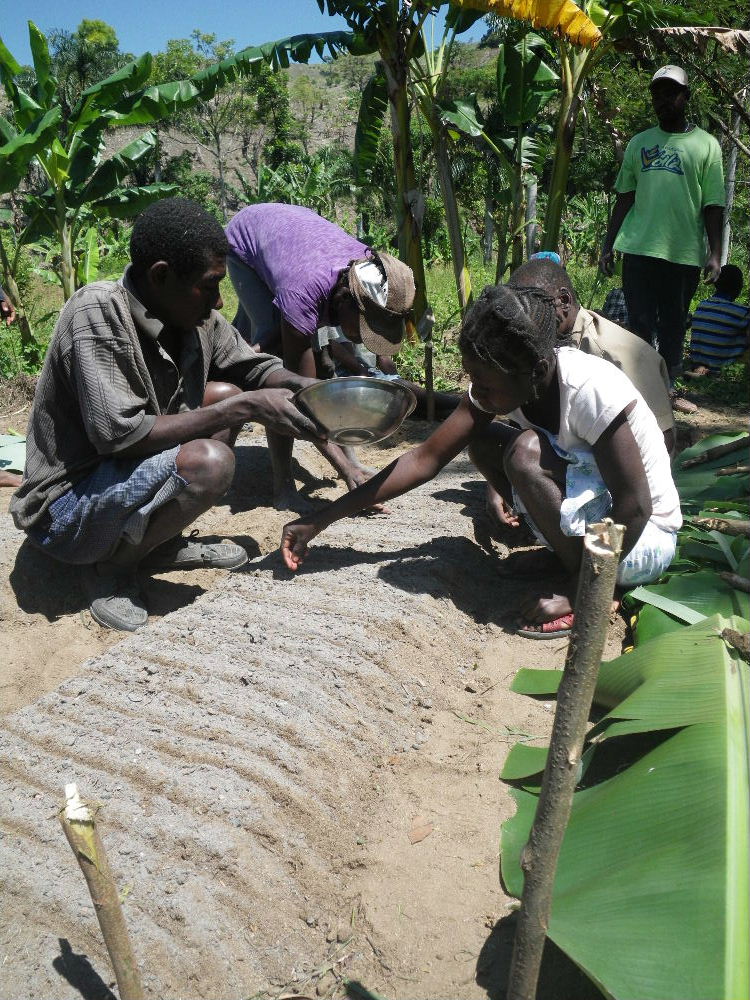
The photos below come from Dotif, a large community in Bay Tourib, about an hour’s hike from our base. Case Managers Rony Dorrélus and Ricot Baptiste led a group of CLM members and their husbands through a morning of work as they prepared a garden patch and then planted it with spinach, peppers, and carrots.

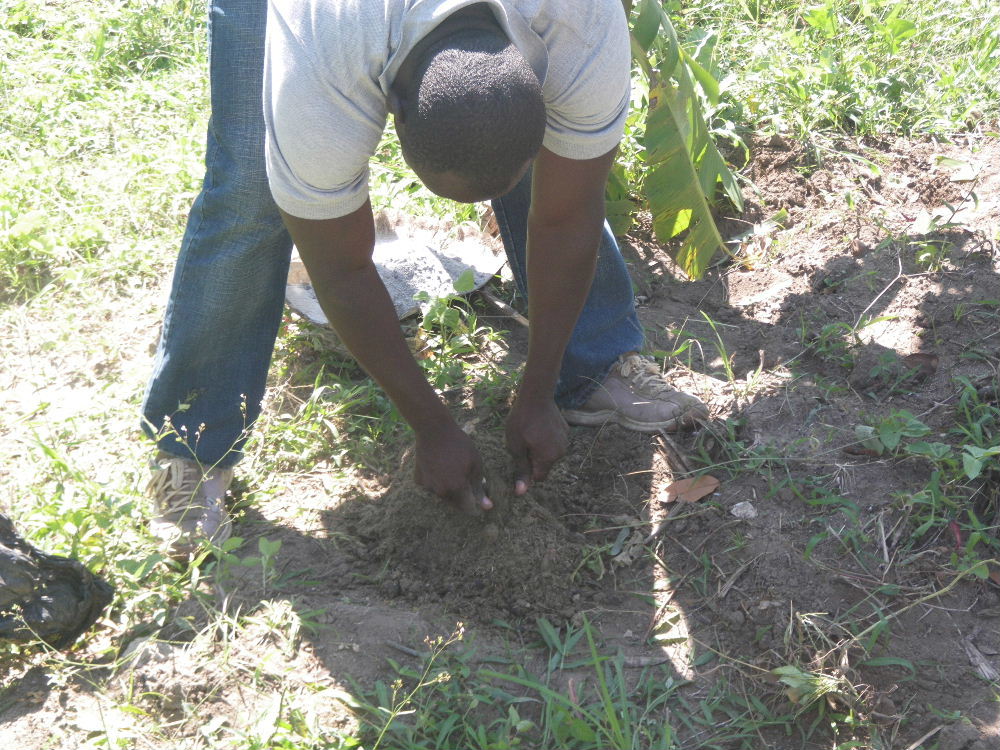
They started by measuring a small square off land close to the river that separates Dotif from Marekaj. The land belongs to Renia and her husband Johnny, a CLM family whom Rony serves. Here Rony and Johnny do the measuring. They drive sticks into the ground as markers.

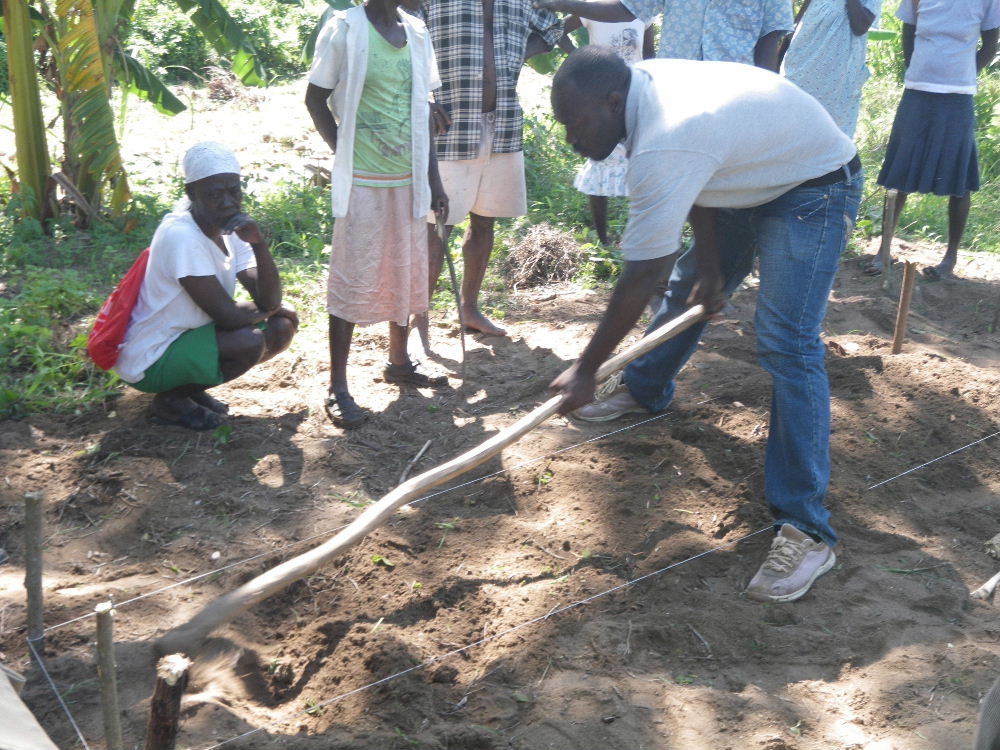
They then clear the weeds off the land with a hoe. Husbands took turns.

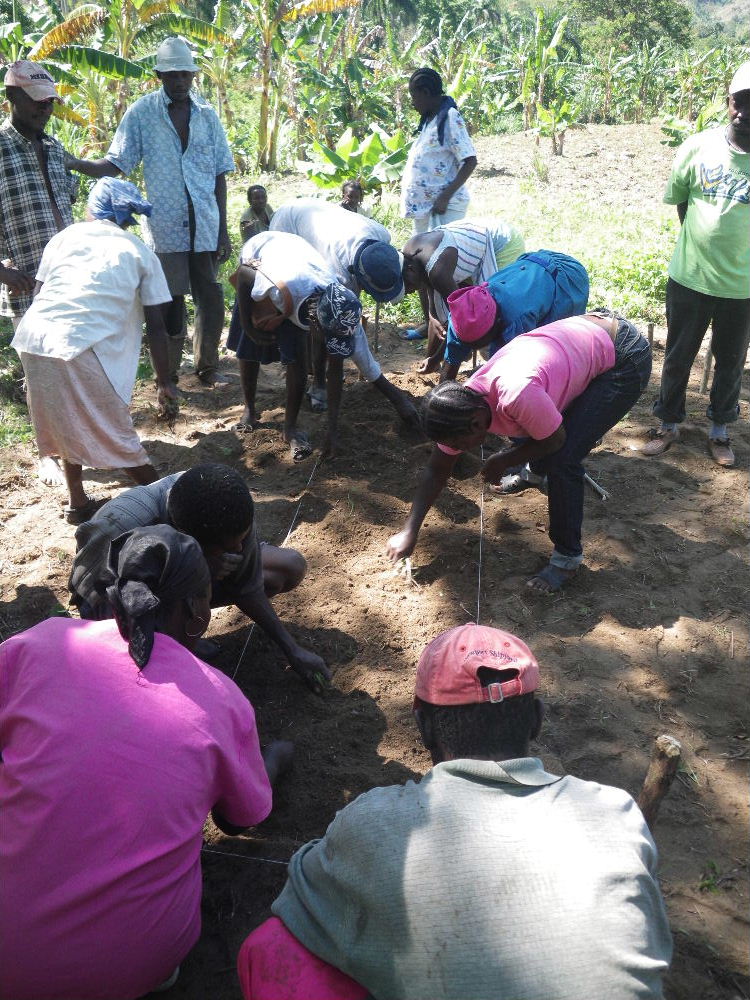
The wives went through and picked out the weeds that had been hacked down. This minimizes the need for weeding later on.

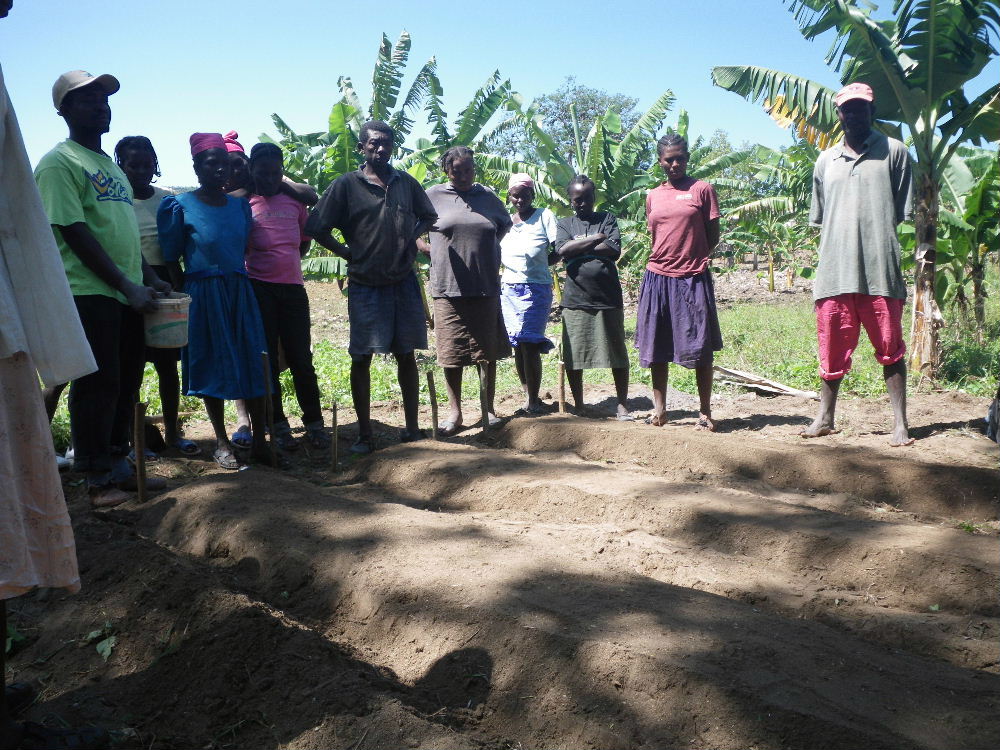
They then measured off three distinct rectangular strips. They’ll eventually plant a different crop in each.

They worked hard to get all the little rocks and the last traces of weeds out of the rectangles. The strips were lovely.

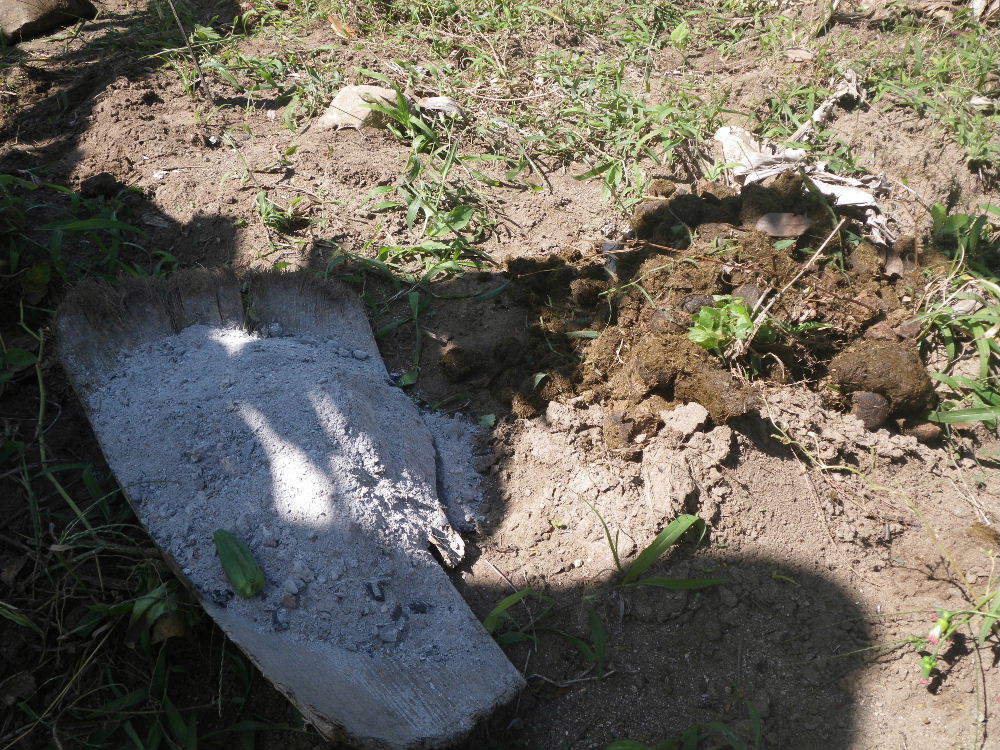
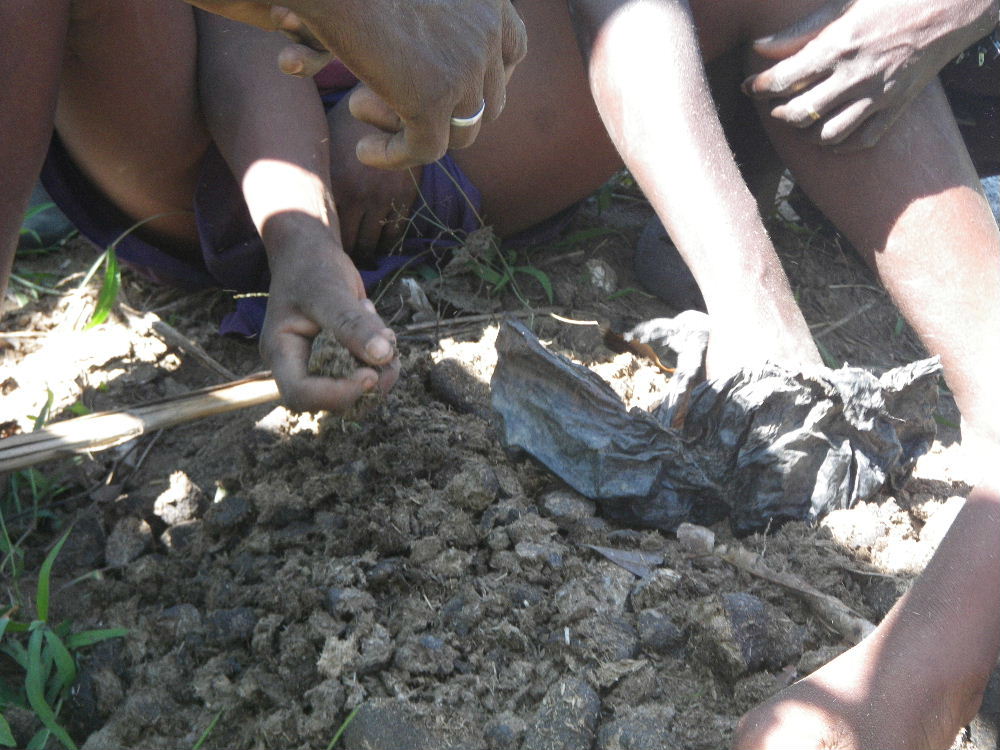
They mixed their own fertilizer, a blend of fireplace ashes, horse manure, and good dirt. They work the clumps out with their hands.

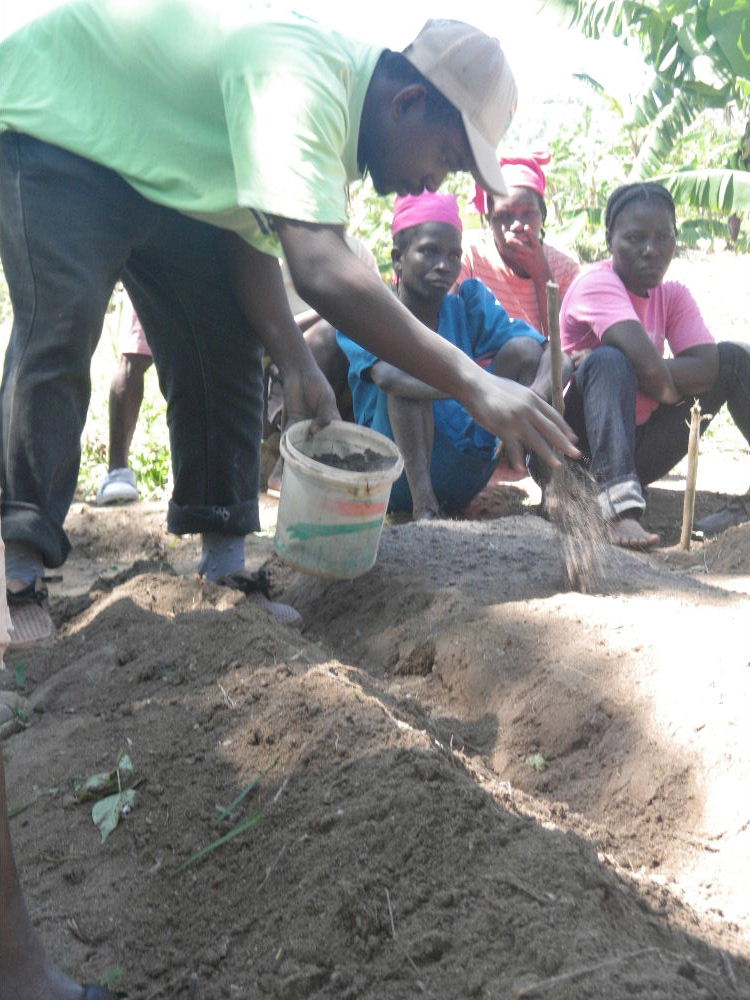
Rony showed them how to sprinkle the fertilizer lightly over the areas they would be planting.

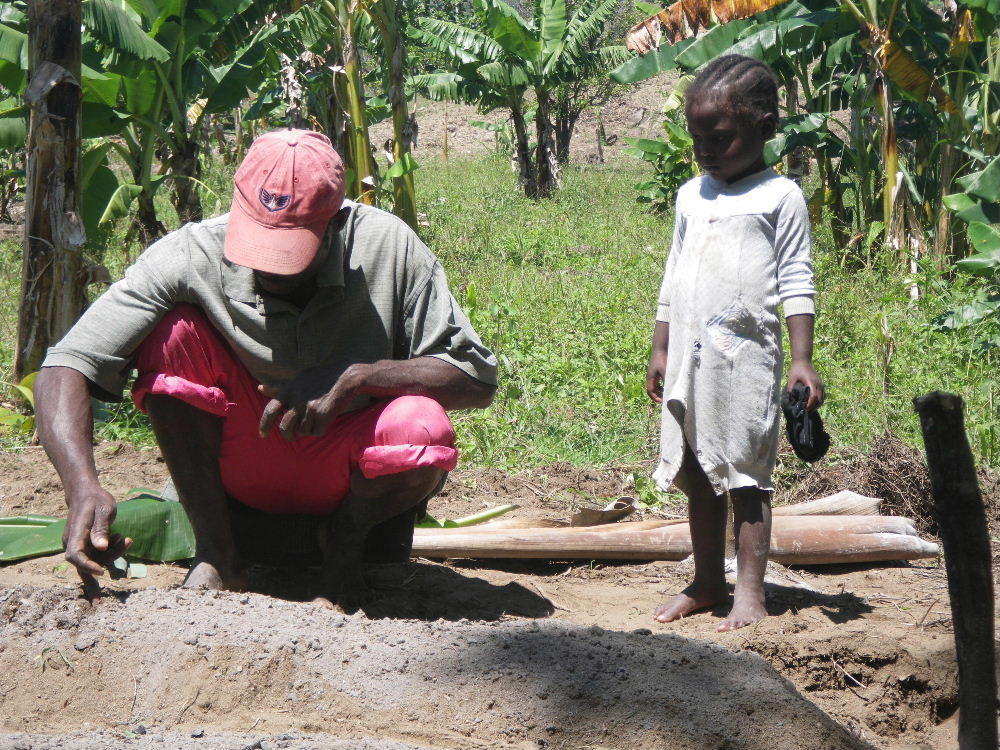
Then they planted the seeds in parallel stripes they would trace across the rectangles.

Renia’s daughter, Da, watches her dad plant some carrots.

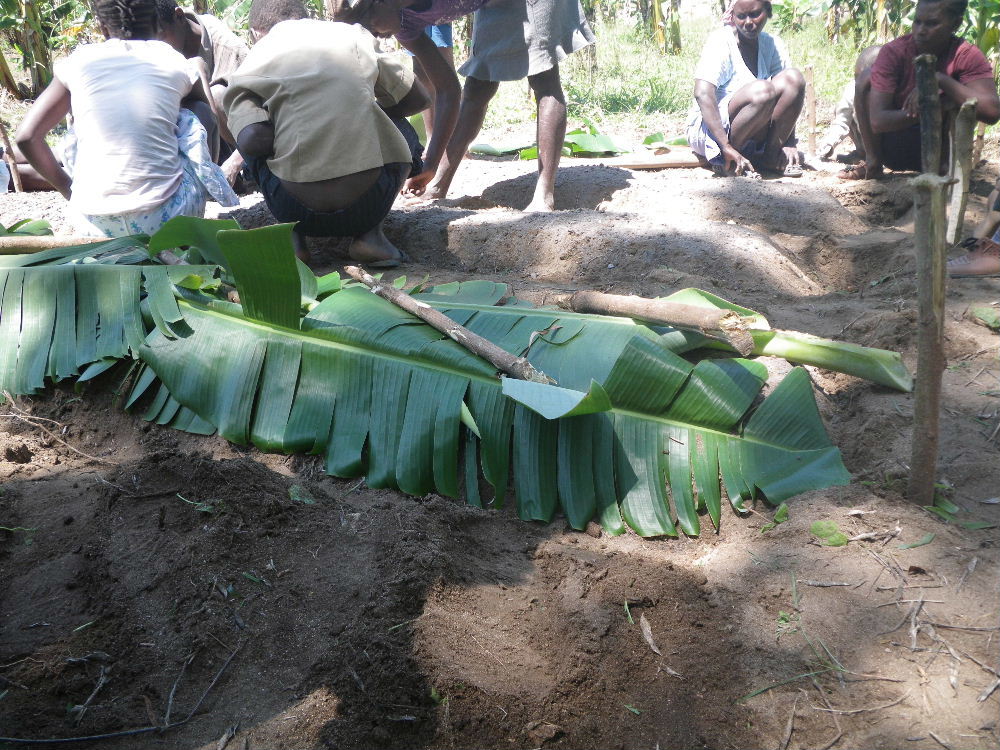
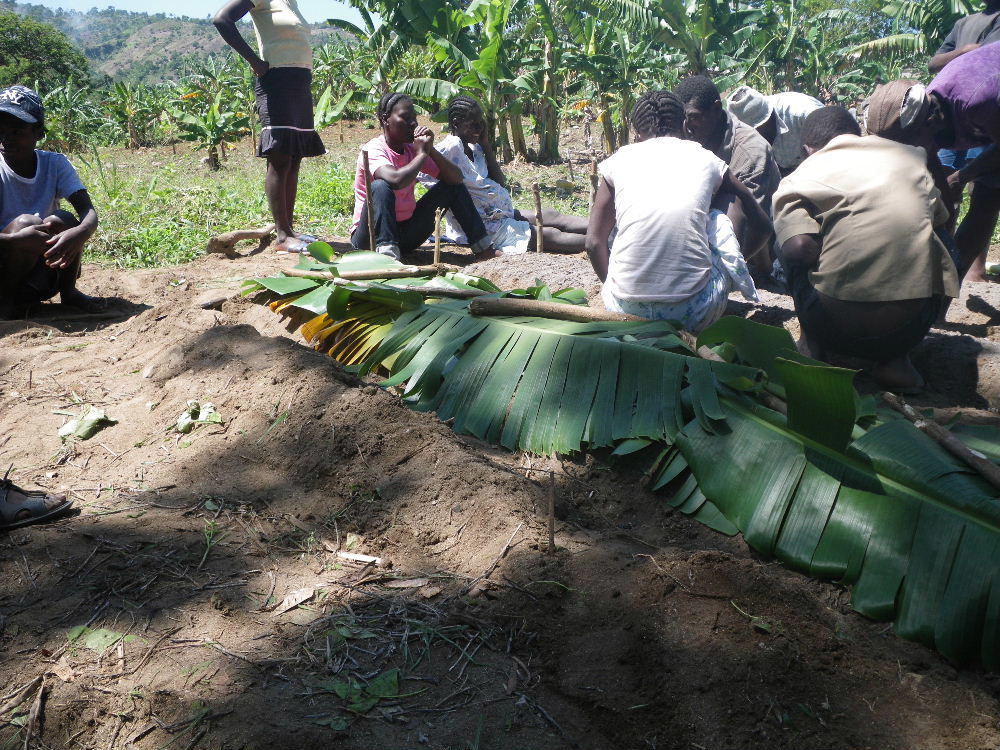
They covered the rectangles with banana leaves and watered them. In a couple of days they’ll start checking to see whether the plants are emerging. As soon as they start to see the shoots emerging, they’ll remove the banana-leaf covering.

This little garden should provide Renia’s family with plenty of spinach and carrots. When the pepper plants start growing, she will share the seedlings with her neighbors.

Marie Gedéon, cont.

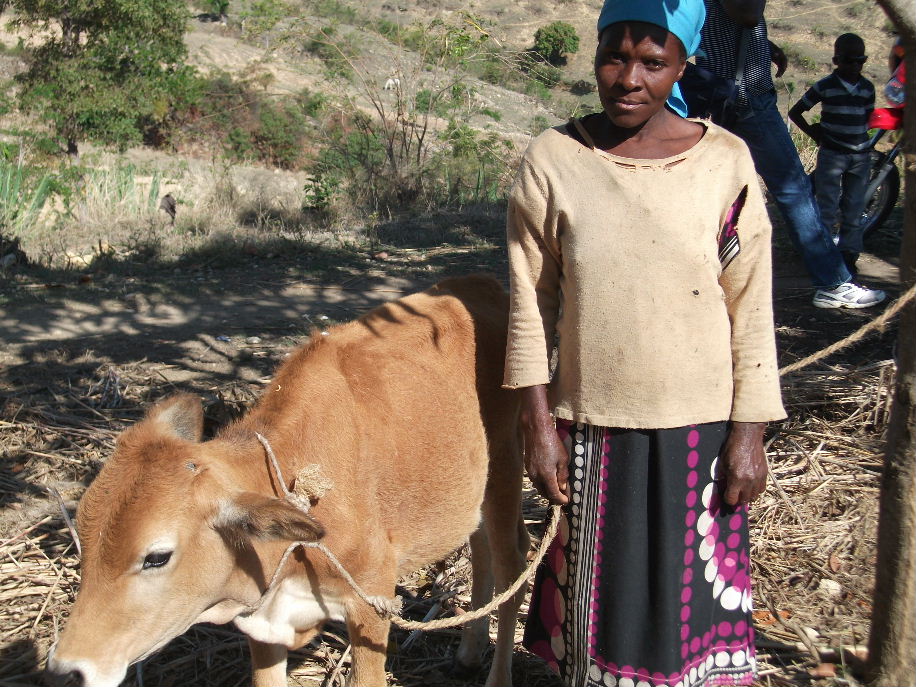
Marie Gedéon has made a lot of progress since we last spoke to her. When I first wrote about her, I called her “Ann.” (See: Introducing Ann.) In a second piece, I described her initial progress. (See: Ann, Part Two.) Her real name is Marie Gedéon, though she is often called by her husband’s name, Madanm Kapitèn. She’s a CLM member from Giyòm, living in an isolated home on top of a hill in the middle of that road-less, agricultural area of Boucan Carré. When we first met her, things were really hard. She was struggling, not always successfully, just to feed her seven children. Her husband, almost paralyzed, was unable to help at all.

Her sole source of income was the scrub palm she could collect from the hills where she lives. She would sell it to passing merchants, and make about five dollars a week. She was grateful for the occasional small bag of sweet potatoes her sister-in-law would give her. She joined the program with enthusiasm, explaining that “a woman always has something going on,” and she went right to work.

She caught her first break when her husband’s health improved. Within a few months of their entry into CLM, Kapitèn was healthy enough to help his wife care for the cow she received from CLM thanks to a special gift to CLM. And his health continued to improve. Now, over two years since he first grew ill, he is able to farm their land again. Their farming is important, too, because Marie Gedéon’s cash income is still weak. The farming that she and Kapitèn do is their main source of food for their kids.

Her cow has been doing very well. It gave birth to a healthy calf, which is flourishing. The excess milk that it produces beyond what the calf needs goes straight to her children. “I don’t want to sell the milk, because I want to make sure the calf has enough. But the kids enjoy drinking it, and it’s good for them.”

Her goats are now flourishing as well. She originally received two from the CLM program, and she bought a third with some of the money that she consistently set aside from her six months of food stipends. Setting that money aside cut into her ability to feed her family and send the children to school, but she felt strongly that her family’s future depended on her saving her money. So, she said, they just needed to be “resigned.” Eventually, two of her goats had kids, which brought her total to five.

But she knows that she will have to start a small commerce if she is ever going to be able to feed her children every day and send them to school, and that she lives too far from the nearest roads and centers of population to be able to develop a business without a horse to carry her merchandise. So she sold one of her larger goats, added the proceeds from the sale to savings from her food stipends and money she made by selling some charcoal and some of their last harvest, and bought a small horse. “I’m just not someone who can carry a lot on her head, and not many people will climb up to my house to buy anything I want to sell.”

So now she has a horse to carry her merchandise with, but still has no merchandise. But she’s not worried. She still has one young male goat, though it’s a small one, and she plans to sell it in a month or so, and use the proceeds to buy merchandise.

One last note: The interview that led to this story was held in Boucan Carré. Marie Gedéon had come to a one-day eye clinic that visiting American optometrists were offering to CLM members. The clinic is not a regular part of our program, but we try to develop any contacts that come our way to get our members services that we know they need. Marie Gedéon didn’t feel the need to have her eyes checked. Her vision is good. But she knew we needed to speak with her, so she came by.
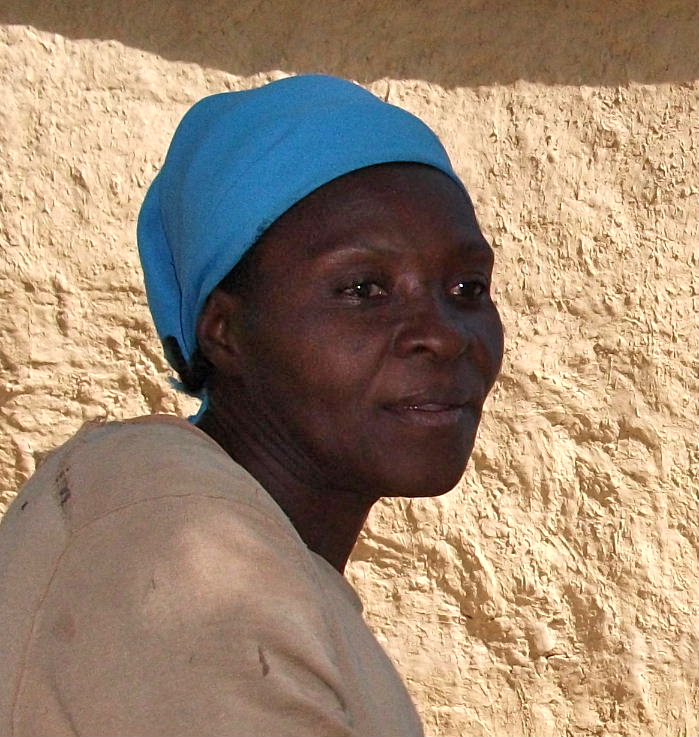
It was lucky that she did. While she was there, one of the optometrists checked her out. It turns out that she has early but clear indications of glaucoma. We gave her the drops she will need to use daily in order to save her vision.

Domestic Violence

Men who beat or threaten their wives or life-partners are an important and difficult problem for our program. Our core strategy is to help women develop independent and sustainable sources of income. Such independence can position women to escape from some violence. But it can also increase the threat of violence, because men can feel threatened by that very independence.

It’s not that domestic violence is especially common among the families we work with. I have no reason to think that it’s either more or less common than it is in other segments of the population, whether those other segments are in Haiti or somewhere else. I don’t have the data. But we have to address the cases we come across, because our program simply cannot succeed unless we do.

I’ve written of Ifania and Grenn, a case in which we were able to intervene with great success. (See: Dele Gasyon.) Grenn is now among the most enthusiastically cooperative husbands we deal with. He worked hard to help Ifania build her house, has defended her loyally in the face of his mother’s jealous interference with her progress, and helps her take good care of her animals. Some stories have happy endings.

I’ve also written about Oranie Pierre. (See: Oranie Pierre.) We haven’t really been able to work things out for her. We want to put her husband in jail, but it requires her agreement. Every time she’s on the verge of asking us to help her do so, he disappears for a couple of days and then returns, less violent. She then decides that she’d like to give him another chance.

And it’s not as though arresting him would be easy. Oranie lives far from anywhere that police regularly go. And the way their home is situated, offering a clear view of the approaching paths, he would have an easy time clearing out if he felt threatened. Police couldn’t approach without his seeing them. So his neighbors would have to arrest him first and deliver him to the police. But they’re a little afraid of him too.

So Oranie continues to move forward, but her progress is fragile. We can’t know when or whether a new act of violence will set her back again. What is certain is that we have to keep working at these problems wherever we encounter them. And we have to grasp at whatever means we can find.

Santiague must be in his 70s. He’s a short, slightly tubby man, with what always looks like a few days’ growth of thin, greyish-white beard. He’s not very distinguished looking, but appearances proverbially deceive. I know him mainly through his daughter, Menmenn. She’s a woman, about my age, who works as the cook and housekeeper at the residence we share with the Partners in Health staff in Bay Tourib.

Menmenn is also a leader in the Bay Tourib community. She’s one of the founders of O.D.B., the Organization for the Development of Bay Tourib, which is the peasant group that originally invited Partners in Health to open a clinic in their town and then worked hard to help us get our work started, too. As one of the most comfortably literate of its founders, she serves as the group’s secretary. People look to her. Her opinions matter. Her grandparents raised her, and they must have made a commitment to her education beyond what other Bay Tourib parents were offering their girls.

Santiague first came to my attention the day we inaugurated CLM in Bay Tourib. We held a large celebration. More than 1000 people attended. In all the confusion, Partners in Health’s most senior representative lost her camera and her cellphone.

“Lost” is a euphemism. They were in her bag, which she put down for a moment. When she went back to the bag, the camera and phone were gone. One of my colleagues got on the PA system we had set up for the event, explained to the crowd that someone had “accidently” picked up the telephone and the camera, and asked that they be returned. He said that we were certain that it was a mistake and that we would not ask any questions of the person who returned them.

Nothing much happened.

When Santiague got wind of the theft, he told us to give him the mike. He said, “Whoever took the foreigner’s stuff: If it’s not brought to me by the end of the week, whatever happens to you is your own fault. I’m the one telling you that.” Both camera and phone turned up the next day.

To influence the goings on in a community sometimes requires finding someone who has real clout. In Bay Tourib, Santiague has clout. Santiague is a gangan, a practitioner of Vodou. His authority is probably based to some degree on the wisdom he is felt to have as an elder in the community, but it’s probably also based on the belief that he has special powers to do his neighbors good or harm.

We thought of Santiague when we were facing a difficult problem. We had two CLM members, Yveroselène and Roselène, who were being beaten by their husband. Each has what counts for a house, but they are both partnered with the same man, Jelik. In fact, he has a third wife as well, Dieukifaite. They live in three separate houses in the same yard. All of them are CLM members.

Jelik was beating both Yveroselène and Roselène. He has beaten Dieukifaite in the past, but hasn’t done so lately. It is not hard to imagine why Jelik would feel threatened by our program. He has three wives, and can support none of them. Meanwhile, our program gives them a real chance to learn to take care of their children and themselves.

We first tried to address the man himself. When we spoke to Jelik, he told us to mind our own business.

Then we spoke to the KASEK, an important local elected official. Since there are no police in the more rural areas, the KASEKs generally are to some degree responsible for law and order. He said he’d talk to the guy, but either he didn’t or he spoke with him to no effect.

The next time we heard that Jelik had beaten one of his women, we tried to confront him with numbers. A bunch of us hiked up to their home. But by the time we got there, he had disappeared.

A few days later, he was hanging around the Bay Tourib clinic. When we addressed him there, he swore at us rudely and boasted about how he would beat his wives whenever he wanted to. It was his right, he said, and none of our concern. It was even, he said, our fault, because since joining our program the women had gotten uppity.

So I asked Santiague to talk with him. I told Santiague that we needed help from someone the man respects. Santiague agreed to intervene, and the guy hasn’t struck his wives since. The last time he spoke to us, he said that he’s “not doing that anymore.”

The economic and social development that we aim to help our members achieve depends on many, many factors. But nothing can be achieved unless, at the very least, our members are safe from physical harm. Working towards that safety is a complicated job. Every case is different. We need to be willing to do whatever it takes to resolve these issues, and to be creative enough to find the places we can turn to for help.

Monique on the Threshold

Jean Ken remembers the day his mother, Monique, was selected for CLM. He didn’t know what it was about, but saw that strangers had come and were talking with her. He was glad they were there because things were hard for his family and he hoped that the strangers might help.

It was midafternoon, and he had worked all morning, preparing their small garden plot so they could plant sweet potatoes. He’s young, and it was hard work. But he’s his mother’s oldest child. He has five younger brother and sisters, and their father is dead. His mother depends on him to help her support the younger kids. So he did the work.

But he was angry because Monique had nothing to feed him. A neighbor had given her a cup of corn to mill, but it wouldn’t be dry enough to grind until the next day. That day, she and her children would just have to do without.

Seventeen months later, a lot has changed for Monique and her children. They’ve exchanged their leaky, thatch-roofed shack for a small, well-built house with a new tin roof. They have a water filter that guarantees that their drinking water is safe, and an outhouse. All the children are in school, and they eat every day.

Monique and Jean Ken used to earn whatever the household had by selling a day’s worth of fieldwork at a time. They wouldn’t earn as much as grown men do, but together they might make almost two dollars when they could find the work. Monique could use that money to buy food for the seven of them. Occasionally, a neighbor would help her out with a small gift.

Today, neither works as a day laborer. Instead, they farm a plot as sharecroppers. Monique and her children planted two large coffee cans full of sorghum, and they harvested enough to give the landowner his share and take away fifteen coffee cans for themselves. “I don’t let the children fool around too much. I want them to know how to work.” She’s been using most of the harvest to feed her kids.

She’s also been managing her goats and pigs. She started with two goats, and one had a kid. Her pig had seven piglets. Two of them died and a third was paid to the owner of the boar that mounted her sow. She sold one of the goats, three of her four remaining young pigs, and her sow, and used the money to buy a small cow. “A cow’s important,” she explains, “because it’s big, and I can sell it if I have a big problem.”

When you ask her how her life has changed, she gives you all these details. But Jean Ken puts things simply: “We didn’t have animals, and we were really hungry.”

Monique still faces challenges, and with only one month remaining before graduation, she will probably have to face them without her case manager’s help. With all her livestock, she has an improving asset base. But she doesn’t yet have a regular income. The harvest that she largely depends upon to feed her kids is very much seasonal.

She could have chosen to start a small commerce by selling some of the sorghum. And she did sell five coffee cans of it. But she decided to use the proceeds of that sale to buy chickens. She had purchased five with money saved up from her six months of CLM food stipends, but those five were stolen. She wanted to replace the loss. “Chickens are important,” she says, “because if I need a little bit of money, I can sell one.”

The conflict between developing a member’s asset base and developing her income is one we struggle with. Case managers can feel pressure to work on the asset base. They like being able to report that their members have cows especially, because it’s such a tangible sign of success. Members too have that orientation. Cows are status symbols in rural Haiti. Really poor Haitians don’t own them. Their neighbors look at our members differently once they own cows, and members see themselves differently as well.

And commerce can be difficult. It’s hard for members to even start developing one until they’ve finished with home repairs. Unless they have a house with a door they can lock, neither money nor merchandise is safe. Women from especially rural areas have a further problem: They need to be able to make sometimes-long hikes, often carrying their merchandise on their head. It takes both strong motivation and real physical strength. There are usually other challenges as well.

But there’s no better way to ensure a regular income. Monique wants to start a small commerce, and she lives relatively close to the market in Ti Sèkèy, but she says that she doesn’t have the money right now. All her funds are in her livestock, and she doesn’t think she has any excess livestock she can sell. She kept one of her female piglets, but it will be some time before it produces young. She has the two goats, but would rather hold onto them right now.

In the weeks that come, Monique will meet a Fonkoze Tikredi agent. Tikredi is the six-month credit program that Fonkoze has for especially poor women. It gives them extra accompaniment, and is designed to prepare them to join its standard solidarity-group credit program further down the line. Monique could choose not to join the credit program, but it might provide her with a good solution. If it can help her establish a business, and teach her to protect the business from the temptation to eat it all up before it can take root, then it might give her the push she needs to take the next step forward.

Monique’s boy, Jean Ken, with Wilson Ozil, the CLM regional director who works in her area.

Other writings about Monique:

More about Raynold

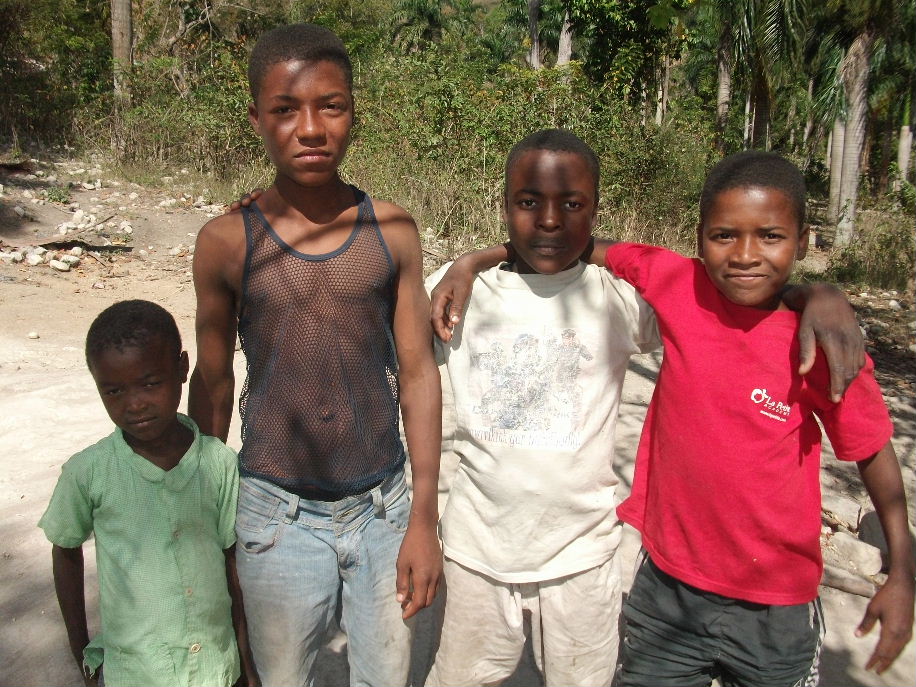
Raynold, second from right, with two little brothers and his older cousin, Bonel

I’ve written about Raynold before. He’s the teenage son of a CLM member from Anba So, a secluded neighborhood of Boukantis. He suffers from scoliosis, a sometimes-painful curvature of his spine that severely limits his activity. It means he can’t carry loads, he can’t comfortably walk the distances that rural life demands, and he sometimes even has trouble breathing. (See: Additional Services.)

Working with someone like him, who has very special challenges, takes much more than a case manager’s weekly visits can accomplish. As Raynold makes his own slow progress, it’s been encouraging to see how a network of powerful and committed organizations are working together to support him along his way.

We first took him to see an orthopedist in Canje, the principal Partners in Health hospital. That first doctor was able to identify the problem, but he couldn’t do much more. He merely pointed out that it would be important for us to bring Raynold for regular check-ups because the scoliosis could get worse as Raynold grows, the spine not just bending but also twisting, and it could lead to further, more serious problems down the road.

But that doctor was not himself the last word in what Partners in Health could offer. Dr. Andrée Leroy, a Haitian-American back specialist, is on staff at their hospital in St. Marc, on the coast to the west of the region CLM works in. We brought Raynold to see her in late January. She spent a couple of hours with us, calling a pediatrician and another specialist to help her check him over thoroughly.

We learned a couple of things. Raynold’s scoliosis curves to the left, which is more rare than the right-curving sort. It’s probably congenital and goes together with his unusually short stature. There’s a standard way of measuring the severity of a curvature, and Raynold’s is serious enough that he would be a candidate for surgery if he were in the States.

But he’s not in the States. We don’t know of anyone in Haiti capable of what would be, Dr. Leroy said, a very difficult operation. And it’s an operation with a long and difficult recovery, so that even if we could send Raynold to the States for the operation — and maybe we could — we might have to keep him there for as much as a year while he was healing. We couldn’t do anything of the sort without interrupting his life with very unpredictable consequences. So Dr. Leroy proposed a less invasive approach. It has three parts: A brace, physical therapy, and an orthopedic mattress.

Unfortunately, Partners in Health doesn’t do bracing. On the other hand, Fonkoze has another partner that does. Fonkoze has worked closely with BRAC since we decided to establish CLM. The program is, in fact, a Haitian adaptation of an approach that BRAC originally developed in Bangladesh. Shortly after the earthquake struck Haiti in 2010, BRAC established a limb and bracing center in Pétion-Ville. We contacted BRAC’s Haiti office and within days had arranged for Raynold and his mother to spend four days at the center while they take his measure, make the brace, and then ensure its proper fit.

While he was in Pétion-Ville, I arranged some extra work for him. Raynold has never been to school for a full year. It was only in the day and a half that he spent in our office so we could bring him to St. Marc that he learned to write his name. He showed that he really wanted to learn. So I asked Mackenson, a high school student who lives near me in Kaglo goes to school near the BRAC center, to spend a couple of hours a day with Raynold, starting to teach him to read. They took a literacy reader that was written by Laurence, Fonkoze’s Director of Education, and worked really hard for those three days. Raynold has already made a good start, and continues to work with his cousin Bonel, at home.

That’s not Bonel’s only role in Raynold’s story. Ten days after he got the brace, we took Raynold back to Cange to meet with Megan Brock, the American physiotherapist on staff there. By then, Raynold was already reporting that he was pain-free. As long as he has the brace on, he doesn’t feel back pain anymore.

Megan thought it would be useful for Raynold to have a family member with him who could help ensure he would stick with the program. It would have to be someone he’s comfortable with, but someone who’s a little older too, someone with the authority to push him a little. He chose Bonel. Raynold’s the oldest of his mother’s ten surviving kids. They live next door to his aunt and uncle, Bonel’s parents, who also have ten kids. It’s quite a collection.

//Raynold with a sample of siblings and cousins. A couple of aunts squeezed themselves into the photo as well.//

Bonel is eighteen, three years older than Raynold, and he’s his closest friend. Bonel’s been to school for several years, and can both read and write. And it turns out that he’s willing to help out a lot. He took a day off from school to go to Cange with us. Megan spent the whole morning with us, developing a program for Raynold and teaching him and Bonel how to do the exercises. They are now doing the exercises regularly in Raynold’s home.

We haven’t yet looked at whether we’ll be able to help Raynold’s family acquire an orthopedic mattress. For the time being, they would yet have a space to put one in. His mother, Antonia, is only just beginning to organize herself to build the new house we’re helping her construct. We provide roofing material and nails, and we pay the people who build up the walls and put on the roof, but she’s responsible for the lumber. She’s started to collect it, but she’s not finished yet. Unfortunately, her husband’s not much help. Their current house isn’t dry enough to protect an expensive mattress. We’ll have to wait and see.

For now, we’re just excited to see the progress Raynold’s made. And it’s been especially encouraging to see how a larger community of people, each of whom had something unique to offer — from Dr. Leroy and Megan to Mackenson and Bonel. Each has been willing and able to contribute importantly to one young boy’s well being. I don’t know what will become of Raynold, but his life is already better than it once was.

Worth The Trouble

Zaboka is the eastern edge of Tit Montayn, the most remote section of Boukankare county. Four case managers work there. It’s four hours from where they can drive to on their motorcycles, through a narrow pass that’s split by a waterfall. Five more case managers work in the western part of Tit Montayn, but they stay for three weeks at a time at a residence we established in the area. The four guys who work in Zaboka have to hike up each Sunday and head back down each Wednesday because they work Thursdays in another part of the county. It’s hard.

One Sunday early last March, Martinière arrived in Zaboka to find one of his CLM members in a panic. Her name is Dorsilia, and she had been waiting for him since early in the day. One of her fellow CLM members was dying, and nobody wanted to do anything about it. Could he help?

He ran off with her, and she led him to Ytelène. Ytelène had a very high fever and was terribly weak. So were her two younger siblings, her brother Dieulonèt, who lives with her, and their sister, Dieudamène, who lives with their parents, next door. The case managers hadn’t been in Zaboka the previous week. They had all been in another part of Boukankare, at a training session for members there. Apparently, Ytelène and the others had been deteriorating for days.

Martinière asked her family why they hadn’t led them to the hospital, and they let him know that she didn’t have the kind of sickness a hospital could treat. They had spoken to local healers, who told them she was going to die. They couldn’t see the point in carrying her all the way down the mountain just to have to carry her back up for burial. Martinière made a lot of noise, but he couldn’t convince the family to take responsibility to get the three of them the care he felt they needed. They were, they said, “used to death.”

They are an unusual family. The three of them were raised as siblings. I’ve referred to them as brother and sisters. There are two younger children as well. But their birth mothers and fathers are not the same. They all lost their mothers in infancy, and were brought to Clemancia. She has never given birth to a child, but is adoptive mother to all five. She says that she chews on cottonseeds, and that it makes her lactate. She can thus nurse babies who are not her own.

Clemancia with her five kids and Ytelène’s boy. Ytelène is on the far left. Dielonet and Dieudamène are on the right.

When Martinière couldn’t get Ytelène’s family to take things seriously, he thought of the CLM team instead. He ran up a ridge to get a telephone signal, and called the CLM driver, Wilfaut, who was at home in Léogâne, about four hours away, spending a rare free Sunday with his family. Wilfaut got in his truck and started driving. He would meet them at the end of the road that cuts through Boukankare, and this would cut a final hour out of their hike to the hospital.

Martinière then went back down the hill into Zaboka, grabbed a stretcher from a local Partners in Health extension worker’s house, unfolded it in front of Ytelène’s home, and recruited a CLM member’s husband to help him carry Ytelène down to the hospital in central Boukankare. By then, Clemancia’s husband, Sourit, had agreed to carry the young boy, Dieulonet, down the hill on his back. He would walk down with a neighbor, another CLM member’s husband, and they’d take turns carrying the boy. Sourit, who is Ytelène’s natural father, would not carry her. As they were leaving Zaboka, word finally got to Dieudamène’s father that she was sick. He lives in another part of the county, but he came running to carry his own little girl to another hospital closer to where he lives.

Ytelène and Dieulonet were in terrible shape when they got to the Partners in Health hospital in the center of Boukankare. They found a bed for Dieulonet in the maternity ward. Eventually they found one for Ytelène someplace else. Having gotten the two of them settled into beds, Martinière gave Dorsilia and Clemancia some money. They had come down the mountain to attend to Ytelène and Dieulonet at the hospital. They would need to buy themselves something to eat. Then he hiked back up to Zaboka so he’d be able to work with the rest of the CLM members up there the next day.

When he got back to Zaboka, it was long past dark. He met with a group of laborers relaxing after a hard day’s work in the field. They said that they hoped it would be as easy for him to carry Ytelène back up the hill as it was to carry her down. They added that it had been a long time since they’d had coffee and bread. That’s typical fare for a rural wake.

But Ytelène didn’t die. Neither did Dieulonet. It’s a year later, and we just evaluated Ytelène’s progress as a CLM member. We evaluated all members at the 12-month point using the same survey that determines whether they’ll graduate from the program in 18 months. It helps us see who will need extra support to finish the program well.

Ytelène has flourished. She and Dieulonet live in a nice little tin-roofed house, with her two kids. She has two goats, a pig, a small cow, and a range of barnyard fowl. She’s worked especially hard buying beans by the sack from the farmers around her, and selling them at a profit. Martinière also got her a job at the local preschool. She herself made it through sixth grade. So she has a small but steady income she can earn on the side.

She herself credits CLM, especially Martinière. “If it wasn’t for the CLM team,” she says, “I wouldn’t be here. Neither would the kids. I would be dead. So would Dieulonet, and so would Dieudamène. I never imagined that the CLM team would do that much for me. When Martinière stood up in the hospital [to get me a bed], it was a really big deal. Since then, my family sees me as someone who really matters.”

She has a big dream, too. She’d “like for CLM to cover all of Haiti so that everyone will know just what CLM is.”

Looking at Ytelène’s evaluation form, seeing how far she’s come, it’s hard to imagine that her friends, family, and neighbors were ready to leave her for dead. It’s even harder to imagine when one meets her. She seems to have so many possibilities in front of her now. She works so hard and so effectively, managing her resources efficiently and energetically. Thanks to Dorsilia and Martinière, she has that chance.

Martinière, the hero of this story.